Why this XRP ETF could drift from XRP price as fees, trading costs and fund structure stack up
REX-Osprey’s XRP ETF held 40.25% of its assets in the CoinShares Physical XRP ETP on Aug. 24, routing $22.87 million of a $56.68 million portfolio through another listed product. That structure means XRP ETF fees and tra...
Archive context
Older archive item. Useful for background and entity history, but not a fresh market-moving signal.
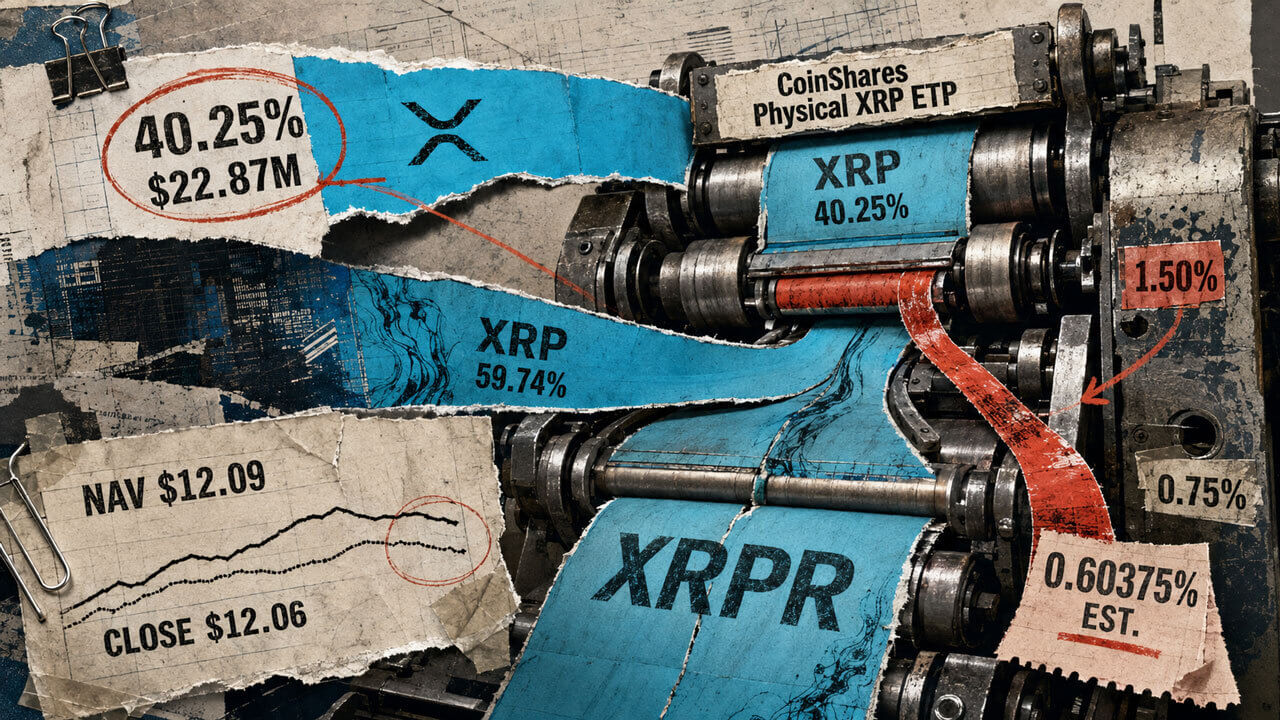
REX-Osprey’s XRP ETF held 40.25% of its assets in the CoinShares Physical XRP ETP on Aug. 24, routing $22.87 million of a $56.68 million portfolio through another listed product. That structure means XRP ETF fees and trading costs can stack up across two listed products. The same holdings snapshot reported 59.74% as XRP, with 4.7 million XRPR shares outstanding, a $12.09 net asset value and a $12.06 closing price.
That split is not evidence that the CoinShares position lacks XRP backing. CoinShares says its product is 100% physically backed. Nor should XRPR’s XRP line be read as proof that the parent fund directly owns every token: its February shareholder report consolidates a Cayman subsidiary used for XRP exposure.
The allocation is consistent with XRPR’s disclosed mandate. Its June 30 prospectus says the fund seeks to keep at least 80% of assets in XRP and instruments providing XRP exposure, while investing at least 40% in securities such as ETFs and non-U.S. exchange-traded products. At 40.25%, the CoinShares sleeve sits just above that floor.
Related Reading Rex-Osprey hybrid spot XRP ETF makes 2025 record-breaking debut How XRP ETF fees stack up in the second layerXRPR discloses a 0.75% total annual operating expense ratio. CoinShares lists a 1.50% annual fee for its XRP ETP. Applying that fee to the Aug. 24 weight produces an estimated 0.60375 percentage-point annual drag inside XRPR before changes in allocation, prices or expenses.
That estimate is not a fixed all-in XRPR fee. The underlying product’s charge is reflected in its own value, while XRPR’s 0.75% is the fund’s disclosed operating expense figure. REX-Osprey’s statement of additional information says shareholders indirectly bear acquired-vehicle fees in addition to the fund’s own expenses, but the weight can change daily and accounting treatment can affect how the cost appears.
Related Reading Investors poured $82 million into Canary’s XRP ETF, but falling prices erased double what they put inThe sleeve can also create tracking differences beyond the stated fee. XRPR investors trade a U.S.-listed ETF, while part of its exposure comes through a Jersey-domiciled debt security listed on European exchanges. CoinShares reported $168.75 million of product assets on Aug. 21, but the XRPR holdings snapshot does not show the position’s current bid-ask spread, market depth or execution price.
Those market frictions matter when XRPR has to rebalance, create or redeem shares, or trade while the underlying venue is less liquid or operating on different hours. The extra security also adds an issuer, custody and trading-venue chain between XRPR and the XRP backing. CoinShares’ physical-backing disclosure addresses the asset backing; it does not eliminate the legal and execution differences between holding XRP exposure through an ETP and obtaining it elsewhere.
Related Reading XRP extends the longest active ETF inflow streak in crypto as rival funds struggle for fresh cashFor shareholders, the practical impact of XRP ETF fees is return divergence: how closely XRPR’s net asset value follows XRP after its own expenses, the weighted CoinShares fee, and the trading costs of maintaining the required securities sleeve.
The post Why this XRP ETF could drift from XRP price as fees, trading costs and fund structure stack up appeared first on CryptoSlate.
Why this matters
XRP is showing up inside the Market Structure theme, so this story is worth tracking for follow-through rather than treating it as a one-off headline.
Original source
Read on CryptoSlateRelated market context

Evernorth XRP Treasury Merger Brings 473 Million XRP to Nasdaq as XRPN Debuts October 12
The transaction gives public-market investors another route to gain exposure to XRP through a company that actively manages its di...

Bitcoin hedge funds face a liquidation trap when their collateral is split across markets
Here's a hypothetical situation: a hedge fund is making money, but one of its exchanges is about to liquidate its position anyway....

XRP Price Prediction: Can Ripple Hold $1.40 or is $1.20 Next?
Today’s XRP price prediction centers on Ripple’s expansion into Wall Street financing, reigniting a familiar concern for XRP holde...
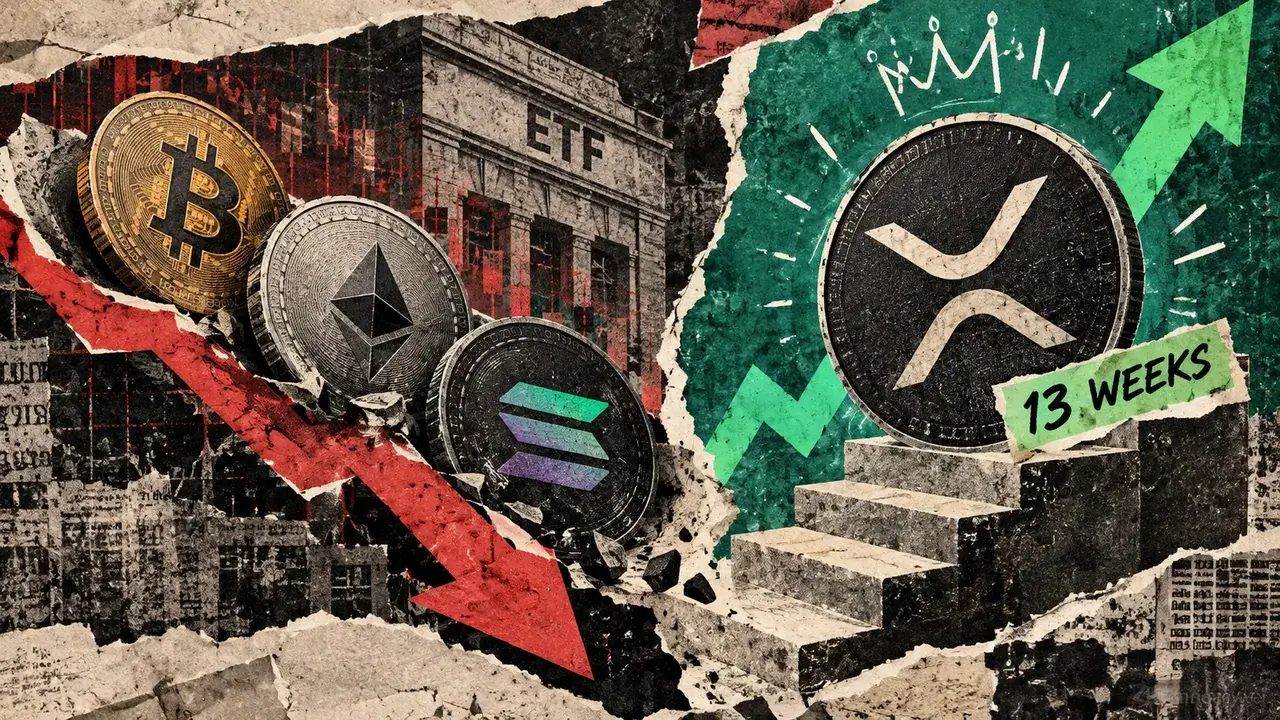
XRP ETFs extend a 13-week inflow streak as Bitcoin, Ethereum and Solana funds shed $1.25 billion
US-listed XRP ETFs extended their inflow streak to 13 weeks as Bitcoin, Ethereum and Solana funds suffered nearly $1.25 billion in...

Bitcoin holder loses 80 BTC worth $5.2 million after moving funds to reseller-bought Ledger
The incident underscores the critical importance of purchasing hardware wallets from official sources to ensure asset security. Th...

Tokenized stocks can carry the same rights without the same trading protections
Tokenized stocks eligible for the SEC’s September exemption must carry equivalent shareholder rights, yet their trading venues can...