XRP Community Day Recap: The 7 Most Bullish Takeaways
Ripple used XRP Community Day to tighten its message: XRP is not an accessory to the business, it’s the organizing principle and the company is positioning its product stack, regulatory posture, and institutional roadmap...
Archive context
Older archive item. Useful for background and entity history, but not a fresh market-moving signal.

Ripple used XRP Community Day to tighten its message: XRP is not an accessory to the business, it’s the organizing principle and the company is positioning its product stack, regulatory posture, and institutional roadmap around that premise.
XRP Community Day HighlightsCEO Brad Garlinghouse went straight for the ceiling. “There will be a trillion dollar crypto company, I don’t doubt that for a second,” he said. “I think Ripple has the opportunity to be that company, and maybe there’ll be more than one.” The framing matters because it’s not a token price call — it’s a scale argument about where regulated rails, liquidity, and enterprise distribution could concentrate as XRP plugs further into legacy finance.
Policy was the second major pillar. Garlinghouse put odds on the table for US legislation, predicting a “75%” chance the CLARITY Act will be “very close to getting signed by the end of April.”
Garlinghouse also tried to reconcile market volatility with institutional appetite, pointing to ETF flow behavior during a rough tape. “I believe in a multi-chain world. Even last week, when there was massive carnage going on in the market, there was positive XRP ETF inflows of $30M or $40M,” he said. “Public markets are keen to invest in crypto. Customers want it.”
The compliance posture was framed less as defensive and more as a competitive moat by Garlinghouse. “We want to be the most regulated, compliant, because we’re focused on institutional flows—that is the priority,” Garlinghouse said. “The OCC charter makes it very clear that RLUSD is a leader under the GENIUS Act, it cements our leading position.” In Ripple’s telling, regulatory credentials aren’t a cost center; they’re how you win mandates, counterparties, and distribution in the parts of the market that actually move size.
He also hinted at some major progress on the Fed Masters Account. “Now, there’s been a lot of speculation about what we could do in the future,” Garlinghouse said. “There’s been some commentary about a Fed Master Account, which we do think is compelling. And there’s things we may do in the future that I’m not gonna go into today.” He then anchored the point in trajectory rather than rumor: conditional OCC approval and engagement, he said, represent “massive progress relative to where we started this journey.”
On XRP itself, Garlinghouse delivered the cleanest thesis statement of the event: “XRP is the north star for Ripple. It’s our purpose.” He tied Ripple Payments, Ripple Prime, Ripple Treasury, custody, and RLUSD to a single objective: “how we can drive utility, trust, liquidity around XRPL.”
President Monica Long expanded that into an execution roadmap: “We’re rewinding the tape back to the founding of the company, like XRP and the Ledger are our reason for being,” she said. “So we call it our North Star, like that this is kind of what guides us in a lot of our product strategy and decision-making.”
From there, she outlined three institutional-flavored pushes: bringing more licensed payments flow onto the XRPL DEX, a “payments credit” concept that matches payment-provider financing needs with XRP holders seeking yield via a proposed lending protocol amendment, and growing custody demand as banks move past safekeeping and into tokenization of deposits, funds, and traditional securities.
At press time, XRP traded at $1.38.
Why this matters
XRP is showing up inside the Regulation theme, so this story is worth tracking for follow-through rather than treating it as a one-off headline.
Original source
Read on NewsBTCRelated market context
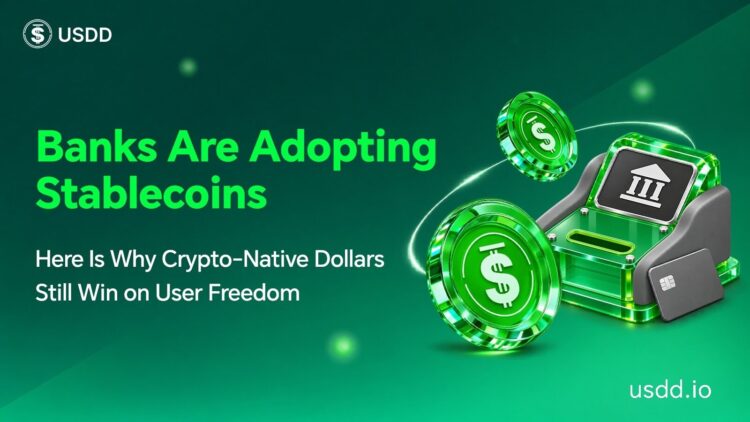
As traditional giants rush into digital dollars, USDD’s Yvonne Chia explains why 24/7 access, self-custody, and transparent yield give decentralized stablecoins an edge banks can’t replicate. 20 November – Road Town, Totorla, British Virgin Islands – Decentralized stablecoin protocol USDD is accelerating its multichain utility across TRON, Ethereum, and BNB Chain—combining automated sUSDD yield via its Smart Allocator with GasFree zero-TRX transfers—as traditional financial giants race to build competing stablecoin rails. In a recent industry interview with instant exchange partner ChangeNOW, USDD Head of Communications Yvonne Chia outlined why self-custody, 24/7 settlement, and transparent onchain reserves give decentralized digital dollars a structural advantage over bank-issued alternatives. 1. Permissionless Access vs. Gatekept Accounts For billions of people globally, opening and maintaining a traditional bank account still involves paperwork, minimum balance requirements, geographic restrictions, and approval delays. Even when banks integrate stablecoin rails behind the scenes, those services remain gated behind legacy compliance walls and intermediary control. Crypto-native stablecoins flip that model on its head. As Yvonne Chia highlighted during the interview: “Compare this to a stablecoin like USDD, where all you need is a phone, a working internet connection, you can immediately start a wallet and you have access to your funds right away.” With USDD, users can access and manage their digital dollars directly through their own wallets, without depending on traditional financial intermediaries. This represents a fundamental shift in financial access: users are no longer limited to the services, operating hours, or account structures of a single institution. Instead, they have the freedom to hold, manage, and transfer their assets on their own terms. Self-custody also gives users greater autonomy over their financial decisions. They can choose which wallets to use, where to transfer their assets, and which supported decentralized applications to interact with, without needing to route every transaction through a centralized financial institution. With USDD, users’ digital dollars can move with them across an open blockchain ecosystem, rather than remaining tied to a particular bank or service provider. 2. 24/7 Global Settlement vs. “Banking Hours” Legacy payment networks still operate on decades-old schedules: weekend cutoffs, bank holidays, and multi-day cross-border settlement delays accompanied by hefty wire fees. Blockchain networks never close. Whether it is a Sunday night or a public holiday, USDD moves globally without depending on traditional banking operating hours or settlement windows. “We are able to have transfers 24/7 and we’re not limited to any traditional banking hours. So I think that in some ways, stablecoins are not just becoming banks, but exceeding what traditional banks can offer to users.” To make everyday transfers even smoother than fintech apps, USDD introduced GasFree integration on TRON, allowing users on supported wallets to pay network fees directly in USDD without needing to hold TRX. This removes another practical barrier to stablecoin adoption: having to acquire and maintain a separate gas token just to transfer digital dollars. With GasFree, eligible users can pay approximately 0.5 USDD per transaction, compared with around 1.5 USDT for a standard USDT transfer under the referenced fee conditions. These improvements matter because the usefulness of a stablecoin is not determined by its peg alone. Low-cost transfers, straightforward wallet experiences, and around-the-clock availability are what make digital dollars practical for everyday payments and global value transfers. 3. Passing Yield Back to Users vs. Bank Spreads Perhaps the sharpest contrast between banks and decentralized stablecoins lies in how yield is distributed. In traditional banking, institutions take customer deposits, deploy them into yield-generating markets, and retain a significant portion of the returns. Everyday depositors may receive relatively low interest rates, while higher-yielding products often come with eligibility requirements, minimum deposits, or fixed maturity periods. Stablecoins introduce another way to participate in digital-dollar opportunities. Rather than keeping capital entirely within a traditional deposit account, users can access onchain yield opportunities through decentralized protocols and transparent investment mechanisms. USDD was built to return that value directly to holders. Through USDD Earn, users can deposit USDD to receive sUSDD, earning automated, competitive yield powered by our Smart Allocator system, with no fixed lock-up periods restricting access to their capital. For users, the distinction is important: USDD Earn provides access to a productive stablecoin while maintaining flexibility, rather than requiring users to commit their capital to a conventional fixed-term product. 4. Onchain Verification vs. Institutional Trust Traditional banks ask customers to trust closed-door balance sheets and periodic regulatory filings—until a crisis proves otherwise. USDD takes a different approach through its “Don’t trust, verify” ethos, emphasizing publicly accessible onchain information and independent verification. Onchain Transparency: Smart contract addresses, collateral reserves, and Smart Allocator deployments are publicly viewable, allowing users to examine relevant information directly on the blockchain. Structured Disclosures: Quarterly Treasury Reports provide additional information about reserve positions, financial performance, and operational developments. Independent Security Reviews: USDD undergoes third-party security audits to assess its smart contracts and identify potential vulnerabilities. Transparency does not eliminate financial or technical risks, but it changes how users can evaluate them. Instead of relying exclusively on an institution’s assurances, users have access to information that can be independently examined and verified. 5. Beyond a Single Network: An Open, Multichain Financial Ecosystem Financial freedom is not just about holding digital dollars. It is also about being able to use them wherever opportunities and applications exist. A stablecoin confined to a single network or limited use case cannot fully realize the potential of open blockchain finance. Following its January 2025 protocol upgrade, USDD expanded natively from TRON onto Ethereum and BNB Chain, extending its reach across multiple blockchain ecosystems. This multichain presence allows USDD to connect with different communities, liquidity environments, and decentralized applications. Its sUSDD product has also expanded into DeFi integrations, including Pendle and Morpho, giving users additional ways to access yield strategies across supported ecosystems. The bigger picture is an interconnected financial ecosystem in which users can move between holding, transferring, exchanging, and deploying their stablecoins according to their own needs. These are not isolated functions. Together, they make stablecoins more useful as everyday financial infrastructure. The Future: Interconnected, Open, and Multichain Banks will undoubtedly continue using stablecoin rails to modernize their back-end settlement. However, true financial freedom comes from open networks where assets flow freely across protocols without intermediaries. For USDD, the opportunity goes beyond offering a dollar-pegged asset. It is about making digital dollars accessible, transferable, and productive across an interconnected financial ecosystem. From self-custody and 24/7 transfers to flexible yield opportunities and multichain DeFi access, these capabilities give users more ways to put their money to work. Banks may be bringing stablecoins into traditional finance. Crypto-native protocols are showing what stablecoins can make possible beyond it.
As traditional giants rush into digital dollars, USDD’s Yvonne Chia explains why 24/7 access, self-custody, and transparent yield...

Tether Backs SCRYPT to Scale Institutional Stablecoin Payments Across Global Markets
Key Takeaways: Tether has staked money in the Swiss stablecoin platform called SCRYPT. This deal is meant for institutional paymen...

Ripple CEO Sees Room for Crypto Rally as XRP Trades Below $1
Ripple CEO Brad Garlinghouse expects a broader crypto rebound after Anthropic’s stock market debut, citing the recovery that follo...

Elon Musk’s Grok AI Predicts ETH Vs SOL For 2027: Who Wins?
Ethereum vs. Solana in 2027: Elon Musk’s Grok AI predicts which is positioned for bigger gains at the end of this article. As of m...

Coinbase Launches Crypto Options Globally, Bringing Deribit Liquidity to Retail Traders
Key Takeaways: Coinbase has rolled out cryptocurrency trading to qualified users outside of the United States. Contracts include B...
How to Find and Read a Company's Public SEC Records
Search company disclosures and SEC enforcement records separately. A missing result cannot rule out a confidential investigation,...