XRP Ledger Congestion Could Burn 1 Billion Coins A Year, Developer Claims
Software Engineer and founder of various AI start ups Vincent Van Code (@vincent_vancode) argues on X that most XRP burn projections are understated because they assume today’s low transaction fees persist even under hea...
Archive context
Older archive item. Useful for background and entity history, but not a fresh market-moving signal.

Software Engineer and founder of various AI start ups Vincent Van Code (@vincent_vancode) argues on X that most XRP burn projections are understated because they assume today’s low transaction fees persist even under heavy network usage. In his framing, sustained congestion on the XRP Ledger (XRPL) could push fees higher via the protocol’s load-scaling mechanics, potentially destroying on the order of one billion XRP annually.
XRPL Load Factor Could Turn Fees Into A Major XRP BurnIn a thread titled “The ‘Supply Meltdown’ Simulation,” Vincent Van Code claimed “everyone is calculating the XRP burn wrong,” starting with the premise that the commonly cited base fee of 0.00001 XRP only reflects a quiet network. “But what happens if the world actually starts using the XRPL at its 3,400 TPS limit?” he wrote, positioning load-driven fee escalation as the pivotal variable rather than raw throughput alone.
Van Code’s simulation walks through multiple fee regimes at the same headline activity rate, emphasizing that burn changes dramatically when the ledger is full and the “Load Factor” increases fees to deter spam. “As the ledger fills up, the Load Factor kicks in to stop spam,” he wrote. “Fees don’t just stay low; they scale exponentially.”
He anchored the thread with four scenarios and daily burn estimates, starting with what he called a “standard day” of 1.2 million transactions and roughly 450 XRP burned per day. From there, he modeled “global adoption” at the stated 3,400 TPS ceiling, translating to about 293 million transactions per day at base fee and an estimated 2,937 XRP burned daily.
The more aggressive claims come when he holds transaction volume constant at that 293 million-per-day level but lifts the effective fee via congestion. In his “congestion hike” case, he assumes the load-scaled fee rises to 0.001 XRP, implying about 293,760 XRP burned per day. In a “full gridlock” case at 0.01 XRP per transaction, he estimates 2,937,600 XRP burned daily.
The thesis leans on a structural feature of XRPL fees: they are not paid out to validators or any sponsoring entity, but removed from circulation. Van Code underscored that distinction directly. “The fees aren’t paid to miners. They aren’t paid to Ripple. They are destroyed forever.”
The “Supply Meltdown” Simulation Headline: Everyone is calculating the $XRP burn wrong. The “base fee” (0.00001 XRP) only exists when the network is quiet. But what happens if the world actually starts using the XRPL at its 3,400 TPS limit? The Congestion Math: As the…
— Vincent Van Code (@vincent_vancode) January 24, 2026
From that, he draws his headline conclusion: “Under extreme global utility, we aren’t burning a few hundred tokens. We could be wiping 1 BILLION $XRP out of existence every year,” framing network demand—and the congestion it creates—as “the ultimate deflationary engine.”
At press time, XRP traded at $1.88.
Why this matters
XRP is showing up inside the Layer 2 theme, so this story is worth tracking for follow-through rather than treating it as a one-off headline.
Original source
Read on NewsBTCRelated market context

ETH fee burns cover just 2% of new coins printed in 2026
Ethereum's transaction fees have burned enough ETH to offset just 2.07% of the new coins issued in 2026, according to an Oct. 9 su...
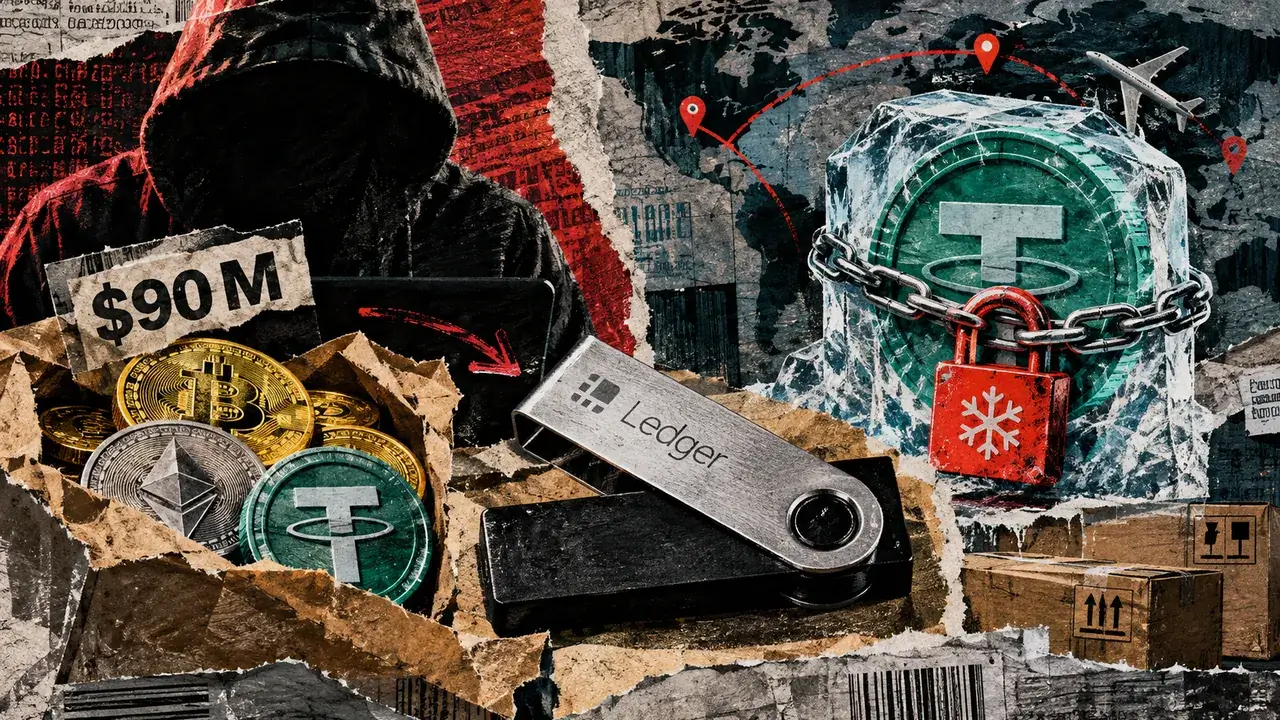
Ledger hack scare nears $90 million as Tether moves to freeze stolen USDT
Suspected Ledger wallet thefts are approaching $90 million as Tether freezes USDT stablecoin linked to the incident, according to...

Brazil’s BRL 22T CSD BR Moves Fund Records to XRP Ledger in Live Tokenization Push
Key Takeaways: CSD BR is leveraging the XRP Ledger to reflect real-time fund holdings. Over BRL 22 trillion in registered assets i...

Ripple Custody Adds Canton Network Support, Bringing CC and CIP-56 Into One Vault
Key Takeaways: Ripple Custody 1.43 adds support for Canton Network, CC and CIP-56 tokens. Institutions can be given the same custo...

Stealing $1.5B in crypto is easy, cashing out is the trap
North Korean hackers stole around $1.5 billion from Bybit in February 2025. While the hack itself has been widely covered and anal...

Samsung Wallet Brings USDC to 82M Galaxy Devices With Coinbase, Solana and Sui Support
Key Takeaways: Samsung Wallet will support 82 million U.S. Galaxy to add transfers on USDC. Coinbase will keep USDC in their Coinb...