$330M Bitcoin social engineering theft victim is elderly US citizen
An elderly US individual is reportedly the victim of a devastating $330 million Bitcoin heist, now ranked as the fifth-largest crypto hack in history.The attacker used advanced social engineering tactics to gain access t...
Archive context
Older archive item. Useful for background and entity history, but not a fresh market-moving signal.

An elderly US individual is reportedly the victim of a devastating $330 million Bitcoin heist, now ranked as the fifth-largest crypto hack in history.
The attacker used advanced social engineering tactics to gain access to the victim’s wallet, onchain investigator ZachXBT said in an April 30 update on X.
The hack took place on April 28, 2025, when ZachXBT flagged a suspicious transfer involving 3,520 Bitcoin (BTC), valued at $330.7 million.
Following the transfer, the stolen stash was quickly laundered through over six instant exchanges and swapped into privacy-focused cryptocurrency Monero (XMR).
Onchain data shows that the victim had held over 3,000 BTC since 2017, with no prior history of large-scale transactions.
ZachXBT confirming the victim of the hack. Source: ZachXBTOnce stolen, the attacker wasted no time laundering the Bitcoin using a peel chain method — a common obfuscation technique in which large sums are broken into smaller, harder-to-trace chunks.
“$330M in BTC was received in two transactions, then immediately distributed via peel chains,” Yehor Rudytsia, onchain researcher at Hacken, explained to Cointelegraph.
“Funds started to flow into multiple instant exchanges / mixers with small amounts, then mixers were distributing funds across multiple new wallets. The biggest funnelling chain is now consists of 40+ wallets.”Related: Loopscale recovers $2.8M after weekend DeFi hack and bounty talks
Over 300 wallets and 20 exchanges were involvedHacken’s internal tool, Extractor, tracked $284 million worth of BTC funneled through these chains, which now amounts to around $60 million after repeated “peeling” and redistribution across low-credibility exchanges.
Rudytsia said over 300 hacker wallets and 20+ exchanges or payment services were involved, including Binance.
Cointelegraph has reached out to Binance for comment.
“Major problem in cases like this (similar to Genesis creditor’s 4064 BTC theft back in Aug 2024) is that freezing centralized exchange accounts used in the laundering process is hardened due to particularly slow legal process of police reporting and investigations,” Rudytsia added.
Adding to the complexity, the attacker rapidly converted a significant portion of the BTC into XMR. The move triggered a 50% surge in Monero’s price, with the token briefly reaching $339.
“Once funds are swapped into Monero, tracing becomes virtually impossible due to its privacy-preserving architecture. The chance of recovery drops significantly after this step,” Cyvers Alerts senior security operations lead Hakan Unal said.
Unal said that the attacker likely had pre-established accounts across multiple exchanges and OTC desks, suggesting a high degree of premeditation.
A small portion of the stolen BTC was also bridged to Ethereum and deposited into various platforms, further complicating tracking efforts. Investigators have since alerted exchanges for potential freezing of funds.
Related: North Korean hackers set up 3 shell companies to scam crypto devs
No familiar laundering tacticsZachXBT had previously dismissed the theory that North Korea’s Lazarus Group could have been behind the attack, suggesting independent hackers were responsible.
ZachXBT dismissing North Korea theory. Source: ZachXBTWhile attribution remains uncertain, experts agree the laundering tactics show rare automation and coordination for a heist of this magnitude.
“So far, we haven’t been able to confidently link this activity to any known hacker group, as the laundering methods used — while sophisticated — don’t clearly match the signature patterns of previously identified actors,” Unal noted.
He recommended using multisignature (multisig) wallets to eliminate single points of failure, minimizing exposure to hot wallets connected to the internet, regularly rotating private keys, and relying on hardware-based cold storage to safeguard large Bitcoin holdings.
In the first quarter of 2025, hackers stole more than $1.6 billion worth of crypto from exchanges and onchain smart contracts, blockchain security firm PeckShield said in an April report.
More than 90% of those losses are attributable to a $1.5 billion attack on Bybit, a centralized cryptocurrency exchange, by North Korean hacking outfit Lazarus Group.
Magazine: TV hit Peaky Blinders to launch crypto game, FIFA Rivals on Polkadot: Web3 Gamer
Why this matters
This bitcoin story adds another data point to the current market tape and is useful when read alongside nearby source coverage.
Original source
Read on CointelegraphRelated market context
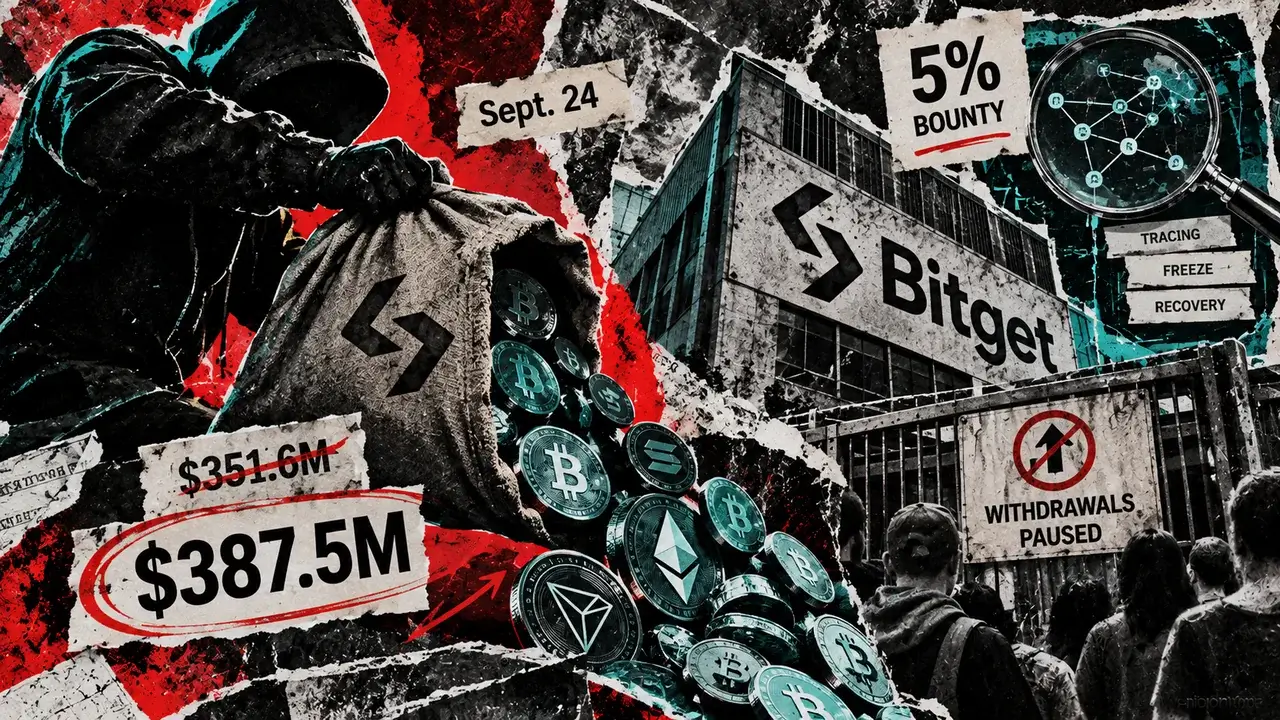
Bitget’s hack just got $36 million bigger, and now there’s a bounty on the stolen crypto
Bitget has raised the estimated value of assets taken in its Sept. 24 breach to $387.5 million as exchanges and security firms mob...

Bitget hacker withdraws $1.23M from Binance, funnels funds to attacker-controlled wallet
The Bitget hack highlights vulnerabilities in crypto exchanges, prompting urgent calls for enhanced security measures and internat...

US Charges Man After Crypto Scam Wallets Received More Than $53M
TL;DR U.S. prosecutors have charged a Vietnamese national with money laundering tied to alleged cryptocurrency “pig butchering” sc...

North Korean Hackers Linked to $388M Bitget Crypto Exchange Theft: CEO
Bitcoin Magazine North Korean Hackers Linked to $388M Bitget Crypto Exchange Theft: CEO Hackers from North Korea targeted crypto e...
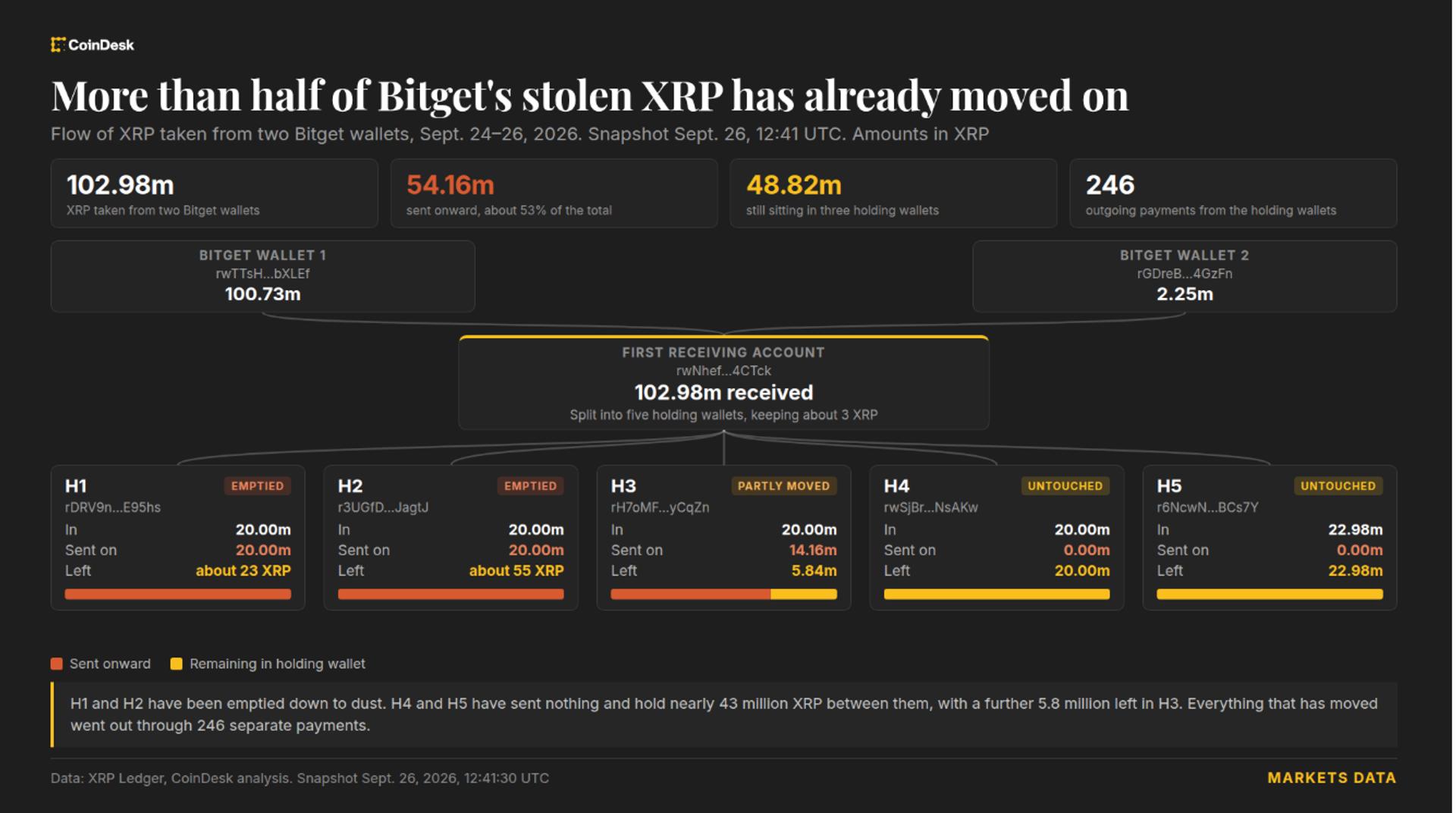
Bitget hacker moves $83 million in stolen XRP that Ripple cannot freeze
Two wallets have been almost emptied and a third is being drained, with about $75 million remaining across the five original holdi...
Circle and Tether Freeze Stablecoins Tied to Bitget Hack—But Most Funds Slip Away
The two stablecoin issuers blacklisted a wallet labeled "Bitget Exploiter 8," locking about $318,000 in USDC and USDT—but the atta...