Aggregate Bitcoin Price Has Increased By $87 Billion In Last Five Months
The realized market capitalization of bitcoin, or aggregate price paid for every coin on the network, increased by $87 billion since last August.The below is from a recent edition of the Deep Dive, Bitcoin Magazine's pre...
Archive context
Older archive item. Useful for background and entity history, but not a fresh market-moving signal.
The realized market capitalization of bitcoin, or aggregate price paid for every coin on the network, increased by $87 billion since last August.
The below is from a recent edition of the Deep Dive, Bitcoin Magazine's premium markets newsletter. To be among the first to receive these insights and other on-chain bitcoin market analysis straight to your inbox, subscribe now.
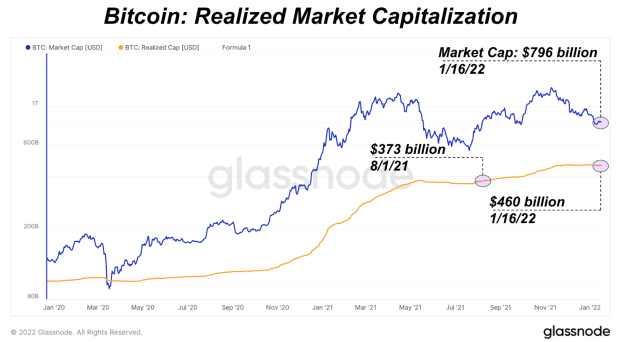
In recent weeks, much of our analysis has been focused on the consolidation period currently occurring in the bitcoin market, with a particular focus on realized price as an indicator of lackluster capital flow. As shown by the chart below, the realized market capitalization of bitcoin, which can otherwise be thought of as an aggregate price paid for every coin on the network, has increased by $87 billion since the beginning of August.
While significant in absolute terms, given that the realized market capitalization of bitcoin was a mere $90 billion at its peak following the 2017 bull market, in relative terms realized cap has not meaningfully increased since early fall of 2021.
A look at the 30-day rate of change of realized price gives additional context to this dynamic.
To dig deeper into the dynamic of price and realized price, we can examine the Delta Gradient indicator. The metric gauges market momentum relative to capital inflows.
As per Glassnode,
“The momentum of a market can be considered by assessing the rate of change of price, or the verticality over some period. The simplest example is a parabolic advance, whereby the rate of price appreciation increases in magnitude as a result of market momentum.
“The Realized Price reflects the aggregate price at which each coin in the supply last moved. Steeper increases in the Realized Price indicates a true and organic capital inflow is occurring, as every coin that is spent on-chain and sold, has a buyer with fresh capital. The steepness of this curve therefore represents a rational baseline for sustainable value growth.
“The Delta Gradient is calculated as the difference between the gradient of the spot Price, and the gradient of the Realized Price. This metric therefore measures the relative change in momentum between speculative value, and true organic capital inflows.
“Statistical normalization is then applied to bring historical values, and log-scale price changes into a consistent scale.”
Why this matters
This bitcoin story adds another data point to the current market tape and is useful when read alongside nearby source coverage.
Original source
Read on Bitcoin MagazineRelated market context

Strategy buys just 334 Bitcoin as preferred-share buybacks reach $1.45 billion
Strategy (formerly MicroStrategy) made its smallest positive Bitcoin purchase of 2026 even as a 43% quarterly rally in the cryptoc...

Japanese Bitcoin Treasury Metaplanet Sold BTC Last Quarter To Demonstrate Liquidity
Bitcoin Magazine Japanese Bitcoin Treasury Metaplanet Sold BTC Last Quarter To Demonstrate Liquidity It may have sold some of its...

Strategy Estimates a $20.9 Billion Q3 Bitcoin Gain, Reversing Its Second-Quarter Loss
Strategy expects to book a $20.91 billion gain on its bitcoin for the third quarter, three months after it recorded a loss. The co...

Bitcoin Price Stays Out of the Red as This Bear Market Breaks a Historic Pattern
Bitcoin price drawdown never produced a daily close below realized price this cycle, while aggregate NUPL remained positive throug...
Bitcoin surges 43% in Q3 as Treasury yields hit highest levels since 2007
Bitcoin's Q3 surge highlights its vulnerability to macroeconomic shifts, as rising Treasury yields challenge its appeal amid tight...

Tokenized stocks hit $3.96 billion in weekend DEX volume, up 106x since November
The surge in tokenized stock trading on DEXs highlights a shift towards decentralized finance, challenging traditional market stru...