Analyzing The Current Long-Term And Short-Term Bitcoin Holder Cost Bases
The current short-term and long-term bitcoin holder cost bases offer some signals about the market.The below is from a recent edition of the Deep Dive, Bitcoin Magazine's premium markets newsletter. To be among the first...
Archive context
Older archive item. Useful for background and entity history, but not a fresh market-moving signal.
The current short-term and long-term bitcoin holder cost bases offer some signals about the market.
The below is from a recent edition of the Deep Dive, Bitcoin Magazine's premium markets newsletter. To be among the first to receive these insights and other on-chain bitcoin market analysis straight to your inbox, subscribe now.
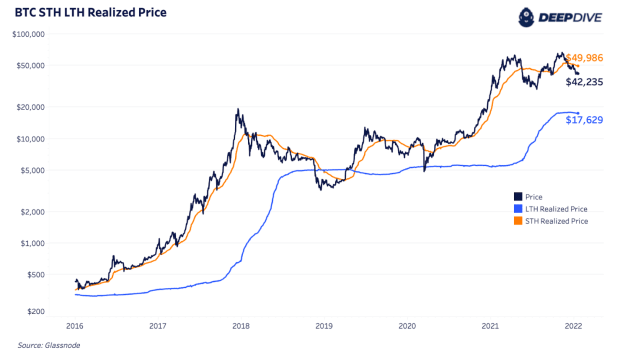
The current short-term holder cost basis has been a key price support to watch over the last couple months as it’s dropped from nearly $53,000 to $49,986. Price below the short-term cost basis is a fairly cautious market sign as recent market buyers are down 15.5% on average. During the summer of 2021, price sustained below the short-term holder cost basis for nearly three months.
At the same time, we’re seeing little movement in the long-term holder realized price with almost no change since November. A rising long-term holder realized price is typically a bullish sign with long-term holders selling older coins with a lower cost basis.
A better way to view this relationship in tandem is using the Short-Term:Long-Term Cost Basis Ratio. We discuss the ratio more in-depth in The Daily Dive #103 - Short-Term Holder Dynamics.
As the short-term holder cost basis has fallen and the long-term holder cost basis has remained fairly neutral, the ratio is showing some signs of a potential uptrend. An upward-sloping ratio is a more bearish market sign.
Below, we highlight when the 14-day change in the ratio is accelerating or decelerating. Dark blue shows when the STH cost basis is increasing relative to the LTH cost basis. Red shows when the LTH cost basis increases relative to the STH cost basis. Historically this has been a quality signal to assess tops and bottoms.
Short-term holders account for 18.23% of outstanding circulating supply, a figure that is near five-year lows, with 93% of said short term holders currently sitting in loss.
Why this matters
This bitcoin story adds another data point to the current market tape and is useful when read alongside nearby source coverage.
Original source
Read on Bitcoin MagazineRelated market context

Ethereum’s past outflow charts can change when more exchange wallets are identified
Coin Metrics has rebuilt Ethereum's historical Standard Flow Metrics, raising a timing problem for tests that treat exchange outfl...

RWA Foundation reports $6.2 billion tokenized credit market as holders climb 12.1%
Rising holder engagement in tokenized credit suggests potential for broader adoption, despite market cap fluctuations and issuer c...

Bitcoin’s large holders are back in profit, and small wallets never really left
The resilience of small holders and strategic accumulation by larger entities may stabilize Bitcoin's market, but profit-taking co...

Strategy asks shareholders to approve daily dividends for STRC preferred stock
Daily dividends could enhance liquidity and investor engagement, potentially stabilizing share prices and reducing reinvestment la...

Bitcoin’s $85,000 recovery awaits proof that ETF investors kept buying after payrolls
Bitcoin's recovery above $85,000 faces a demand test after a sharp fall in bets on another Federal Reserve rate hike. A new post-p...

Bitcoin Price Stays Out of the Red as This Bear Market Breaks a Historic Pattern
Bitcoin price drawdown never produced a daily close below realized price this cycle, while aggregate NUPL remained positive throug...