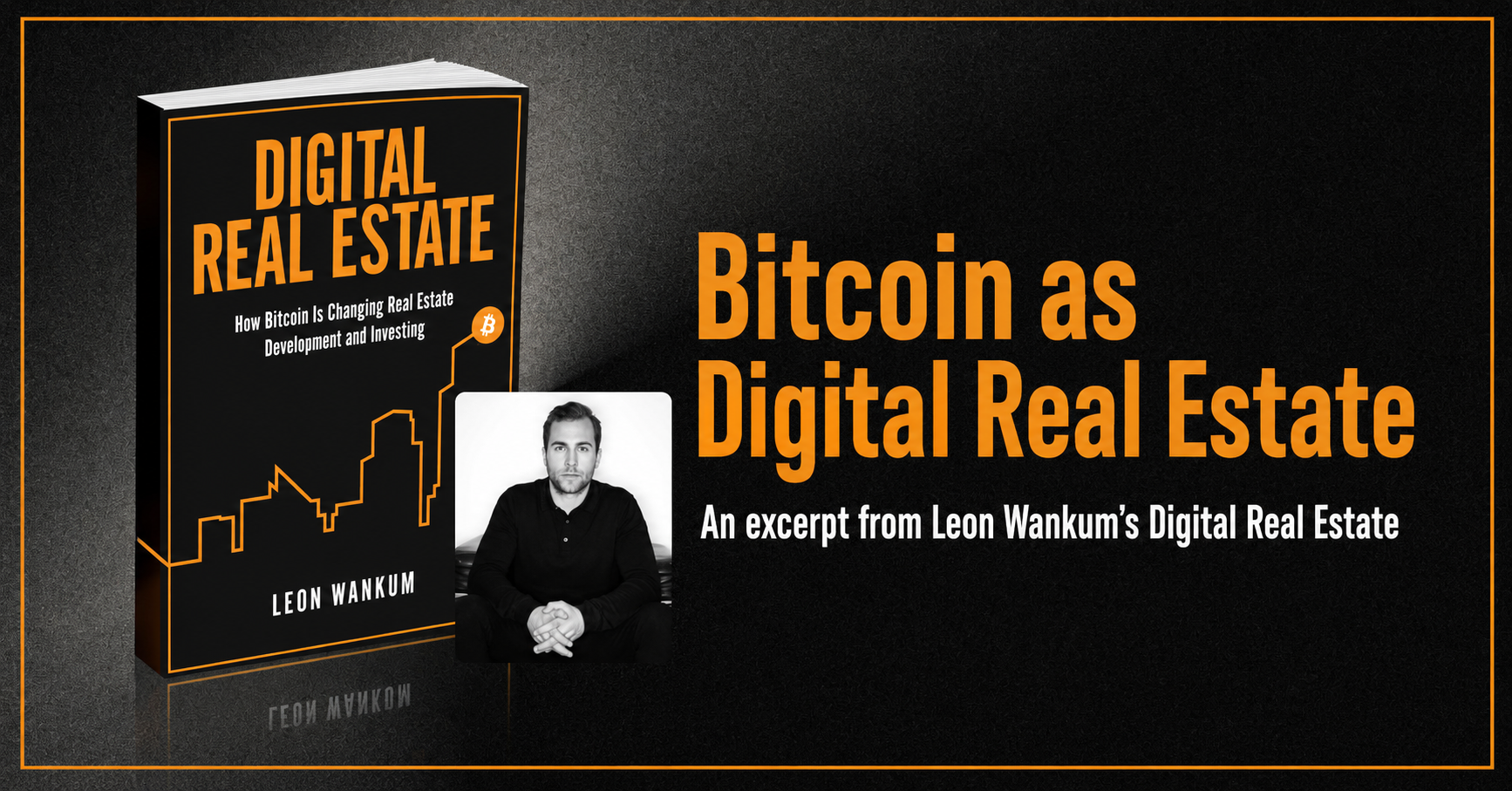
Bitcoin as Digital Real Estate: An Excerpt from Leon Wankum’s Digital Real Estate
Bitcoin Magazine Bitcoin as Digital Real Estate: An Excerpt from Leon Wankum’s Digital Real Estate Bitcoin can be understood through an analogy with real estate.16 Michael Saylor, Executive Chairman and Co-Founder of Str...
Archive context
Older archive item. Useful for background and entity history, but not a fresh market-moving signal.
Bitcoin Magazine
Bitcoin as Digital Real Estate: An Excerpt from Leon Wankum’s Digital Real Estate
Bitcoin can be understood through an analogy with real estate.16 Michael Saylor, Executive Chairman and Co-Founder of Strategy (formerly MicroStrategy), has compared investing in bitcoin to buying real estate in downtown Manhattan during the early stages of its development. As population, commerce, and cultural activity concentrated in the city, demand for limited land surged, dramatically increasing property values. Many of the world’s wealthiest families built their fortunes by owning scarce real estate. When something limited is in high demand, its value rises. As the saying commonly attributed to Mark Twain goes, “Buy land—they’re not making it anymore.”
Scarcity plays a central role in determining value, which is why real estate in densely populated areas is more expensive than in sparsely populated ones. Real estate has utility value—it can be used for living or production—but its price is largely driven by the limited supply of land in prime locations. There are only so many properties that can be built in Manhattan, London, Shanghai, Mumbai, Paris, Beijing, Tokyo, or Venice. What ultimately makes these locations valuable is what occurs on top of them: the people, the capital, the creativity, the energy. As a city flourishes, whether through rising population, growing business activity, or cultural relevance, demand for that scarce land surges.
The value of land does not rise in a vacuum; it rises because it captures an expanding layer of economic activity that cannot be easily replicated or relocated. This dynamic is further amplified by fiat monetary expansion, which channels ever more liquidity into real estate, raising nominal prices well above what utility and income-generating capacity alone would support. Market mechanisms such as speculation and the widespread expectation of rising prices reinforce this scarcity and deepen that perception.
Bitcoin operates under a similar logic. Just like prime real estate, it gains value as more people, capital, economic activity, and trust accumulate around it. At the same time, the economic network built on top of it—financial infrastructure, global adoption, liquidity, and digital connectivity—can continue expanding globally through digital networks without corresponding expansion of the underlying monetary base. Adoption on the internet occurs globally and continuously—much faster than in the physical world, where economic expansion is constrained by geography.
But there is a crucial difference. In real estate, prices are shaped by development potential, location-specific utility, and relative scarcity, which is frequently intensified by regulations and policy decisions. Government interventions such as tax incentives for investors, zoning laws, and restricted building permits can artificially limit supply, pushing prices higher. These dynamics are further amplified by speculative behavior and the widespread expectation of continued price increases, making scarcity appear more absolute than it is. Bitcoin’s scarcity, by contrast, is absolute: its supply is fixed at twenty-one million, beyond the reach of policy decisions or political interference. Real estate’s manufactured constraints highlight the importance of distinguishing between natural and engineered scarcity in asset evaluation.
Owning bitcoin is comparable to owning a plot in a growing, borderless economy not tied to any government or geography. As more people and businesses adopt bitcoin, the value of that digital “plot” increases. The difference is mobility—this digital plot is not tied to any location and can be transferred globally within minutes. Unlike land, bitcoin enables the rapid, low-friction transfer of value anywhere in the world, subject only to network conditions and liquidity constraints.
Holding bitcoin provides a new way to participate in the global economy. While bitcoin operates on a global network, its effects are local. By enabling individuals to hold and transfer value without centralized permission, it allows participation in economic systems that are less dependent on institutions able to impose restrictions, exclude participants, or change rules unilaterally.
Bitcoin’s accounting model reinforces the real estate comparison. In a traditional bank account, value is recorded as a balance held by an institution. In Bitcoin, ownership is defined by direct control over individually defined units—unspent transaction outputs (UTXOs)—recorded on the network.
You can think of each bitcoin as a square of land that remains under your control until it is spent. Once spent, that square disappears, and new squares are created for the recipient. Each UTXO can be independently transferred or combined in future transactions. The result is a continuously evolving map of property claims secured by cryptography rather than institutional authority.
The analogy has limits. Bitcoin differs from real estate used to generate income. It generates no operating cash flow and is best understood as a scarce digital asset whose value lies in absolute scarcity and optionality rather than income. But like real estate, bitcoin functions as a long-term savings vehicle and increasingly as collateral, capable of supporting credit formation and broader economic activity while absorbing monetary demand. This makes real estate a useful framework for understanding bitcoin’s evolving role within capital markets and monetary systems.
This post Bitcoin as Digital Real Estate: An Excerpt from Leon Wankum’s Digital Real Estate first appeared on Bitcoin Magazine and is written by Leon Wankum.
Why this matters
Bitcoin is showing up inside the Institutional Adoption theme, so this story is worth tracking for follow-through rather than treating it as a one-off headline.
Original source
Read on Bitcoin MagazineRelated market context

LiquidAcre Selects Uphold to Power Digital Asset Infrastructure and Future Tokenized Real Estate Offerings
LiquidAcre, a financial technology company building a platform designed to expand access to real-world assets and digital financia...

LiquidAcre selects Uphold to power tokenized real estate infrastructure
The partnership could accelerate the adoption of tokenized real estate, potentially transforming property investment and ownership...
XRP’s next Wall Street expansion comes with an unexpected complication from Ripple
Evernorth is preparing to begin trading on Nasdaq on Monday, bringing approximately 473 million XRP into a publicly traded treasur...

What Is Crypto Spot Trading?
For example, a token can be up 70% and still be a terrible trade if you have no idea when to take profits. Likewise, a 30% dip can...

Evernorth XRP Treasury Merger Brings 473 Million XRP to Nasdaq as XRPN Debuts October 12
The transaction gives public-market investors another route to gain exposure to XRP through a company that actively manages its di...
Brazil’s BRL 22T CSD BR Moves Fund Records to XRP Ledger in Live Tokenization Push
Key Takeaways: CSD BR is leveraging the XRP Ledger to reflect real-time fund holdings. Over BRL 22 trillion in registered assets i...