Bitcoin Could Explode On Bessent’s $250 Billion Deregulation Shock
US Treasury Secretary Scott Bessent has signalled that the long-debated overhaul of banks’ supplementary leverage ratio (SLR) is imminent—a policy pivot that could reverberate through Bitcoin markets—telling television i...
Archive context
Older archive item. Useful for background and entity history, but not a fresh market-moving signal.

US Treasury Secretary Scott Bessent has signalled that the long-debated overhaul of banks’ supplementary leverage ratio (SLR) is imminent—a policy pivot that could reverberate through Bitcoin markets—telling television interviewers that regulators are “very close to moving” on the rule and that the adjustment could compress Treasury yields by “tens of basis points.”
Rocket Fuel For BitcoinAlthough the proposal must still clear the Federal Reserve, the Office of the Comptroller of the Currency and the FDIC, the direction of travel is clear: exempting, or partially exempting, US Treasuries from the SLR will let large banks recycle balance-sheet capacity into fresh purchases of government debt.
The SLR, introduced after the 2008–2009 crisis, forces even risk-free assets such as Treasuries to carry a capital charge; a global systemically important bank must fund five cents of equity for every dollar of total assets, including central-bank reserves. Bessent’s plan would lift that burden for sovereign bonds, a step the industry has lobbied for since the temporary pandemic waiver expired in March 2021. Kevin Fromer, chief executive of the Financial Services Forum, calls the current leverage-based stack “outdated and at odds with financial stability and economic growth,” describing relief as necessary “to better serve US taxpayers, capital markets, consumers, businesses, and the economy.”
While officials frame the move as a micro-prudential calibration, the macro-liquidity impulse is substantial. Market commentator Furkan Yildirim tells his 103,000 subscribers that US banks collectively hold about $5 trillion in Treasuries; eliminating the five-percent capital haircut would liberate roughly $250 billion of tier-one capital—fifty times the Federal Reserve’s current monthly quantitative-tightening pace of $5 billion. “This is a liquidity injection by regulatory pen stroke,” he says, adding that the step “lowers yields without the Fed printing money,” a mix that historically pushes investors further out the risk curve.
The market is already trading on that expectation. Benchmark ten-year yields slid below 3.95 percent after Bessent’s remarks and after President Trump deferred a threatened 50 percent tariff on EU goods until 9 July. Yildirim argues that “every basis-point drop in the ten-year is basically a marketing campaign for Bitcoin,” because “liquidity doesn’t disappear—it just looks for a new home.” He stresses that the Treasury’s willingness to change bank-capital rules, rather than rely on the central bank, “tells you how cornered policymakers feel by deficits, debt service and political optics.”
Not everyone is convinced the rule change will work as intended. Critics such as Peter Boockvar of Bleakley Advisory note that banks’ appetite for duration risk has not fully recovered since the 2023 regional-bank failures; if dealers fail to absorb the incremental Treasury supply, the Federal Reserve could be forced back into the market. The Bank Policy Institute, while welcoming SLR relief, argues that it must be paired with a broader rethink of post-crisis overlays such as the GSIB surcharge and the stress-test regime to unlock balance-sheet capacity on a lasting basis.
Bitcoin, however, responds reflexively to dollar-liquidity metrics. Lower Treasury yields diminish the allure of money-market funds paying north of five percent, releasing capital that has been parked in cash-equivalent vehicles since 2022. On-chain data highlighted by Yildirim show over-the-counter (OTC) desk inventories sliding to 115,000 BTC, evidence that large buyers are sourcing coins directly; when that stock is depleted, desks must restock from public exchanges, a dynamic that tightens float and historically amplifies upside moves.
Ultimately the SLR reprieve is no panacea for America’s fiscal arithmetic, but it removes a near-term balance-sheet choke point and lowers the opportunity cost of holding non-yielding assets. As Yildirim puts it, “A deregulation that stabilises sovereign funding while nudging investors into risk assets is, almost by definition, a tailwind for Bitcoin.” In that sense the rule change functions like shadow quantitative easing, arriving at a moment when the Federal Reserve is hamstrung by sticky inflation and political constraints—one more structural catalyst for Bitcoin.
At press time, BTC traded at $108,790.
Why this matters
This bitcoin story adds another data point to the current market tape and is useful when read alongside nearby source coverage.
Original source
Read on NewsBTCRelated market context
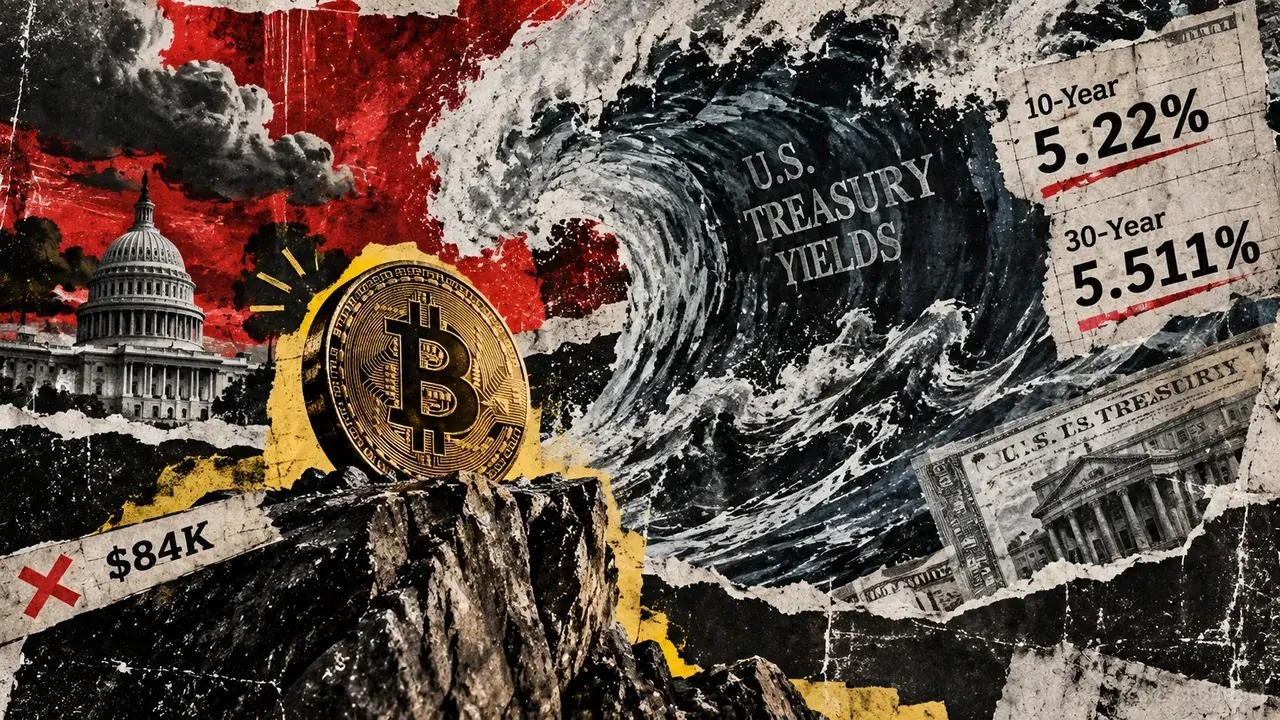
Bitcoin survives a 5.2% Treasury shock as traders slash $1.7 billion in leverage
Bitcoin is holding near $84,000 even as a historic US bond selloff pushes Treasury yields to decades-high levels. The benchmark 10...

Bitcoin Falls Back Below $85K As Treasury Yields Jump Above 5%
TL;DR Bitcoin fell below $85,000 after stronger U.S. business data pushed Treasury yields higher. S&P Global’s flash U.S. Composit...

Banks in London capitalize on bond strategy fueled by cheap Bank of England financing
London banks' bond strategy may amplify market volatility, influencing future Bank of England policy and economic stability assess...

Kalshi must lock out state users after major court loss
The Sixth Circuit ruled Sept. 25 that Ohio and Tennessee can apply their gambling laws to Kalshi's sports contracts. The court rej...

EU Banking Regulator Urges Crypto Lending Rules, Floats Leverage Caps and DeFi Certification
The European Banking Authority (EBA) recommended on Sept. 24 that the European Commission consider regulating crypto borrowing and...
Bitcoin Treasury Strategy Proposes Daily Dividends For Preferred Stocks
Bitcoin Magazine Bitcoin Treasury Strategy Proposes Daily Dividends For Preferred Stocks Bitcoin treasury company Strategy wants t...