Bitcoin Is A Possession, Not Property
Property arises naturally, through labour (transformation of matter) and through the peaceful exchange of individuals. It is a foundational concept that enables human action by allowing individuals to satisfy needs and n...
Archive context
Older archive item. Useful for background and entity history, but not a fresh market-moving signal.
Property arises naturally, through labour (transformation of matter) and through the peaceful exchange of individuals. It is a foundational concept that enables human action by allowing individuals to satisfy needs and navigate uncertainty. This results in resources being used most efficiently as individuals who own them have a strong interest in doing so. In contrast, the need for a legal definition of property by a central authority such as the state may result in resources being controlled by individuals who do not have a strong interest in using them effectively. This can lead to inefficiencies and abuse, as we can observe worldwide.
„The human economy and property have a common economic origin, since both have their ultimate reason in the fact that there are goods whose available quantity is less than people's needs, and property is thus the same as the economy, not an arbitrary invention, but rather the only possible practical solution to the problem that the nature of things, the above-mentioned mismatch between demand and available quantity of goods, imposes on us for all economic goods – C. Menger (Principles of Economics, p. 56).
Challenging Digital Property
When discussing the nature of bitcoin, it's important to address its classification as property. Unlike traditional assets, bitcoin as a digital asset, cannot be classified as property, because digital "property" is a concept that paradoxically excludes itself. Digital "things” do not exist, they are information. Therefore, one can never own the “thing” itself. While one can be in possession of bitcoin and have complete control over it by being in control of the private key or seed that enables the initiation of bitcoin transactions, one can never own bitcoin.
Possession is not ownership, and vice-versa. In political and legal philosophy, a distinction is made between possession (control), which Ludwig von Mises calls "catallactic" or "sociological ownership", and ownership, a normative concept, which Mises calls "juristic ownership". One is factual, and one is normative. In addition, the digital nature of Bitcoin complicates the definition of ownership when multiple individuals possess the same seed. In such cases, legal frameworks are required to define ownership, underlining the need for a reassessment of the notion of digital property.
Bitcoin: A Paradigm of Digital Self-Sovereignty
Property is fundamentally a construct of the physical world and cannot be copied digitally. The importance of Bitcoin lies in establishing a paradigm of digital self-sovereignty that does not rely on authorities or legal systems. It centres around cryptographic control. This provides protection against invasions of privacy and ensures the protection of individual freedom. When stored in cold storage (offline), those bitcoin are the holder’s alone and are not at risk of confiscation or inflation by third parties. In addition, little can stop you from selling or taking bitcoin with you.
Satoshi Nakamoto explaining the power of Bitcoin at $0.07, exactly 13 years ago.
Bitcoin: A Portable Store of Value
The portability of bitcoin distinguishes it from physical assets like gold, real estate, or art. While physical assets can be easily confiscated, destroyed, or taxed, bitcoin's digital nature renders it highly portable. In times of conflict or flight, bitcoin holders can securely relocate with their wealth by memorising a seed phrase. This mobility empowers individuals to escape the vulnerabilities of legal ownership and preserve their assets independently. Bitcoin is permission-less and resistant to censorship.
Due to its superiority as a store of value, bitcoin has the potential to absorb a significant portion of the monetary premium that various forms of scarce goods have accumulated in the last decades under an inflationary monetary regime. This is especially relevant for real estate, as it has become the most widely used store of value under fiat. Around 67% of the world's wealth ($330 T) is stored in real estate today. A significant portion of that is likely to flow into Bitcoin over time.
Bitcoin's Absolute Scarcity
Bitcoin's unique feature of absolute scarcity sets it apart from other assets. New building land can be developed, new zoning laws may allow for more building space. A living artist can create more art. Gold production can increase when demand increases, and new gold can always be discovered. On earth and in space. The scarcity of bitcoin, however, is immutable. The finite supply of 21,000,000 is hard-coded into the protocol. The transparency of the open-source code ensures verifiability, reinforcing bitcoin's status as an absolutely scarce digital commodity.
Conclusion
Bitcoin is creating a paradigm of digital self-sovereignty, empowering individuals with full control over their wealth. Its inherent qualities, including portability, absolute scarcity, and cryptographic control, position it as a formidable store of value. It offers a new paradigm that aligns with the libertarian principles of the Austrian School of Economics. As societies navigate an evolving economic landscape, Bitcoin's role in securing productivity and promoting individual freedom becomes increasingly vital.
The ability to store value separate from the physical world is just as important as the separation of money and the state, because it guarantees everyone in the world with internet access the opportunity to build and protect wealth, which is one of the most important foundations for a free and self-determined life.
Bitcoin cannot be created arbitrarily or taken easily by force, but through proof-of-work and cooperation. This creates the basis for peaceful coexistence and efficient resource allocation between market participants.
I would like to thank Scala for his valuable feedback on this article as well as R0ckstar and Erik Cason for the inspiration and our conversations about Bitcoin, property, crypto-sovereignty and real estate.
This is a guest post by Leon Wankum. Opinions expressed are entirely their own and do not necessarily reflect those of BTC Inc or Bitcoin Magazine.
Why this matters
This bitcoin story adds another data point to the current market tape and is useful when read alongside nearby source coverage.
Original source
Read on Bitcoin MagazineRelated market context
Hester Peirce departs SEC after years of advocating for digital assets
Peirce's departure leaves the SEC with a narrowed perspective, potentially impacting future crypto regulation and innovation initi...

Base Cobalt Goes Live With Conditional Trades and New B20 Controls for Tokenized Assets
Key Takeaways: The newest Cobalt upgrade by Base has been activated on the mainnet. Traders can send orders which will only be fil...

Tokenized Stocks, Investor Rights, and Their Crypto Role
Tokenized stocks could give crypto-native investors access to equity exposure through crypto platforms, but a token that tracks a...

OpenWorld Begins Nasdaq Trading As VerifyMe Deal Creates Public Tokenization Company
TL;DR OpenWorld and VerifyMe have completed their business combination, with the combined company trading on Nasdaq under OPNW fro...
BNY weighs digital asset infrastructure deal with Kraken parent Payward: CoinDesk
A potential BNY-Payward partnership could significantly enhance crypto infrastructure, fostering greater integration with traditio...
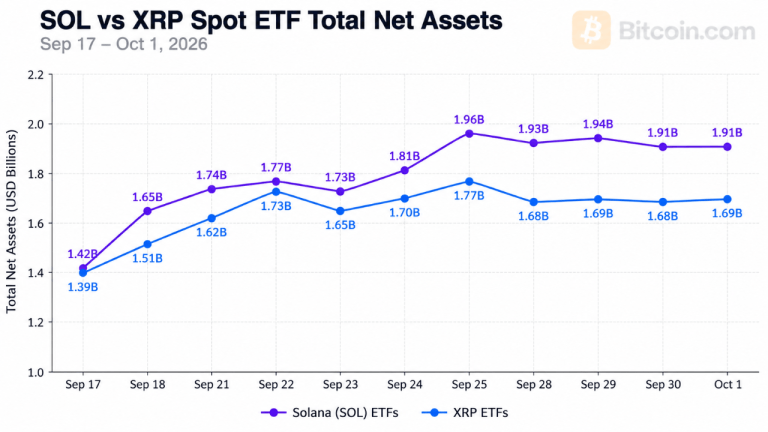
Solana ETFs Overtake XRP Funds With $1.91 Billion in Assets
Solana ETFs have overtaken XRP products in total net assets after an eight-day inflow streak brought in nearly $254 million. The s...