Bitcoin pioneer and felon says he’s ‘vibe coding’ to restart the BTC faucet
Early Bitcoin entrepreneur Charlie Shrem says he’s working on bringing back the Bitcoin faucet — a website that hands out Bitcoin to whoever solves CAPTCHA tasks, normally used to distinguish humans from machines.Shrem s...
Archive context
Older archive item. Useful for background and entity history, but not a fresh market-moving signal.

Early Bitcoin entrepreneur Charlie Shrem says he’s working on bringing back the Bitcoin faucet — a website that hands out Bitcoin to whoever solves CAPTCHA tasks, normally used to distinguish humans from machines.
Shrem shared his new Bitcoin (BTC) faucet website — 21million.com — in a May 4 X post, which mimics the first-ever Bitcoin CAPTCHA page created by early Bitcoin innovator Gavin Andresen back in 2010.
The 21million.com website currently displays a screenshot of a CAPTCHA task and a box to enter a receiving Bitcoin address, which was not functional at the time of writing.
Shrem’s Bitcoin faucet website also shows that there are 0 Bitcoin available to claim.
Like Andresen’s old website, Shrem’s page explains what Bitcoin is and how to receive Bitcoin.
Charlie Shrem’s Bitcoin faucet website. Source: 21million.com
“What’s the catch?” According to Shrem, there is no catch. “I want Bitcoin to be successful, so I created this little service to give you a few coins to start with.”
When asked whether Shrem is “vibe coding” the project or receiving external assistance, he responded: “Vibe coded! It’s a lot of fun.” Vibe coding relies on artificial intelligence and prompting to write code.
Source: Charlie ShremBitcoin faucets assisted Bitcoin adoption in the early days
Bitcoin faucets were key in spreading awareness about the cryptocurrency and facilitating its adoption in the early 2010s.
Andresen’s Bitcoin Faucet page handed out 19,700 Bitcoin — now worth $1.86 billion — for solving CAPTCHAs.
Users could earn up to 5 Bitcoin per day from Andresen’s page. The Bitcoin faucets encouraged wallet creation and transactions, which assisted with the expansion of Bitcoin’s user base and network activity.
Other websites such as FreeBitco.in started offering similar services between 2011 and 2013. But as Bitcoin’s price increased and transaction fees rose, rewards shrank, and the model eventually became unsustainable.
Shrem’s crypto journey has been a rollercoasterShrem co-founded one of the first Bitcoin exchanges, BitInstant, with Gareth Nelson in 2011. At its peak, the exchange facilitated around 30% of all Bitcoin transactions, according to Shrem’s personal page.
In order to offer the instant Bitcoin purchases that Bitcoin’s first dominant exchange, Mt. Gox, lacked, BitInstant purchased Bitcoin from Mt. Gox in large batches before reselling it to customers nearly instantly.
However, BitInstant’s business model faced scaling issues as its transaction volume grew.
To support its expansion, the company received $100,000 from early Bitcoin investor Roger Ver, with additional backing later coming from Erik Voorhees and Cameron and Tyler Winklevoss.
BitInstant co-founders Gareth Nelson (left) and Charlie Shrem (right) pictured together at an industry event. Source: Charlieshrem.com
Shrem also co-founded the Bitcoin Foundation in 2012, serving as vice chairman to encourage the adoption of Bitcoin as an alternative to traditional banking.
However, on Jan. 26, 2014, Shrem was arrested while attempting to disembark from a plane in New York and later charged with money laundering related to his role with BitInstant.
Authorities claimed that some BitInstant customers used the Bitcoin purchased from BitInstant for illicit purposes, including criminal transactions on the Silk Road dark web marketplace.
Shrem pleaded guilty to a reduced charge and served one year before being released in 2016.
Related: Bitcoin eyes $95K retest as traders brace for Fed rate cut volatility
After prison, Shrem returned to the crypto space, founding crypto advisory firm CryptoIQ and Druid Ventures, a $13 million crypto-focused venture capital fund.
He also launched The Charlie Shrem Show, a podcast with over 400 episodes featuring some of the industry's most notable crypto figures.
Shrem was then sued by the Winklevoss twins in 2018, claiming Shrem stole 5,000 Bitcoin from them in 2012. A court overturned an asset freeze against Shrem and ordered the brothers to cover Shrem’s legal fees in November 2018. The case was settled confidentially in 2019.
Magazine: Crypto wanted to overthrow banks, now it’s becoming them in stablecoin fight
Why this matters
This bitcoin story adds another data point to the current market tape and is useful when read alongside nearby source coverage.
Original source
Read on CointelegraphRelated market context

US crypto ETFs draw over $3 billion this week, with nearly $800 million flowing beyond Bitcoin
US crypto exchange-traded funds have pulled in more than $3 billion this week as fresh demand spread beyond Bitcoin into Ethereum...

TokenInsight September Report: MEXC Posts Deepest BTC and ETH Futures Depth at $21.03M, Lowest Silver Slippage at 0.002%
Mutsamudu, Comoros, September 25, 2026 – MEXC, a pioneer in 0-fee digital asset trading, recorded the deepest combined BTC and ETH...

Bitget Confirms $387.5 Million Security Breach as Revised On-Chain Accounting Reveals Wider Losses
Bitget raises breach losses to $387.5 million after Zcash and TRON transfers found. Attackers spoofed backend transaction data to...
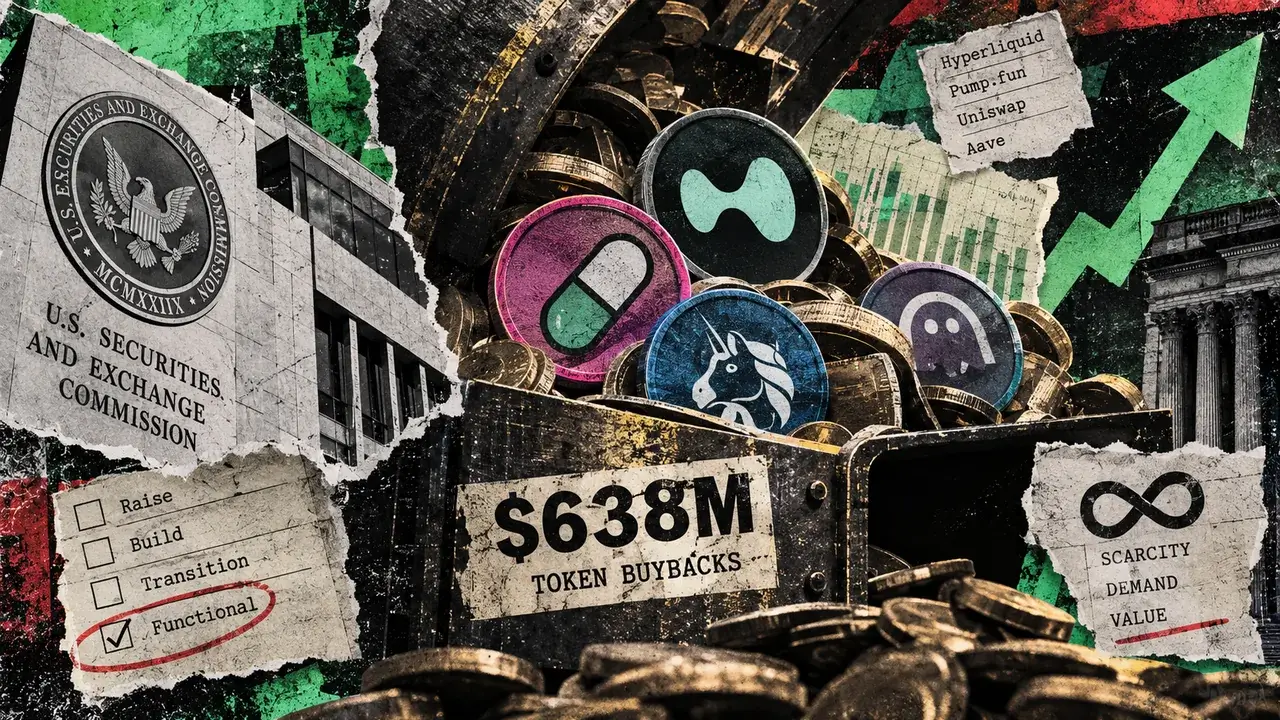
SEC clears regulatory hurdle as crypto token buybacks hit record $638 million
Crypto projects spent about $638 million with token buybacks through late August 2026, according to Allium Labs data. That is alre...

Bitget raises breach losses to $387.5 million after on-chain tracing uncovers Zcash and TRON transfers
Bitget raises breach losses to $387.5 million after tracing reveals Zcash and TRON transfers. Cold wallets secure, protection fund...
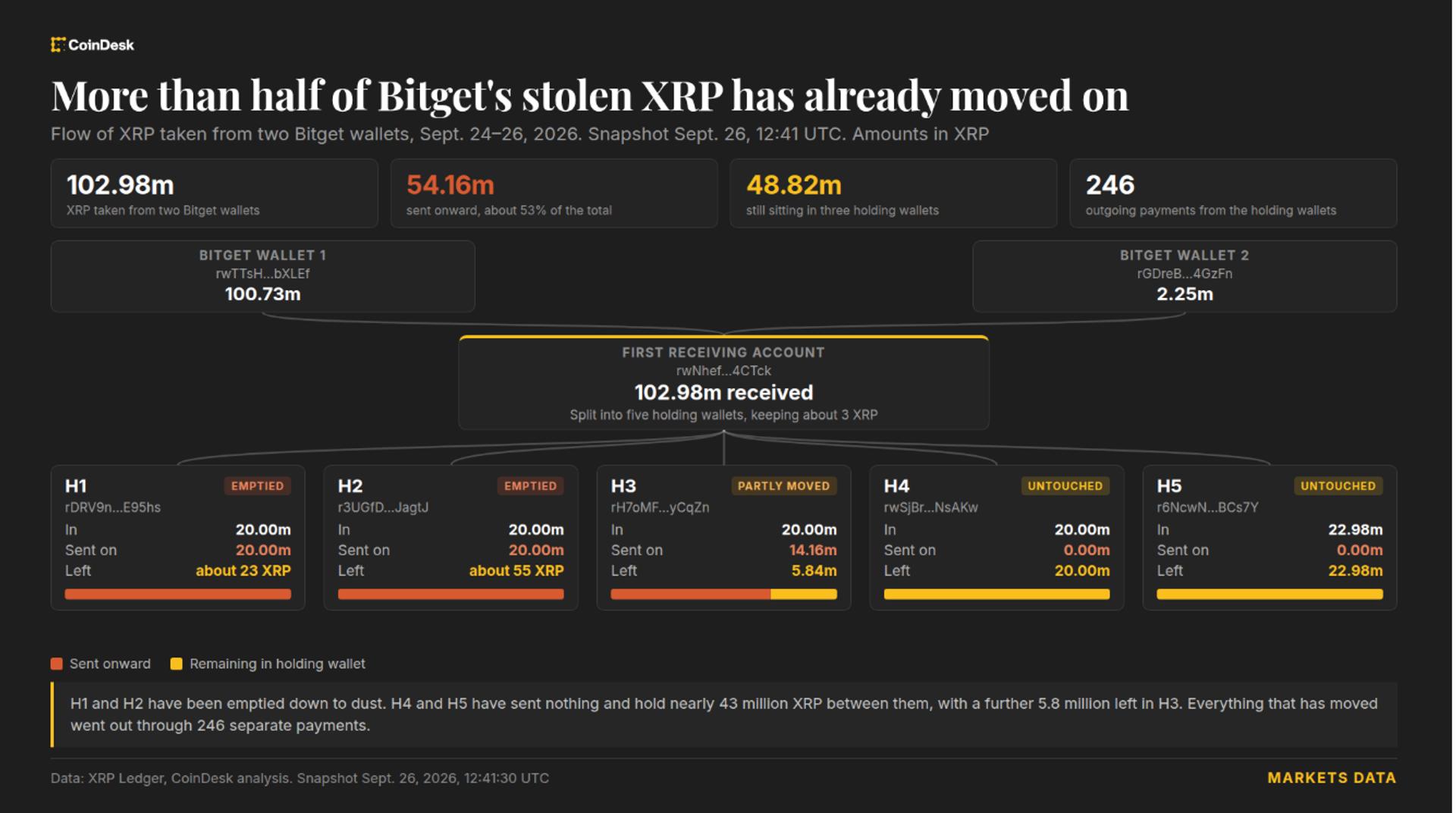
Bitget hacker moves $83 million in stolen XRP that Ripple cannot freeze
Two wallets have been almost emptied and a third is being drained, with about $75 million remaining across the five original holdi...