Bitcoin Surpasses Swiss Franc To Become World’s 13th Largest Currency
The Swiss Franc (CHF) is worth 18,826,374 BTC in market cap at the time of writing, a little less than Bitcoin.At the time of writing, Bitcoin has surpassed the Swiss Franc (CHF) in market capitalization as the world’s t...
Archive context
Older archive item. Useful for background and entity history, but not a fresh market-moving signal.
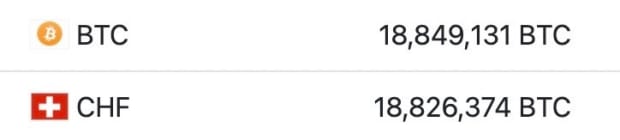
The Swiss Franc (CHF) is worth 18,826,374 BTC in market cap at the time of writing, a little less than Bitcoin.
At the time of writing, Bitcoin has surpassed the Swiss Franc (CHF) in market capitalization as the world’s thirteenth largest currency, according to data from Fiatmarketcap.com. There are only 12 world currencies left for Bitcoin to overcome.
Fiatmarketcap.com takes a Bitcoin standard approach to analyze currencies. It measures the world’s biggest currencies in terms of market capitalization as priced in BTC, the best form of money ever created but still lagging in perception.
The website also uses BTC as a measuring stick for countries’ gross domestic product (GDP), which puts Bitcoin at eighteenth place.
As the world starts recognizing the superiority of BTC in nearly all aspects of a good money, namely durability, portability, verifiability, divisibility, and scarcity. As time progresses and bitcoin adoption increases, it is set to have a more well-established history of success, which confers upon it a greater appeal for usage.
By thinking in bitcoin terms right away, people can realign the incentives governing their economic decisions. As monetary supply increases indefinitely, inflation follows suit and so do prices, leading to a distorted view of the economic reality based on the feedback given by free market prices.
A Bitcoin standard has the potential to restore the confidence of market participants in the overall prices being used in the economy. Since one BTC cannot be debased through loose monetary policies governed by corruptible human beings, its assurances of retaining purchasing power allow for a realignment of economic incentives.
In the fiat system based on debt, people are discouraged from saving and encouraged to take on debt, never deferring the option to spend now for later. In a Bitcoin economy, people would not be rushed to spend their money since they would have the assurance that their purchasing power would be preserved over the long term.
Why this matters
This bitcoin story adds another data point to the current market tape and is useful when read alongside nearby source coverage.
Original source
Read on Bitcoin MagazineRelated market context

Smart Money Helping Support Bitcoin Rebound, Says Pantera Capital
Bitcoin Magazine Smart Money Helping Support Bitcoin Rebound, Says Pantera Capital American investment firm Pantera Capital’s port...

US Treasury buyback plan boosts gold, bitcoin prices
The Treasury's buyback plan underscores gold and bitcoin's role as hedges against currency devaluation and economic uncertainty. T...

Bitcoin and Ethereum ETFs just had their biggest week of 2026 as crypto exploded higher
US spot Bitcoin and Ethereum ETFs recorded their strongest inflow week of 2026 as a sharp crypto rally pulled investors back into...

America is creating a new class of crypto banks – but they aren’t really banks
Circle now has a federal bank charter. However, the charter provides no ordinary checking accounts, FDIC-insured savings accounts,...

Ethereum hits new all-time high, surpassing its 2021 peak on Coinbase
Ethereum's surge highlights evolving market dynamics, with institutional interest and macroeconomic factors potentially sustaining...
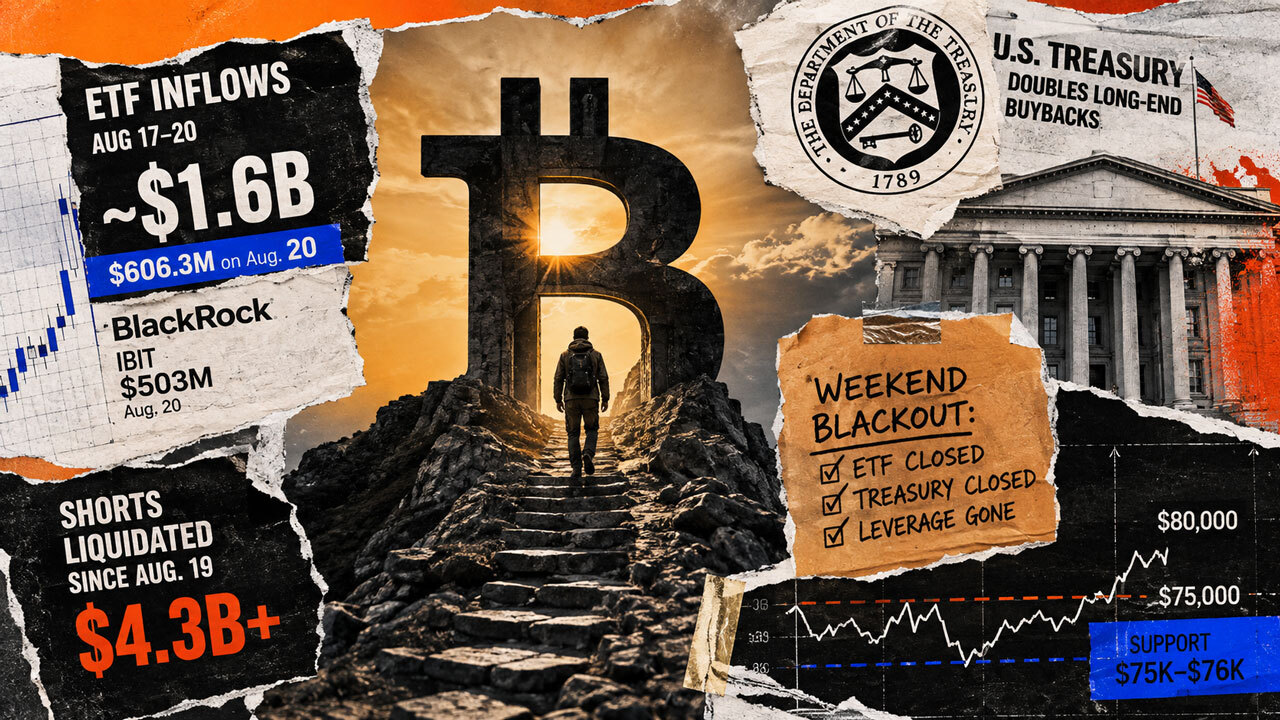
Bitcoin hits $80,000’s doorstep just as the ETF bid disappears for the weekend
Bitcoin enters the weekend within striking distance of $80,000, registering an intraday high at $79,500 on Aug. 21. The move caps...