Bitcoin vs. Quantum Computers: US Government Says Post-Quantum World Is Getting Closer, CISA Warns Contemporary Encryption Could Break
According to the U.S. Cybersecurity and Infrastructure Security Agency (CISA), while quantum computers are incapable of breaking public key encryption algorithms, public and private entities need to prepare for future th...
Archive context
Older archive item. Useful for background and entity history, but not a fresh market-moving signal.

According to the U.S. Cybersecurity and Infrastructure Security Agency (CISA), while quantum computers are incapable of breaking public key encryption algorithms, public and private entities need to prepare for future threats against cryptography that is not quantum resistant. Most of today’s digital communications, including cryptocurrencies, leverage public key encryption and CISA believes when “quantum computers reach higher levels of computing power and speed, they will be capable of breaking the public key cryptography algorithms that are in use today.”
US Government Warns Nation-States and Private Companies Are Actively Pursuing Quantum Computing Methods That Could Threaten Current Cryptographic Standards
Cryptocurrencies that leverage contemporary encryption techniques could be broken by quantum computers someday, alongside other digital communications like email, messaging services, and online banking. That’s according to a recent CISA report published at the end of August. The U.S. government entity stresses in the report that a transition to post-quantum cryptography is necessary. “Do not wait until the quantum computers are in use by our adversaries to act,” CISA’s report details. “Early preparations will ensure a smooth migration to the post-quantum cryptography standard once it is available.”
Discussions about whether or not quantum computing will be able to break public key encryption have been taking place since scientists made progress entangling the first pair of quantum bits (qubits) back in 1998. Quantum computers utilize intricate physics in order to calculate powerful equations related to today’s contemporary crypto and mathematical systems. Since 1998, super quantum computers have improved with 14 calcium ion qubits entangled in 2011, 16 superconducting qubits in 2018, and 18 entangled qubits in 2018. CISA says quantum computers will create new opportunities but the tech also leads to negative consequences in terms of encryption security.
“Nation-states and private companies are actively pursuing the capabilities of quantum computers,” CISA’s report details. “Quantum computing opens up exciting new possibilities; however, the consequences of this new technology include threats to the current cryptographic standards.”
Cryptocurrencies like Bitcoin leverage contemporary encryption methods and it has been said many times over the years that there’s a need to protect cryptocurrencies with post-quantum encryption. In 2020, when the industrial firm Honeywell revealed it built a quantum computer that effectively leverages six effective qubits, crypto supporters started discussing quantum computers’ potential future effects on Bitcoin and 256-bit encryption. Some digital currency supporters have already started making preparations for a quantum computer encryption-breaking event. Cambridge Quantum Computing is in the midst of working with Honeywell on a project that “can be applied to any blockchain network.”
Despite the efforts by cryptographers, some researchers wholeheartedly believe large-scale quantum computers will never come to fruition. Others think the timeline is much closer than people expect and a few scientists have said it could be roughly five years from now. The National Institute of Standards and Technology (NIST) thinks 15 years is more reasonable. Meanwhile, Ethereum developers have been researching quantum resistance alongside the Hyperledger Foundation’s distributed ledger project Ursa. Cryptographers preparing for a post-quantum world believe encryption techniques like AES-128 and RSA-2048 will not provide adequate security against quantum computer attacks.
The debate has raged on for years and many people think the government’s warnings and the recent quantum-based technological achievements by Honeywell, Google, Microsoft, and others, are the incentives people need to embrace post-quantum cryptography.
Many articles, research reports, and mainstream headlines claim quantum computing will break any contemporary encryption and even forecast traffic jams and accidents well before they happen. However, Bitcoin proponents have said on various occasions that the SHA256 encryption employed by Satoshi’s creation is a formidable foe against a post-quantum world.
“In Bitcoin your public key isn’t (initially) made public. While you share your bitcoin address with others so that they can send you bitcoins, your bitcoin address is only a hash of your public key, not the public key itself,” software developer and cryptocurrency proponent Chris Pacia wrote in 2014. “What does that mean in English? A hash function is a one-way cryptographic function that takes an input and turns it into a cryptographic output. By one-way, I mean that you can’t derive the input from the output. It’s kind of like encrypting something [and] then losing the key.”
The software developer’s 2014 paper on the subject concludes:
All of that is a complicated way of saying that while an attacker with a quantum computer could derive the private key from the public key, he couldn’t derive the public key from the bitcoin address since the public key was run through multiple quantum-resistant one-way hash functions.
In a video featuring the bitcoin evangelist Andreas Antonopoulos, he said that using different bitcoin addresses every time is key to bitcoin security. Antonopoulos stressed that Satoshi’s two cryptography design choices are “absolutely genius.” “What you use, which is a Bitcoin address, is a double-hashed version of your public key — which means that the public key is never seen by anyone until you claim it by spending the transaction … This little genius design element is not an accident,” Antonopoulos further said in his keynote speech. “What it does is, it creates a second layer abstraction of the underlying cryptographic algorithm used in elliptic curve digital signatures allowing you to do future upgrades.”
Antonopoulos continued:
Which means that the past is secure because it is hidden behind the second veil of a different algorithm and the future can be changed because you can present an address that is not the hash of an elliptic curve, or its the hash of a different elliptic curve, or its the hash of a bigger elliptic curve, or its the hash of a signing algorithm that is quantum-resistant that has nothing to do with elliptic curve. So, you can do forwards modification to secure the future, and you’ve got backwards protection because you have hid the past.
What do you think about the U.S. government’s recent warning about quantum computers? Let us know what you think about this subject in the comments section below.
Why this matters
This bitcoin story adds another data point to the current market tape and is useful when read alongside nearby source coverage.
Original source
Read on Bitcoin NewsRelated market context
SEC Targets Tokenization, AI and Quantum Computing in 2027 Examination Priorities
The Securities and Exchange Commission (SEC) is putting tokenized securities, artificial intelligence, and quantum computing under...

Bitcoin and Ethereum Take Different Paths to Post-Quantum Wallets
Ethereum contracts can verify alternative signatures today, but protecting existing accounts requires more than adding a new signe...

Starknet Moves Toward Post-Quantum Layer 1 as Voters Back Ethereum Split
Starknet is taking its first formal steps toward potentially becoming an independent, quantum-resistant Layer 1 blockchain, follow...

NIP Group Signs Bitcoin Miner Purchase To Add 4.47 Exahash Of Capacity
TL;DR: NIP Group has agreed to purchase already deployed Bitcoin mining machines with about 4.47 EH/s of hash rate, subject to clo...
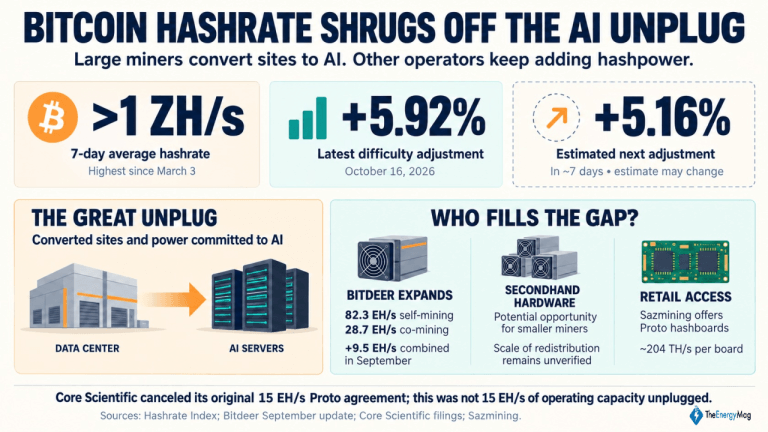
Miner Weekly: Bitcoin Hashrate Shrugs off the AI Unplug, Regaining 1 ZH/s Level
Big public miners are making room for artificial intelligence (AI). Bitcoin’s hashrate is climbing anyway. This article first appe...
Bitcoin Hashrate Reclaims One Zettahash As Mining Competition Rebounds
TL;DR: BlocksBridge reported Bitcoin’s seven-day hashrate above one zettahash in the week to October 22. Mining competition has re...