Bitcoin Will Hit $1 Million By 2028 As Capital Controls Kick In: Top Expert
In his latest essay, Arthur Hayes, co-founder and CIO of Maelstrom, draws a stark parallel between America’s growing economic imbalances and its unsustainable reliance on foreign capital—and argues that capital controls,...
Archive context
Older archive item. Useful for background and entity history, but not a fresh market-moving signal.

In his latest essay, Arthur Hayes, co-founder and CIO of Maelstrom, draws a stark parallel between America’s growing economic imbalances and its unsustainable reliance on foreign capital—and argues that capital controls, not tariffs, are the only politically viable solution to rebalance the system. In what he dubs the “Boiling Frog Theory,” Hayes foresees a slow, stealthy imposition of financial restrictions on foreign investors that will ultimately accelerate Bitcoin’s rise to $1 million by 2028.
Titled Fatty Fatty Boom Boom, the essay begins with a provocative metaphor: America’s bloated financial system is likened to the obesity crisis—a pathology enabled by cheap processed inputs and pharmaceutical band-aids that preserve a diseased status quo. “The American economy was hijacked by printed money,” Hayes writes, tracing the origin of US imbalances back to the Federal Reserve’s inception in 1913 and the permanent shift away from natural business cycles to a regime of endless stimulus.
Why Capital Control’s Could Drive Bitcoin To $1 MillionTariffs, according to Hayes, are politically and structurally impotent. Even under Trump, their application will be diluted through bilateral carve-outs and geopolitical concessions, allowing countries like Vietnam and Mexico to act as arbitrage hubs. “Without one tariff for all, there will always be a country or countries that act as trans-shipment arbitrage points,” he explains, noting that this same dynamic lets China skirt semiconductor restrictions via third-party intermediaries.
Instead, Hayes sees capital controls—specifically taxes on foreign ownership of US financial assets—as the only strategy with both economic bite and political payoff. He proposes a 2% annual tax on foreign-held stocks, bonds, and property, totaling approximately $33 trillion. Such a levy could eliminate federal income taxes for the bottom 90% of Americans, making it a “winning political strategy” for Team Trump. “Either foreign capital stays, pays the tax, and revenue is used to eliminate income taxes… or foreign capital leaves, and American manufacturing grows,” Hayes argues.
But if capital leaves, who replaces it? Hayes is blunt: the US will turn to the printing press. “Remember that 4/4 kick drum, the Brrr button. Y’all know what the answer is,” he quips, referring to the return of quantitative easing, the suspension of QT, treasury buybacks, and loosened regulatory constraints like the supplemental leverage ratio. Hayes believes the Fed, despite rhetorical resistance, is already enabling this stealth monetization by targeting long-duration treasury bonds for QE. “Powell’s ass is sat firmly in the cuck chair, and he ain’t leaving. Now pass the lube,” he writes, in typical Hayes fashion.
The ultimate effect of this capital exodus and ensuing monetary response, he contends, will be the devaluation of US treasuries in real terms and the reallocation of global capital into stateless, censorship-resistant assets like Bitcoin. Unlike gold, which requires intermediaries to function in the digital realm, Bitcoin is a native digital bearer asset that can operate outside state-controlled financial infrastructure. “Bitcoin is the perfect and only lifeboat for global capital that must leave America and elsewhere,” he asserts.
Hayes notes that even the Trump administration appears ideologically aligned with Bitcoin and gold, pointing to the removal of tariffs on gold and the regulatory de-escalation around crypto. With these assets potentially being elevated to reserve status, Bitcoin is poised to absorb capital fleeing dollar-denominated instruments.
In his forecast, Hayes considers the migration of even 10% of foreign-held US portfolio assets—$3.3 trillion—into Bitcoin. At current market depth, that would trigger a supply shock far beyond a simple 10x price move. “If 10x the amount of capital attempted to squeeze into the market, it would lead to a much greater than a 10x rise in price,” he predicts, citing the inelastic supply and long-term holders unwilling to sell. The result? A path to $1 million per Bitcoin by the 2028 US presidential election.
Hayes also reveals that Maelstrom went “maximum long” during the early April financial turmoil and is now rotating into “quality altcoins”, which he believes offer real services and return profits to token holders. Still, he warns of tactical volatility, noting that Trump’s strategy is fluid and opposition within the administration remains.
But for Hayes, the trajectory is clear. Capital controls are no longer fringe theory—they are becoming inevitable policy. And Bitcoin, he concludes, is the only asset positioned to benefit from the collapse of Pax Americana’s financial plumbing.
At press time, BTC traded at $102,377.
Why this matters
This bitcoin story adds another data point to the current market tape and is useful when read alongside nearby source coverage.
Original source
Read on NewsBTCRelated market context
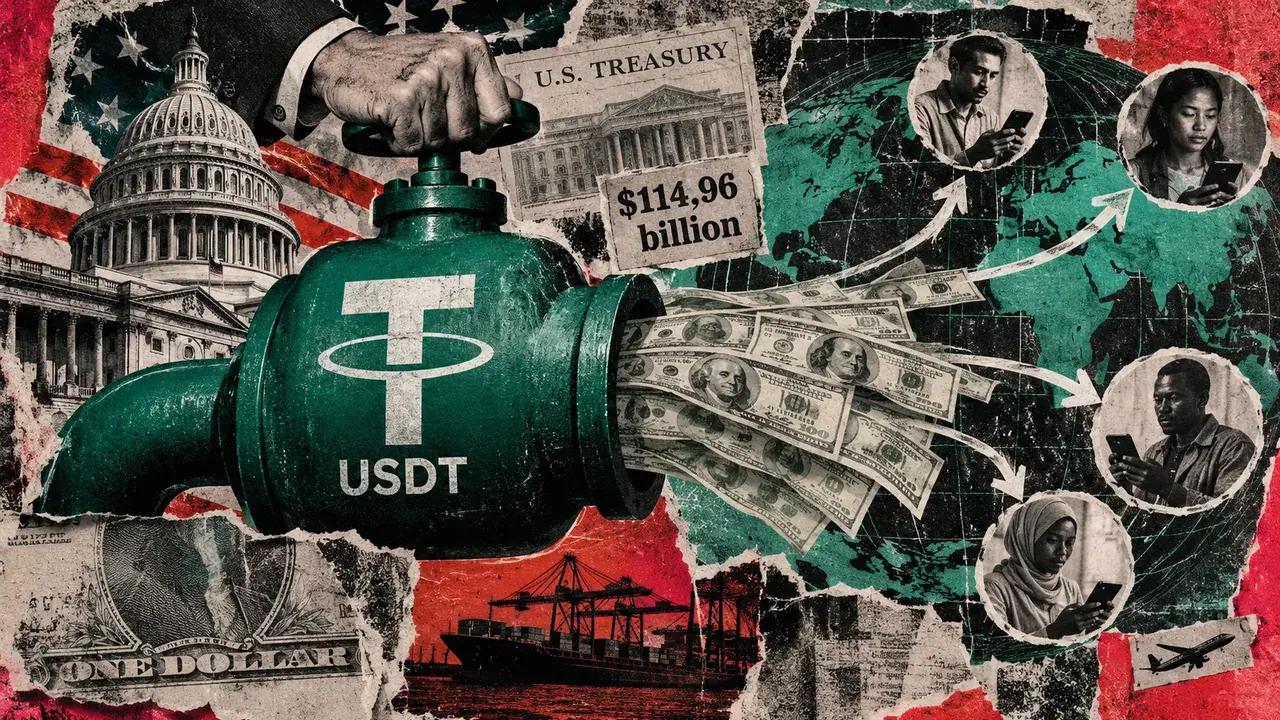
Washington has $114 billion reasons to want Tether around
Not that long ago, Washington fined Tether for misleading people about the dollars behind its tokens. Today, the company's insatia...

SEC clears regulatory hurdle as crypto token buybacks hit record $638 million
Crypto projects spent about $638 million with token buybacks through late August 2026, according to Allium Labs data. That is alre...

Who Bought Bitcoin’s Breakout? The Answer Will Decide Whether The Price Holds
In August, bitcoin’s rally was driven by spot bitcoin ETFs, which bought for nine straight trading days, and by short sellers who...

Ledger Opens 24/7 Tokenized Stocks to Millions With xStocks Integration
Key Takeaways: Ledger and a new partnership with Payward have brought xStocks to the Ledger wallet ecosystem. Eligible Ledger hold...

US crypto ETFs draw over $3 billion this week, with nearly $800 million flowing beyond Bitcoin
US crypto exchange-traded funds have pulled in more than $3 billion this week as fresh demand spread beyond Bitcoin into Ethereum...

The NFT party is over and everybody now owes storage rent
In 2021, Christie's sold a Beeple NFT for $69.35 million, and Sotheby's took another $24.40 million for 101 Bored Ape Yacht Club N...