Bitcoin’s Bear Market Is Over, Galaxy Says
Bitcoin Magazine Bitcoin’s Bear Market Is Over, Galaxy Says Galaxy Research believes bitcoin’s bear market ended in June and that the asset has entered an accumulation phase, according to a research alert from the firm....
Watchlist
Published in the last two hours. A tracked entity is involved.

Bitcoin Magazine
Bitcoin’s Bear Market Is Over, Galaxy Says
Galaxy Research believes bitcoin’s bear market ended in June and that the asset has entered an accumulation phase, according to a research alert from the firm. “We believe now is an attractive time to buy and hold bitcoin,” the report said.
Bitcoin traded near $80,000 at the time of the note, about 35% below its October 2025 high and 39% above the June 30 low. The price would need to rise 53% to retake the previous record. The S&P 500, by comparison, sits within 1% of a record set on Oct. 6.
The report lays out four arguments: technical, positioning, fundamental and sentiment.
Bitcoin technicalsGalaxy uses two weekly moving averages to track bitcoin’s bear markets. The 200-week average has acted as a floor in each one, and the 50-week average has acted as a ceiling, according to the firm.
Bitcoin lost the 50-week average in November 2025 and stayed below it for 44 weeks. The June low tested the 200-week average and held, with the worst weekly close coming 4.7% beneath it. Price closed back above the 50-week average in September, and the week ended Oct. 18 was the fifth consecutive weekly close above that level.
Galaxy counted 13 such reclaims since 2011 and said the outcome depended on how long price had spent below the line. The four reclaims that ended spells of 20 weeks or more were higher a year later, by between 55% and 1,497%, and none closed more than 8.4% below the reclaim level in the following 12 months. Of the nine that ended shorter spells, seven fell more than 25% within a year.
The firm said the halving cycle supports the same conclusion. Prior cycles bottomed on days 777, 889 and 912 after their halvings. Oct. 22 was day 916 of the current cycle. Galaxy said the gains that followed those lows (87x, 19x and 7.6x) have shrunk each cycle and that it does not forecast a repeat.
The current drawdown of 53% is the shallowest in bitcoin’s history, the report said, and the first in which price did not fall below the network’s realized cost basis.
PositioningThe report identified basis traders and macro funds as the main sellers since the top. Asset managers’ net long position in CME bitcoin futures fell 57% from the week of the all-time high, according to Commodity Futures Trading Commission data cited by Galaxy.
Leveraged funds’ net short position, which represents the futures side of the cash-and-carry trade against spot ETFs, shrank by a similar amount. The front-month basis averaged 7.9% annualized in the 30 days before the high and 4.8% in the 30 days to Oct. 21, which the firm said no longer covers the trade’s costs and risk.
Galaxy pointed to 13F filings to identify the sellers. Millennium Management, Brevan Howard, Goldman Sachs, Capula, Farallon, D. E. Shaw, Schonfeld, Symmetry and Tudor cut their spot ETF holdings by between 29% and 100% between the September 2025 and June 2026 quarter-ends, a combined 68,000 BTC.
Because total holdings across all 2,200 filers fell by 48,000 BTC, the remaining institutions added in aggregate. Morgan Stanley’s wealth management arm, Mubadala and the Abu Dhabi Investment Council were among the buyers.
Spot ETF holdings dropped 11% from peak to trough while price fell 53%, and the funds have added 87,000 BTC since the June low, the report said.
Fundamentals and sentimentGalaxy’s fundamental case centers on U.S. fiscal conditions. Federal debt reached $40.44 trillion on Oct. 20, fiscal 2026 ended with a $1.99 trillion deficit, and the 10-year Treasury yield hit 5.31% on Oct. 5, its highest since 2007.
The firm argued that a government refinancing that debt at 5% while running 6% deficits faces pressure to inflate.
The report described AI-related borrowing, which Morgan Stanley expects to reach $570 billion this year, as a contributor to that pressure rather than a competitor for capital.
On sentiment, Galaxy compared the current environment to 2015–16 and 2018–19, when mainstream finance embraced “blockchain” and dismissed bitcoin. Both periods coincided with cycle lows. The firm said the 2026 version is “stablecoins and tokenization, not bitcoin,” citing bank pilots of tokenized deposits, the Senate’s failed cloture vote on the Clarity Act on Sept. 15, and Google searches for “bitcoin” at multiyear lows.
RisksGalaxy set a tripwire for its view: a weekly close below the 50-week average, about $76,540, that is not regained within a month. It cited AI-enabled theft, including the $387.5 million Bitget exploit, while noting none of the incidents involved the Bitcoin protocol itself.
On quantum computing, the report said 7.1 million BTC sit in outputs with exposed public keys but that no cryptographically relevant quantum computer exists. It pointed to BIP-360’s merge into the BIP repository in February and Galaxy’s own $5 million quantum readiness commitment.
This post Bitcoin’s Bear Market Is Over, Galaxy Says first appeared on Bitcoin Magazine and is written by Micah Zimmerman.
Why this matters
Bitcoin is showing up inside the Institutional Adoption theme, so this story is worth tracking for follow-through rather than treating it as a one-off headline.
Original source
Read on Bitcoin MagazineRelated market context

Galaxy says bitcoin bear market is over; now is the time to buy and hold
Galaxy said bitcoin’s bear market ended in June as fading long-term holder selling signals an attractive buying opportunity.

Bitcoin Briefly Dips Below $80,000 as AI Worries Weigh on Asian Stocks Before the Fed Decides
Bitcoin slipped under $80,000 during Asian trading hours on Monday, Oct. 26, and stood at $79,785 at 08:07 UTC. It was back at $80...

Bitcoin Slips Below $80,000 as US Evacuations Across the Middle East Spark Risk-Off Weekend
Bitcoin slid to a one-month low near $79,700 as the US evacuated Middle East personnel over Iranian attack threats. Ether, XRP and...

CoinDCX Confirms $15.99M USDT Loss After Failed Sweep Hit Old Crypto Wallets
Key Takeaways: CoinDCX announced a $15.99M USDT loss from the old wallet infrastructure in the last contaminated security event im...
Bitcoin’s Fed Week Starts With A Fresh Rise In US Inflation Expectations
TL;DR: US household inflation expectations rose in October while consumer sentiment barely changed. The readings add context ahead...
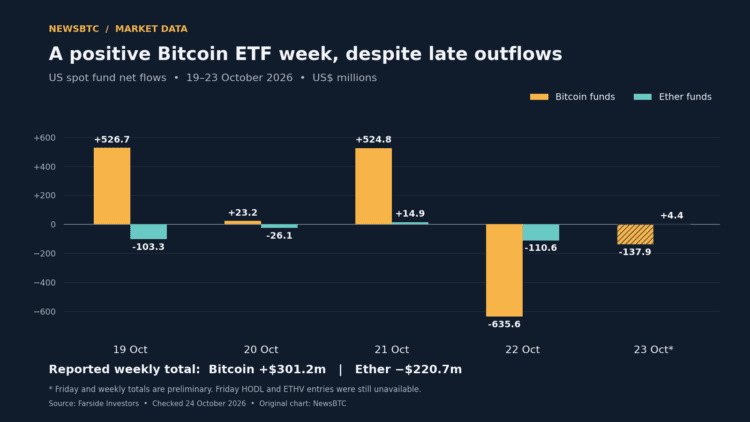
Bitcoin ETF Week Stays Positive After Nearly $774 Million In Late Outflows
TL;DR: Farside’s preliminary figures show US Bitcoin funds retaining a $301.2 million weekly inflow despite two days of withdrawal...