Bloomberg Calls Questioning Of Chainalysis ‘Smear Campaign'
Journalism has been getting an ill rep. A survey held by the communications firm Edelmann has found that trust in the media in the UK was at 35% and 37% in 2021 and 2022, while trust in the media in the US was only a few...
Archive context
Older archive item. Useful for background and entity history, but not a fresh market-moving signal.
Journalism has been getting an ill rep. A survey held by the communications firm Edelmann has found that trust in the media in the UK was at 35% and 37% in 2021 and 2022, while trust in the media in the US was only a few basis points ahead, with 39% and 43%, respectively.
The problem of eroding trust in the media seems to arise increasingly where corporate and state interests cross the free press. The media plays a key role in combating corruption, yet it seems the days of publishers suing governments over press freedom are largely over. As reporting made way for 'content' and authors turned into 'influencers', the stage has been set to foster media corruption: Thou shalt not piss on the foot that kicks its scraps towards thy.
A recent example of the free press representing corporate (and intelligence) interests can be found in Bloomberg’s coverage of the Bitcoin Fog trial; and the problem begins as early as the headline.
In “Wall Street-Backed Crypto Tracer Faces ‘Junk Science’ Attack”, we can firstly find the allegation that the definition of non-scientifically proven software as ‘Junk Science’ is some sort of newly found conspiracy – when the US based innocence project, which has dedicated itself to criminal justice reform, frequently uses the term to describe flawed forensics methods.
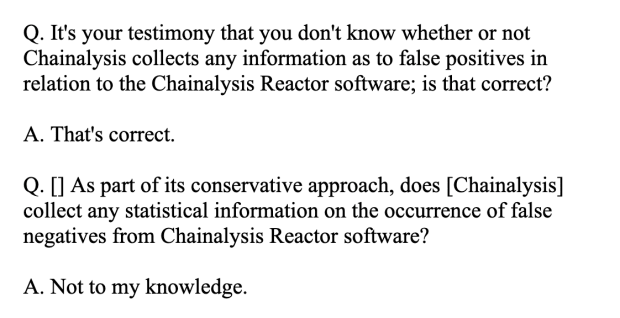
Junk science describes the use of non-scientific methods to prove (or disprove) a hypothesis. In legal contexts, scientific accuracy is determined via the Daubert standard, which defines the following methodologies which cannot be met by Chainalysis Inc. as uncovered in the Bitcoin Fog case: whether the method has a known error rate, whether the method has been subjected to peer review and publication, and whether the method applied is generally accepted by the scientific community.
Expert testimonies of Chainalysis head of investigations Elizabeth Bisbee and FBI special agent Luke Scholl attesting to the lack of scientific evidence for Chainalysis’ Reactor software, commonly defined as ‘Junk Science’ https://storage.courtlistener.com/recap/gov.uscourts.dcd.232431/gov.uscourts.dcd.232431.164.0_1.pdf“Chainalysis is looking into the potential of trying to collect and record any potential false positives and margin of error, but such a collection does not currently exist,” reads an official Chainalysis statement addressing the case.
Blockchain Forensics expert Jonelle Still of the chain surveillance firm Ciphertrace has described the use of Chainalysis’ heuristics as “reckless'' in an expert report issued in the Sterlingov case, stating that “Law enforcement and other customers of Chainalysis have approached CipherTrace on this topic and have expressed frustration related to the errors they experience using Chainalysis Reactor.” According to Still, “Chainalysis attribution data should not be used in court for this case nor any other case: it has not been audited, the model has not been validated, nor has the collection trail been identified.”
Instead, however, Bloomberg chose to cite a September 11th filing, which alleges that “the FBI validates Chainalysis’ clustering every day, and it is ‘generally reliable and conservative.’” “Prosecutors said Chainalysis information is “frequently validated and found to be reliable” in supporting subpoenas and search warrants,” writes Bloomberg, apparently taking the state’s and Chainalysis’ word at face value – no questions asked – because what else would a journalist do.
What Bloomberg conveniently forgot to highlight is that the Department of Justice, too, has found blockchain forensics to be “highly imperfect”, specifically citing Chainalysis software in a report published in the Journal of Federal Law and Practice – ironically written by C. Alden Pelker, an expert in computer crime, who currently serves as co-counsel to Sterlingov’s prosecution.
The description of a software which fails to meet scientific standards is hence not an ‘attack’ but rather an accurate description within the meaning of the term in light of the facts at hand – all of which have been ignored by Bloomberg – which we can either ascribe to incredibly bad journalism, or outright corporate propagandaism.
Circling back to Bloomberg’s headline, this author would like to note that Chainalysis is not just backed by Wall Street, but also backed by In-Q-Tel, receiving over $1.6 Million from the Central Intelligence Agency’s ‘non-profit’ venture capital fund. How fortunate that this fact, too, appears to have escaped the Bloomberg author's research capabilities.
TLDR: Corporate journalism has shit the free press’ bed once again, and it’s the people that continue to have to lie in it. Auld Lang Syne.
Why this matters
This bitcoin story adds another data point to the current market tape and is useful when read alongside nearby source coverage.
Original source
Read on Bitcoin MagazineRelated market context

Bitcoin’s $113,000 case strengthens as US regulators push 9 crypto actions
The US Securities and Exchange Commission (SEC) proposed a custody framework on Oct. 1 that would let investment advisers and regu...

Ethereum Foundation Launches Privacy Tool That Cuts the Link Between AI Prompts and Payers
The Ethereum Foundation has launched zkAPI, a system for paying for AI models and other metered online services without that usage...

Aave Founder Warns EU MiCA Review Could Restrict DeFi Access
Aave founder Stani Kulechov is criticizing proposals from European regulators that could extend restrictions on stablecoin yield a...

South Africa’s Absa Becomes First Bank on the Continent to Custody Bitcoin: Report
Bitcoin Magazine South Africa’s Absa Becomes First Bank on the Continent to Custody Bitcoin: Report South African bank Absa has be...

Aave Labs proposes Cayman foundation to hold Aave brand and IP for the DAO
Aave's proposal could enhance DAO governance and transparency, potentially reshaping control dynamics over its brand and IP assets...

Chainalysis links most of the stolen XRP in $387M Bitget hack to North Korea
The Bitget hack highlights escalating cyber threats from North Korea, stressing the need for enhanced security measures and rapid...