CEO Jeremy Allaire says Circle built “the platform for the internet financial system”, but cirBTC has only 40 BTC
Circle's wrapped Bitcoin product entered the market with unusually strong institutional credentials and almost no visible scale. The company paired cirBTC with segregated reserves, a federally supervised custodian, direc...
Archive context
Older archive item. Useful for background and entity history, but not a fresh market-moving signal.
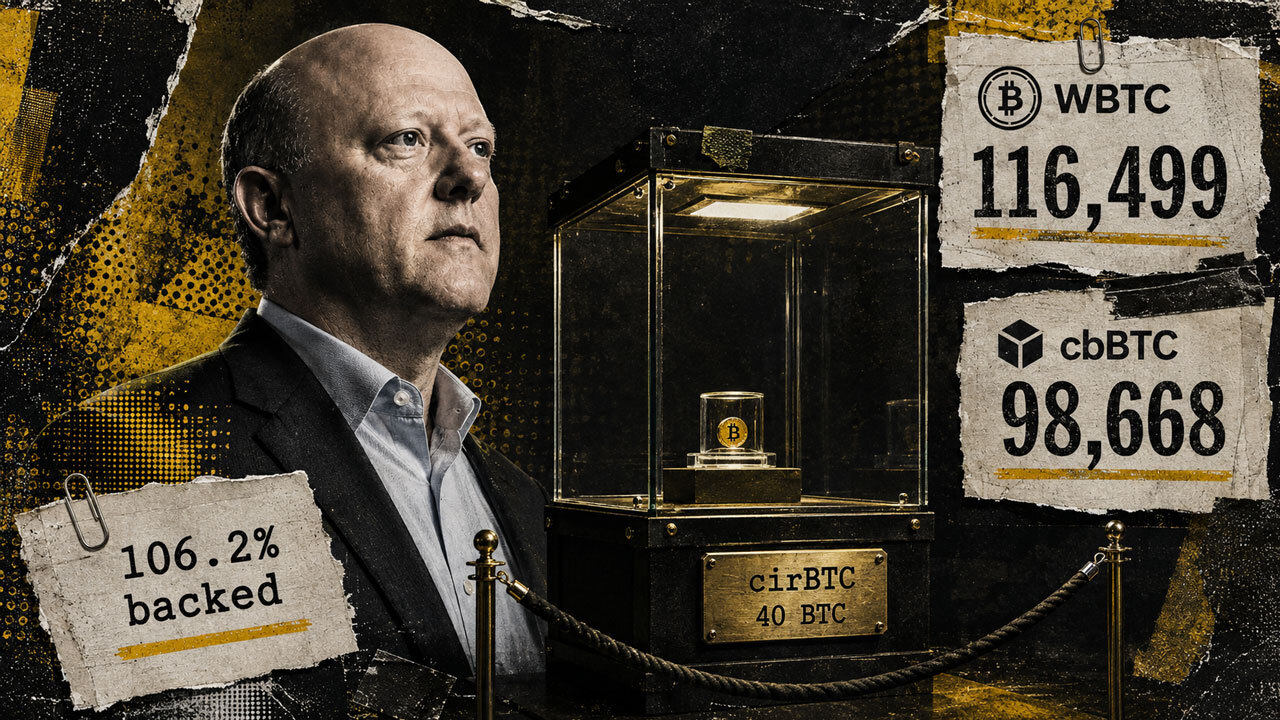
Circle's wrapped Bitcoin product entered the market with unusually strong institutional credentials and almost no visible scale.
The company paired cirBTC with segregated reserves, a federally supervised custodian, direct minting and redemption for eligible businesses, and the distribution infrastructure behind USDC. Circle's Aug. 27 reserve panel nevertheless showed just 40.02450077 cirBTC outstanding about 11 weeks after its Ethereum launch.
The same panel showed 42.5114162 BTC in reserve, equal to about 106.2% coverage and a 2.48691543 BTC cushion across 14 disclosed Bitcoin addresses. The reserve cushion settled the backing question at that snapshot. The 40-token float exposed the harder problem: Circle had built a credible institutional wrapper but had barely begun to build a market around it.
That gap turns cirBTC into a test of a broader Circle thesis. Jeremy Allaire said in the company's second-quarter results that Circle had built “the platform for the internet financial system.” He was describing Circle's larger platform, including its trust charter, USDC and planned Arc network. cirBTC now has to show whether that infrastructure can produce the liquidity and integrations that make wrapped Bitcoin useful as collateral.
Related Reading Circle wants wrapped Bitcoin to look bank grade before institutions trust it as collateral A 40-BTC float enters a market measured in six figurescirBTC is Circle's tokenized representation of Bitcoin on Ethereum. WBTC and Coinbase's cbBTC serve the same basic purpose, allowing Bitcoin value to move through smart-contract networks, but their scale makes the competitive gap stark.
Token Outstanding supply at check Underlying BTC reserves Scale versus cirBTC cirBTC 40.02450077 42.5114162 1x WBTC 116,499.2018 116,512.0029 About 2,911x cbBTC 98,668.19 98,678.96 About 2,465xThe cirBTC figures are from Aug. 27. The WBTC transparency dashboard and Coinbase's cbBTC reserve page were checked Aug. 29, making this a close two-day comparison. Coinbase's total covered cbBTC across Ethereum, Base, Solana and Arbitrum and was counted once, avoiding double-counting of its multichain representations.
Supply is only one measure of a wrapped token's usefulness, but it is also evidence of distribution. Each token in circulation reflects demand to mint, acquire or deploy that representation of Bitcoin. The incumbents' six-figure supplies give venues and protocols far larger pools from which to build trading and lending markets.
Public activity data reinforced the scale difference. At the Aug. 29 check, DefiLlama showed about $110.49 million in 24-hour WBTC trading volume and $3.12 billion in maximum observed lending exposure. Its cbBTC page showed about $338.55 million of volume and $2.817 billion in maximum observed lending exposure. Those exposure figures describe DefiLlama's recorded maxima, rather than live lending balances or market share.
CoinGecko's verified cirBTC contract page showed no tracked 24-hour trading volume, liquidity or transactions. CoinGecko captures public tracked activity, leaving private, over-the-counter or untracked flows outside that observation. Its empty market fields still showed that cirBTC had yet to develop visible liquidity on a major public tracker.
A public Aave governance proposal sought to onboard cirBTC. The proposal status meant live collateral support, borrowing demand and risk parameters remained pending. For institutions, prospective support becomes useful only when positions can be opened, financed and unwound through functioning markets.
Related Reading Bitcoin DeFi’s demand problem is becoming harder to ignore Circle's integrated stack combines trust with platform controlThe adoption gap stands out because cirBTC arrived with a deliberately formal operating structure.
Circle's whitepaper identifies Circle International Bermuda Limited as the legal issuer. Circle National Trust holds the underlying Bitcoin as custodian, while Circle Internet Financial, LLC provides Circle Mint and related distribution services. The Ethereum token is an eight-decimal ERC-20 at 0x72DFB2E44f59C5AD2bAFE84314E5b99a7cd5075E, an identity also reflected on Etherscan.
Circle National Trust received final approval from the Office of the Comptroller of the Currency in July. The approval applied to the national trust bank, not to cirBTC as a separately approved financial product. It gave Circle a recognizable custody credential: underlying Bitcoin held by a federally chartered trust bank, paired with an issuer-operated transparency panel and direct conversion for qualified customers.
Circle Mint is designed for eligible institutions and is unavailable to individuals. Secondary-market users can transfer the ERC-20 token, while direct issuance and redemption depend on institutional eligibility, supported jurisdictions and Circle's compliance process.
That model may appeal to regulated funds and businesses that value a known redemption counterparty. It also creates a more selective path to primary-market access. WBTC and cbBTC already sit inside established exchange, wallet and lending networks. cirBTC needs dealers, market makers, protocols and custodial platforms to add another Bitcoin representation before its trust architecture can become useful collateral at scale.
Circle brings substantial distribution experience to that challenge. It reported $73.3 billion of USDC in circulation at the end of the second quarter and $14.8 trillion of USDC onchain transaction volume during the period. Those figures establish Circle's ability to operate a large token network. Demand for cirBTC will depend on whether venues and customers find comparable utility in its Bitcoin product.
Circle argues that wrapped Bitcoin should be “strategically neutral.” In its Aug. 11 thesis, the company focused on conflicts that can arise when a wrapped asset is controlled by an operator with its own centralized exchange, decentralized exchange or lending protocol. Under that definition, Circle can pursue broad distribution without steering users toward an affiliated trading or lending venue.
The operating structure defines neutrality as a commercial rather than structural condition. Circle-affiliated entities occupy each major point in cirBTC's design: issuance, custody, direct redemption and distribution. Circle also supplies USDC, the dollar liquidity that could pair with cirBTC, and is building Arc, a network that may become another venue for the token.
Circle can therefore claim commercial neutrality among third-party venues while retaining an integrated operating stack. Institutions may see that concentration as efficient accountability or as platform dependence. Adoption will decide which interpretation carries more weight.
The current numbers show that trust credentials have yet to overcome incumbent network effects. A reserve dashboard establishes backing. A collateral standard also needs broad acceptance, borrowing demand, deep trading and inexpensive redemption.
Arc gives Circle a future distribution checkpointArc could connect Circle's custody, stablecoin and wrapped Bitcoin products inside one settlement environment. Circle said the network's public mainnet was on track for Sept. 16, with more than 100 builders and a validator cohort that included major financial and payments companies.
Related Reading Circle adds $3 billion Wall Street Arc token risking an uncomfortable rivalry with CoinbaseThe Aug. 29 reporting cutoff came before that scheduled launch. Circle's cirBTC documentation described Arc testnet support and broader Arc availability as forthcoming, leaving cirBTC's day-one public-mainnet availability unconfirmed.
Arc is therefore a future checkpoint rather than evidence of present distribution. Live cirBTC support, USDC markets, institutional participants and borrowing or trading integrations would shorten the route from minting to utility. Continued supply near 40 BTC after those rails arrive would make the gap between Circle's infrastructure and cirBTC adoption harder to explain as an early-launch condition.
For now, Circle's reserve panel supports two simultaneous conclusions. cirBTC was backed by more Bitcoin than Circle had issued, validating the disclosed reserve position at that moment. Relative to the dominant alternatives, almost nobody had minted it.
Circle has built the institutional plumbing. cirBTC still has to prove that users, venues and protocols want to connect to it.
The post CEO Jeremy Allaire says Circle built “the platform for the internet financial system”, but cirBTC has only 40 BTC appeared first on CryptoSlate.
Why this matters
Bitcoin is showing up inside the Stablecoins theme, so this story is worth tracking for follow-through rather than treating it as a one-off headline.
Original source
Read on CryptoSlateRelated market context

Claude AI Predicts an Astonishing Price for Ethereum: Is Claude Broken?
Anthropic’s Claude AI predicts an unbelievable price for Ethereum (ETH USD), saying it could hit as high as $80,000 by January 1,...

Securitize Cuts Out Stablecoin Middlemen in Deal With Anchorage Digital Bank
Securitize now creates and redeems stablecoins directly with Anchorage Digital Bank, N.A., the two companies announced on Tuesday....

Kazakhstan’s AIFC Regulator Turns to Apple and Google to Enforce Coinbase, HTX Injunctions
Kazakhstan’s Astana Financial Services Authority (AFSA) says it will serve Apple and Google with injunctions it won against Coinba...

Ethereum and Arbitrum Gain New Privacy Layer as Fhenix Goes Live
Fhenix has launched its mainnet alongside its fully homomorphic encryption coprocessor, enabling smart contracts to execute direct...

Coinbase lets AI agents trade perps after a five-minute feedback loop
AI-driven trading's rapid evolution may increase market volatility and necessitate robust oversight to manage synchronized agent a...

GTA 6 trailer’s fictional DacityCoin sends a real Solana meme token on a wild ride
The incident highlights the volatility and speculative nature of meme tokens, where fictional elements can trigger real-world fina...