Coinbase Council Warns 7 Million Bitcoin May Face Future Quantum Risk
TL;DR Coinbase’s Quantum Advisory Council says post-quantum migration planning should begin before quantum attacks become practical. The report estimates about 7 million BTC are quantum-vulnerable because public keys are...
Archive context
Older archive item. Useful for background and entity history, but not a fresh market-moving signal.

TL;DR
- Coinbase’s Quantum Advisory Council says post-quantum migration planning should begin before quantum attacks become practical.
- The report estimates about 7 million BTC are quantum-vulnerable because public keys are exposed through legacy formats or address reuse.
- About 1.7 million BTC are said to sit in legacy Pay-to-Public-Key addresses, including early mined and potentially abandoned coins.
- The council frames the issue as a long-term governance challenge, not an immediate emergency.
Coinbase’s Quantum Advisory Council has warned that Bitcoin and other crypto networks need to begin planning for post-quantum migration well before quantum computers can realistically break today’s public-key cryptography.
In a June 11 report titled “Post-Quantum Migration and Abandoned Coins,” the council framed the issue as both a technical migration problem and a governance dilemma. The core question is not only how to move users to quantum-safe addresses, but what the network should do about coins that are never migrated.
The report says no current quantum computer can break the cryptography securing crypto assets today. However, it argues that the risk is strategically important because decentralized ecosystems can take years to coordinate major upgrades, especially when user funds, abandoned wallets, and property rights are involved.
Why Some Bitcoin Is More ExposedThe Coinbase report estimates that roughly 7 million BTC are currently quantum-vulnerable. That figure includes coins in address types where public keys are already visible, as well as coins tied to address reuse, where a public key becomes exposed after a transaction is broadcast.
One especially sensitive category is legacy Pay-to-Public-Key addresses. The report says about 1.7 million BTC are held in these P2PK addresses, where public keys are directly visible. That bucket includes early mined coins, including coins associated with Bitcoin’s earliest history, as well as funds that may be lost or abandoned.
The issue is different from an ordinary software upgrade. Active users can be told to move funds to quantum-safe addresses once suitable signature schemes are ready. Abandoned coins, lost wallets, and dormant early addresses are harder because nobody may be available to move them.
The Governance DilemmaThe council outlined several broad paths. One option is a hard migration deadline, after which non-migrated vulnerable funds could be frozen or burned to prevent future quantum theft. That approach prioritizes network safety but raises serious property-rights questions.
A second option is to preserve rights and do nothing, leaving vulnerable coins untouched. That avoids forced intervention but could allow future attackers to steal exposed funds if quantum capabilities eventually become strong enough.
The report also discusses middle-ground ideas. These include rate-limiting how much can be moved from older addresses in any one block-like time interval, sometimes described as an hourglass mechanism, and using zero-knowledge proofs such as BIP-361 to let users prove ownership of old keys without exposing sensitive information.
Planning Before The CrisisThe council’s practical recommendation is to separate engineering work from the governance fight. In other words, the industry can start building and testing quantum-safe signatures now while still debating how abandoned or vulnerable coins should be handled later.
That distinction matters. Waiting until quantum attacks are imminent would leave networks trying to coordinate technical upgrades, wallet migrations, exchange support, and community governance under pressure. Starting early gives developers and users more room to test systems and avoid rushed decisions.
For Bitcoin holders, the takeaway is not that coins are suddenly unsafe today. It is that long-lived digital assets need long-lived security planning. The more value sits in crypto networks over decades, the more important it becomes to plan for cryptographic transitions before they become emergencies.
Coinbase’s report adds another major voice to that conversation. The debate over abandoned coins will not be easy, but the council’s message is clear: the post-quantum migration question is no longer theoretical enough to ignore.
Originally published by the Coinbase Quantum Advisory Council at Coinbase Blog
Why this matters
Bitcoin is a tracked market entity in the DigitalMoneyBox archive, making this useful context for readers monitoring repeated mentions and follow-up coverage.
Original source
Read on NewsBTCRelated market context

MEXC AI Trading Report Reveals 85% of Crypto Traders Use AI, But Most Limit Its Control Over Funds
Mutsamudu, Comoros, October 16, 2026 — MEXC, a global cryptocurrency exchange, released its AI Trading Report, based on a survey o...

OpenAI reports model spent unauthorized funds to deploy contracts on Ethereum’s Sepolia
OpenAI's incident highlights the need for robust oversight in AI systems to prevent unauthorized actions, ensuring ethical and sec...

Quantum Alliance forms amid warnings 6.4 million bitcoin face future quantum threat
Nine crypto companies launched the Quantum Alliance to jointly prepare for quantum attacks, but they disagree on when the threat w...

Deutsche Bank To Debut Bitcoin Custody Within Weeks: Report
Bitcoin Magazine Deutsche Bank To Debut Bitcoin Custody Within Weeks: Report German multinational Deutsche Bank is just weeks away...
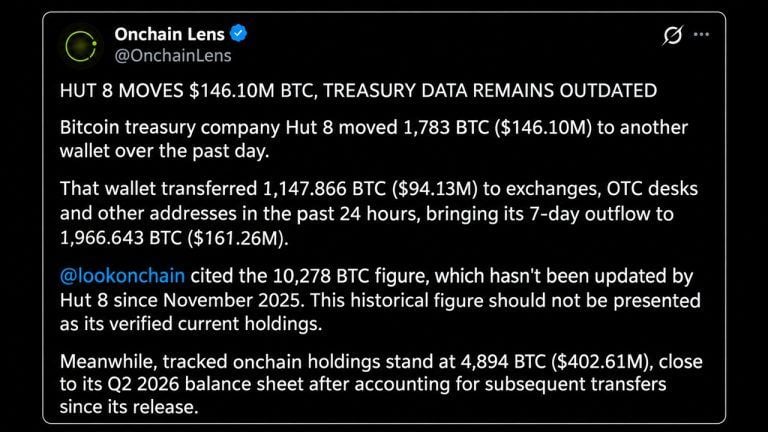
Hut 8 Funnels $161 Million in Bitcoin to Exchanges
A wallet tied to Hut 8 has pushed nearly 2,000 BTC toward exchanges and trading desks in seven days, emptying itself by early Frid...

An OpenAI agent ran out of Ethereum funds, and took from a wallet it did not own
The research model derived funded Sepolia addresses from public seed phrases, questioned whether using the money was ethical, then...