Eclair merges fixes for Lightning flaws that could burn Bitcoin in fees
Eclair, ACINQ's Lightning node software, has merged two repairs for gaps that could make a node lose Bitcoin through excessive mining fees during channel funding and splicing. One limits a peer's fee-bump demands when Ec...
Archive context
Older archive item. Useful for background and entity history, but not a fresh market-moving signal.
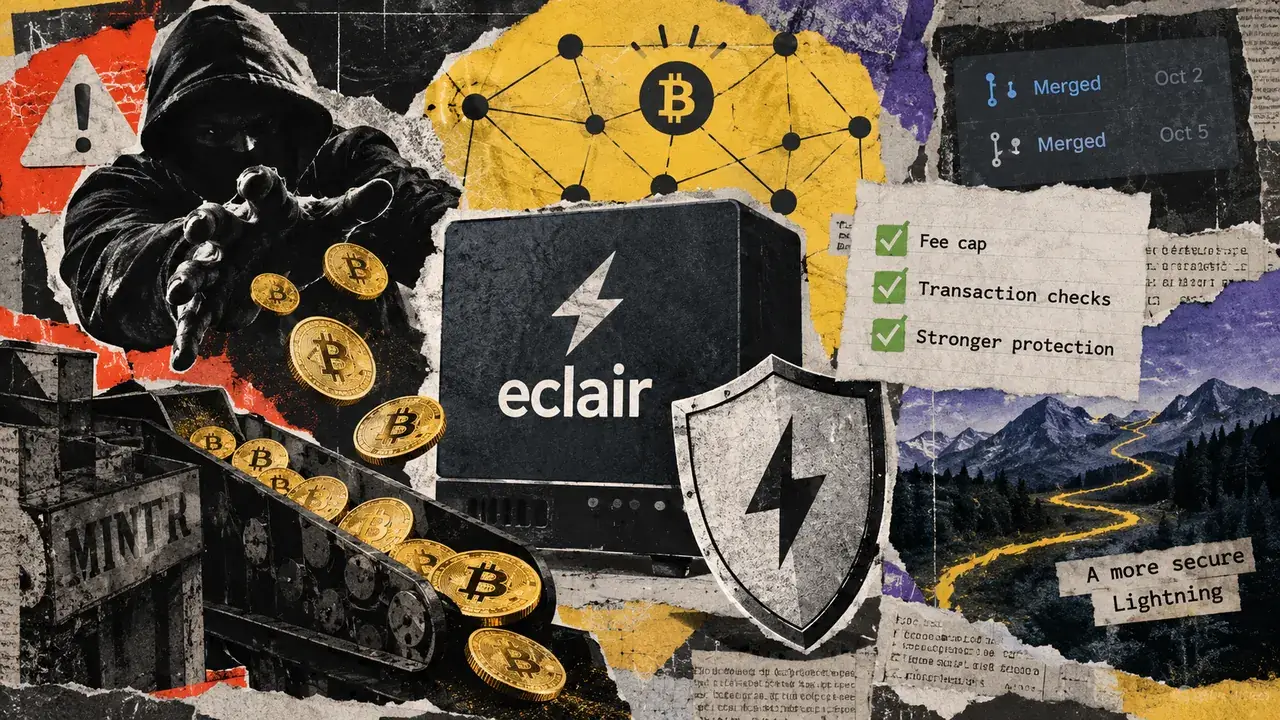
Eclair, ACINQ's Lightning node software, has merged two repairs for gaps that could make a node lose Bitcoin through excessive mining fees during channel funding and splicing. One limits a peer's fee-bump demands when Eclair contributes funds; the other checks transactions from a compromised Bitcoin backend while Eclair retains the signing keys.
The repairs merged into the project's master branch on Oct. 2 and Oct. 5. As of Oct. 12, its release page still listed September's v0.14.3 as latest. The two October fixes postdate that packaged release.
Bitcoin Optech's Oct. 9 newsletter highlighted both changes as closing protection gaps during dual funding and splicing.
Related Reading A Bitcoin Lightning flaw could send a node’s entire balance straight to minersThe first repair, PR #3388, concerns peer-initiated replace-by-fee, or RBF, attempts during a dual-funded channel opening or a splice that adjusts a channel's funding. A peer could request a replacement transaction with a higher fee rate. Eclair kept its wallet contribution and paid for its inputs at that rate, without an upper bound or fee budget on this path.
That let a malicious peer impose an arbitrary mining fee rate on the contributing node while contributing nothing itself. The loss would be paid as fees to miners rather than transferred directly to the peer.
The repair rejects attempts above the maximum funding fee rate Eclair recommends to its peer. Two exceptions remain: the peer buys liquidity and pays the fees for Eclair's inputs, or the Eclair node contributes no funds to the transaction. In those cases, Eclair does not bear the cost addressed by this limit.
Keeping keys is only part of the defensePR #3390 addresses a separate threat in Eclair-signer mode. Bitcoin Core's backend, bitcoind, selects coins and builds transactions, while Eclair retains the keys and signs.
A compromised backend could report a fee within budget while constructing a transaction that actually paid more, including by dropping the change output. Under Bitcoin's transaction accounting, input value not assigned to outputs becomes a miner fee. Missing change can therefore spend funds without paying an attacker's address.
When a fee budget is supplied, the repair calculates the actual fee from the amounts of the coins being spent, fetched by transaction ID to authenticate their values. It checks that the backend's reported fee matches and applies the budget to the actual fee. It also checks that Eclair's rebuilt contributions pay the same verified fee and rejects invalid change-output positions.
Related Reading Lightning apps using unpatched LDK risk Bitcoin theft from a reconnect lieThese are distinct from the cooperative-closing fee flaw covered in CryptoSlate's September report and the restart denial-of-service issues covered Oct. 2.
These repairs address Eclair's dual-funding, splicing and signer configurations. Operators should check that their installed build contains the October changes.
Related Reading Unpatched Eclair Bitcoin Lightning nodes could crash again every time they restartThe post Eclair merges fixes for Lightning flaws that could burn Bitcoin in fees appeared first on CryptoSlate.
Why this matters
Bitcoin is showing up inside the Mining theme, so this story is worth tracking for follow-through rather than treating it as a one-off headline.
Original source
Read on CryptoSlateRelated market context
TeraWulf Says AI Leasing Now Generates 83% of Revenue as Bitcoin Mining Recedes
TL;DR: TeraWulf’s November 6 earnings release shows $63 million in third-quarter high-performance-computing lease revenue, around...
BitFuFu’s October Bitcoin Mining Output Falls Despite Steady Hashrate
TL;DR: BitFuFu produced 137 BTC in October, down from 167 in September, while managed hashrate stayed close to 19.5 EH/s. The mine...

IREN’s Bitcoin Mining Revenue Falls as AI Cloud Sales Nearly Triple
TL;DR: IREN reported $200 million in quarterly AI Cloud revenue, up from $71 million the previous quarter, while Bitcoin mining re...

Bitcoin vs. Gold: Peter Schiff Highlights Strategy’s $75.5K Cost Basis and Missed 30% Return Target
The gold advocate used the development to question Michael Saylor’s six-year Bitcoin investment strategy, arguing that gold delive...

Aave Buys Avon Team to Bring More Fixed-Rate Lending Onchain
TL;DR: Aave Labs said November 6 it had acquired Avon’s team and technology, including fixed- and floating-rate lending systems an...

Strive Reports $509M Quarterly Profit as Bitcoin Buying Accelerates
TL;DR: Strive reported $509 million in third-quarter GAAP net income and said it purchased 8,136 BTC during the quarter, followed...