Examining Short-Term Bitcoin Holder Behavior
Examining the dynamics of short-term holders during bitcoin bull markets and bear markets.The below is from a recent edition of the Deep Dive, Bitcoin Magazine's premium markets newsletter. To be among the first to recei...
Archive context
Older archive item. Useful for background and entity history, but not a fresh market-moving signal.
Examining the dynamics of short-term holders during bitcoin bull markets and bear markets.
The below is from a recent edition of the Deep Dive, Bitcoin Magazine's premium markets newsletter. To be among the first to receive these insights and other on-chain bitcoin market analysis straight to your inbox, subscribe now.
Relevant Articles:
The Daily Dive #070 - Short-Term:Long-Term Cost Basis Ratio
The Daily Dive #083 - Bitcoin All Time High
The Daily Dive #081 - HODLer Engineered Supply Squeeze
In previous Daily Dives we examined the supply dynamics of long-term and short-term holders and what it means for the bitcoin market. Today, we will further examine the dynamics of short-term holders during bull markets and bear markets.
Before we begin, it is important to define some terminology for those who may not be familiar.
In this piece, when referring to cost basis, we are referring to the realized price, which uses the price at which the coins were last transferred on the Bitcoin blockchain. Due to the transparent nature of Bitcoin’s ledger, we can quantify a cost basis of various cohorts of holders. Below are a few other terms and abbreviations that will be mentioned frequently in today’s Daily Dive.
- Cost Basis = Realized Price
MVRV = Market Value (price) to Realized Price Ratio
LTH = Long-Term Holder
STH = Short-Term Holder
Let’s dig in.
Short-Term Hodler Cost-Basis AnalysisFor information about the quantification of short/long term holders click here
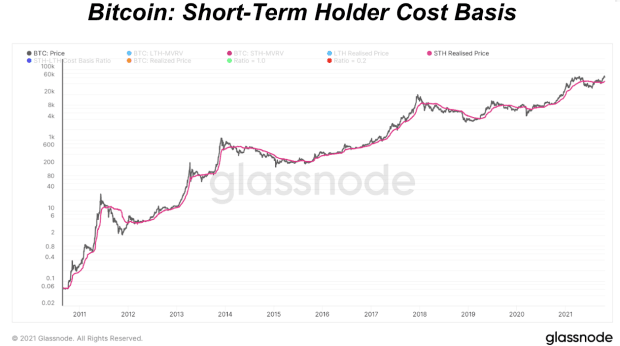
Pictured below is the cost basis for short-term holders over time:
Source: GlassnodeIt is clear that the STH cost basis oscillates around the bitcoin price, but when analyzing further, bull markets are driven by new capital flowing into the market, and as a result price will far outpace STH as new money competitively bids for allocations. Examine the trends between STH cost basis and price since the beginning of 2020, as well as the 2017 bull market.
Source: Glassnode Source: GlassnodeWe can display the same value as a ratio using STH MVRV (short-term holder market value to realized value ratio). Notice how 1.0 acts as support for STH MVRV in bull markets?
This can be thought of as new participants aggressively defending their average cost basis, as they continue accumulating a position size.
Why this matters
This bitcoin story adds another data point to the current market tape and is useful when read alongside nearby source coverage.
Original source
Read on Bitcoin MagazineRelated market context

Holders face permanent token destruction with no guarantee of value as deadline looms for Shade’s privacy protocol
Shade Protocol says only SHD burned before 18:00 UTC on Aug. 21 will qualify for a future Feather allocation, leaving holders hour...

SEC Opens Comment Period On Cboe 3x Bitcoin And Ethereum ETF Proposal
The SEC has opened a public comment period on Cboe BZX Exchange’s proposal to list six daily 3x leveraged Bitcoin and Ethereum fut...
Bitcoin hits $80,000’s doorstep just as the ETF bid disappears for the weekend
Bitcoin enters the weekend within striking distance of $80,000, registering an intraday high at $79,500 on Aug. 21. The move caps...

Solana RWA Value Explodes 300% to $4B, Adding $3 Billion in Under 12 Months
Key Takeaways: For the first time in Solana’s history, the real-world asset ecosystem has surpassed $4 billion in total value. The...

Google Gemini AI Predicts Ethereum Could Become the Trade Retail Misses in 2026
The biggest protocol change since The Merge is days away. Google Gemini AI predicts it resets Ethereum’s trajectory, and the price...

Bitcoin drops below $76K, wiping out $100M in long positions
The recent Bitcoin sell-off highlights the risks of high leverage in volatile markets, potentially deterring future bullish specul...