How Bitcoin Offers a Speed Advantage for Driving Shareholder Value
Bitcoin Magazine How Bitcoin Offers a Speed Advantage for Driving Shareholder Value Bitcoin is the first instantiation of digitally scarce capital—allowing companies to raise, deploy, and prove value faster than ever bef...
Archive context
Older archive item. Useful for background and entity history, but not a fresh market-moving signal.

Bitcoin Magazine
How Bitcoin Offers a Speed Advantage for Driving Shareholder Value
Bitcoin is the first instantiation of digitally scarce capital—allowing companies to raise, deploy, and prove value faster than ever before.
In legacy finance, capital formation is a slow, friction-filled process. A company raises funds, deploys them over months or years into infrastructure, products, or real estate—and only then begins the long wait to see whether the capital generated a return.
This lag isn’t a bug. It’s a defining feature of the traditional system, built on physical constraints, regulatory overhead, intermediated trust, and long feedback loops. That system has not changed—until now.
Bitcoin is fundamentally different. For the first time, companies have access to capital that is digital, scarce, and verifiable in real time. It allows for a corporate capital cycle that doesn’t take years. It takes 24 hours.
Legacy Capital Formation: Built for FrictionIn the legacy model, capital formation is expensive, slow, and often opaque. It requires multiple layers of intermediation and a high tolerance for time risk.
Capital is typically raised through equity or debt offerings, which are subject to underwriting, roadshows, board approvals, and investor due diligence. Once funds are secured, they’re often deployed into physical infrastructure, human capital, or R&D—all of which require multi-year timelines to execute and mature. ROI is projected, not immediate. Outcomes are contingent on operational success and macroeconomic conditions.
Investors, meanwhile, are left waiting—quarter to quarter—for signs of progress, often relying on opaque metrics, delayed reporting, or narrative guidance from executives.
Even for high-performing companies, the cycle between raise and return is measured in years, not days.
This model worked in a world where capital couldn’t move faster than its physical constraints. But in a digital age, the question is whether such delay is still necessary—or defensible.
The Bitcoin Treasury Model: Raise on Monday, Deploy by TuesdayCompanies holding Bitcoin on their balance sheet are already proving a radically compressed alternative.
In this model, capital is raised on a Monday—through a convertible note, equity issuance, or other capital market instrument. By Tuesday morning, the proceeds are converted into Bitcoin. That same day, reserves are verifiably posted on-chain, and shareholder value is updated in Bitcoin terms.
This process removes intermediaries. It eliminates construction or execution risk. It creates instant, observable movement of capital—and ties that movement directly to long-term strategic value through Bitcoin’s monetary properties.
For financial leaders, this model solves several pain points:
- Time lag between raise and deployment is eliminated
- Reporting opacity is replaced by proof-of-reserve transparency
- Shareholder uncertainty is answered with real-time asset accumulation
- Dilution narratives are counterbalanced by measurable BTC/share growth
This cadence—raising, deploying, and proving value within 24 hours—does more than accelerate capital formation. It unlocks a new relationship between corporate action and market trust.
Why Bitcoin Enables ThisBitcoin is not just an asset. It is an entirely new substrate for capital. No other form of reserve asset offers:
- Digital nativity: Bitcoin moves and settles like software—globally, 24/7
- Absolute scarcity: With 21 million units, it introduces a hard cap on monetary supply
- Instant verifiability: Reserves can be publicly proven on-chain, without intermediaries
- Neutral settlement: Bitcoin does not rely on any central party or jurisdiction to function
This combination is what makes Bitcoin digital capital. It is not a synthetic product or a derivative of another asset. It is the capital itself—programmable, transferrable, and incorruptible.
That is why Bitcoin enables a capital model no other asset can match.
Speed as StrategyCompressing the capital cycle isn’t just operationally efficient—it’s strategically powerful.
With Bitcoin, capital deployment becomes a public signal. It shows conviction. It’s auditable. It builds trust. It removes guesswork and replaces it with verifiable shareholder alignment.
Historically, treasury was a back-office function: protect cash, preserve yield, minimize risk. Today, a Bitcoin treasury allows companies to drive capital markets strategy from the balance sheet.
This model resonates because it addresses investor needs directly:
- Proof, not promises
- Scarcity, not dilution
- Velocity, not delays
It turns treasury into a tool for compounding confidence.
The CFO’s New CalculusFor financial leaders, the question is no longer “Where do we invest over the next five years?” but rather, “How do we use capital today to increase provable shareholder value—now?”
That change in mindset reflects a deeper shift in how capital is understood: not as something locked into long-term plans, but as something that can move, signal, and compound in real time.
Bitcoin enables that shift. It allows companies to operate not on forecasts, but on actions.
Conclusion: The Rise of Capital Without DelayLegacy capital models were built for an analog world—slow, permissioned, and dependent on intermediaries. Companies moved cautiously because capital couldn’t move quickly.
Bitcoin rewrites that architecture. It introduces capital that is digitally scarce, globally liquid, and verifiable on arrival.
With a Bitcoin treasury, companies no longer need to wait to prove strategic alignment. They can act and validate in the same cycle. They can move with speed and transparency. They can raise on Monday, deploy on Tuesday, and show their shareholders exactly what they’ve done.
This is not a gimmick. It is a serious evolution in financial operations—and the companies that recognize it early will lead the next phase of capital market innovation.
Disclaimer: This content was written on behalf of Bitcoin For Corporations. This article is intended solely for informational purposes and should not be interpreted as an invitation or solicitation to acquire, purchase, or subscribe for securities.
This post How Bitcoin Offers a Speed Advantage for Driving Shareholder Value first appeared on Bitcoin Magazine and is written by Nick Ward.
Why this matters
This bitcoin story adds another data point to the current market tape and is useful when read alongside nearby source coverage.
Original source
Read on Bitcoin MagazineRelated market context

XRP News: Ripple’s Multi-Asset Payments Model Predates Resurfaced XRP Remarks
Ripple CEO Brad Garlinghouse said XRP may be the best bridge asset for some cross-border payments, while a stablecoin could solve...
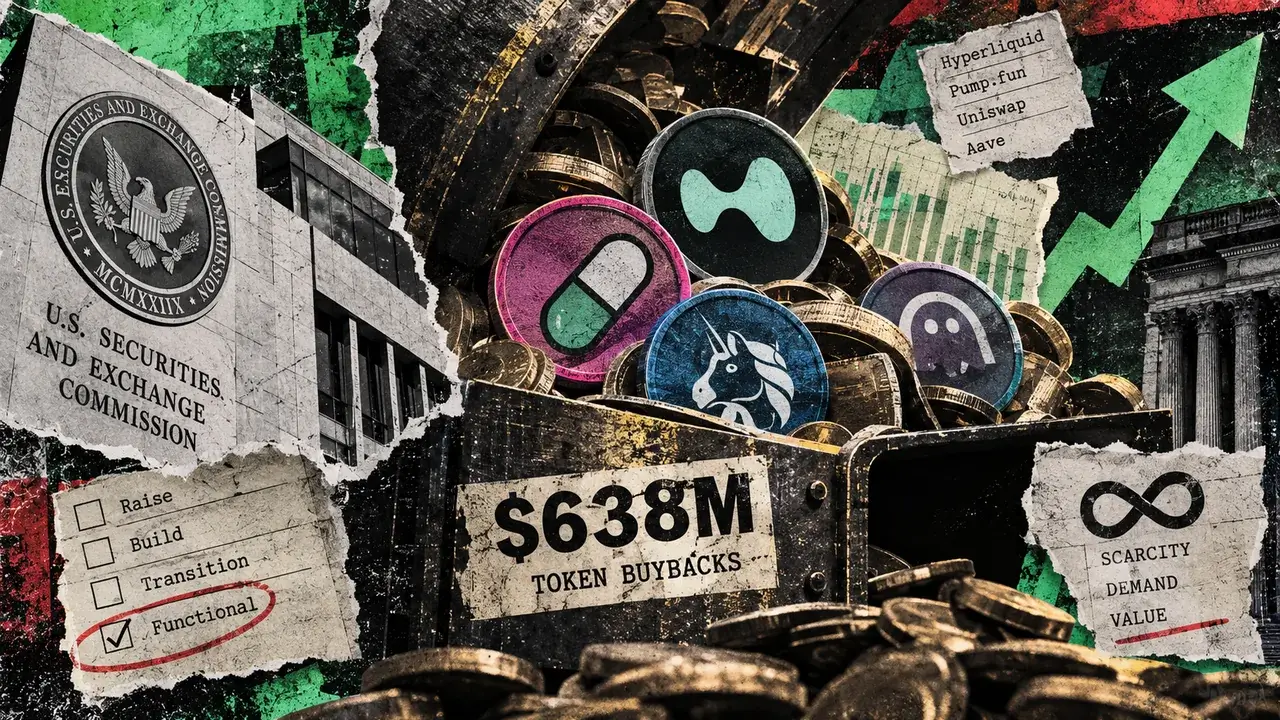
SEC clears regulatory hurdle as crypto token buybacks hit record $638 million
Crypto projects spent about $638 million with token buybacks through late August 2026, according to Allium Labs data. That is alre...

HIFI Raises $37M To Build Stablecoin And Tokenized Market Infrastructure
HIFI has raised a $37 million Series A led by Left Lane Capital. The company says the funding will expand stablecoin payments, car...

Bitcoin survives a 5.2% Treasury shock as traders slash $1.7 billion in leverage
Bitcoin is holding near $84,000 even as a historic US bond selloff pushes Treasury yields to decades-high levels. The benchmark 10...

Fed proposed stablecoin rule could trigger a 48-hour liquidation run
The Federal Reserve's proposed rules for the payment stablecoin issuers it supervises include a crisis clock measured in hours. An...

Washington has $114 billion reasons to want Tether around
Not that long ago, Washington fined Tether for misleading people about the dollars behind its tokens. Today, the company's insatia...