IMF Sees Significant Increase in Correlations Between Bitcoin and Asian Equity Markets
Officials at the International Monetary Fund (IMF) say that the correlation between the performance of the Asian equity markets and crypto assets such as bitcoin and ethereum has increased significantly. IMF Staff on Cry...
Archive context
Older archive item. Useful for background and entity history, but not a fresh market-moving signal.
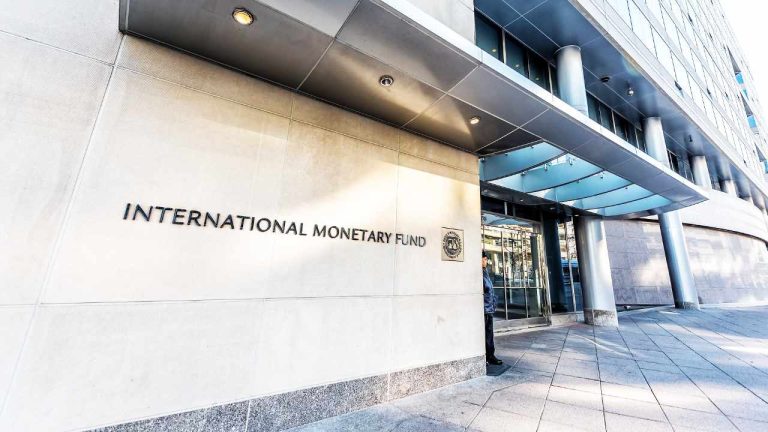
Officials at the International Monetary Fund (IMF) say that the correlation between the performance of the Asian equity markets and crypto assets such as bitcoin and ethereum has increased significantly.
IMF Staff on Crypto and Correlation to Asian EquitiesThe International Monetary Fund (IMF) published a blog post on Monday on cryptocurrency regulation and how crypto is now “more in step with Asia’s equities.”
Anne-Marie Gulde-Wolf, deputy director of IMF’s Asia and Pacific Department, Nada Choueiri, the mission chief for India, and Tara Iyer, an economist in the global financial stability analysis division of the IMF’s Monetary and Financial Markets Department, authored the post.
“While the returns and volatility correlations between bitcoin and Asian equity markets were low before the pandemic, these have increased significantly since 2020,” they wrote. “Crypto trading, however, soared as millions stayed home and received government aid, while low interest rates and easy financing conditions also played a role.”
They detailed:
As Asian investors piled into crypto, the correlation between the performance of the region’s equity markets and crypto assets such as bitcoin and ethereum has increased.
The IMF officials noted that for example, “the return correlations of bitcoin and Indian stock markets have increased by 10-fold over the pandemic, suggesting limited risk diversification benefits of crypto.” In addition, “The volatility correlations have increased by 3-fold.”
The IMF officials further noted that “the rise in crypto-equity correlations in Asia has been accompanied by a sharp rise in crypto-equity volatility spillovers in some Asian countries,” elaborating:
This indicates a growing interconnectedness between the two asset classes that permits the transmission of shocks that can impact financial markets.
The IMF officials also asserted that “Regulatory frameworks for crypto in Asia should be tailored to the main uses of such assets within the countries.”
The authors added, “They should establish clear guidelines on regulated financial institutions and seek to inform and protect retail investors,” elaborating:
Finally, to be fully effective, crypto regulation should be closely coordinated across jurisdictions.
What do you think about the comments by the IMF officials? Let us know in the comments section below.
Why this matters
This bitcoin story adds another data point to the current market tape and is useful when read alongside nearby source coverage.
Original source
Read on Bitcoin NewsRelated market context
SEC clears listing of Volatility Shares’ 3x Bitcoin and Ether ETFs
The SEC's approval of 3x crypto ETFs could increase market volatility and attract speculative trading, impacting broader financial...

Binance Founder CZ Makes Shocking Claim About AI Hacking: “No Crypto Wallet Is 100% Safe”
The comments followed two X posts in which CZ discussed the limits of digital security and AI risks, highlighting phishing and soc...
China Sets 2030 Deadline for National Blockchain Network Despite Sweeping Crypto Ban
Key Takeaways: Under the new 5-year digital strategy, China aims to achieve a national blockchain network which will be largely co...

OpenAI faces financial scrutiny amid reduced valuation and discounting strategy
OpenAI's financial strategies and valuation adjustments may signal deeper liquidity issues, raising concerns about its long-term v...
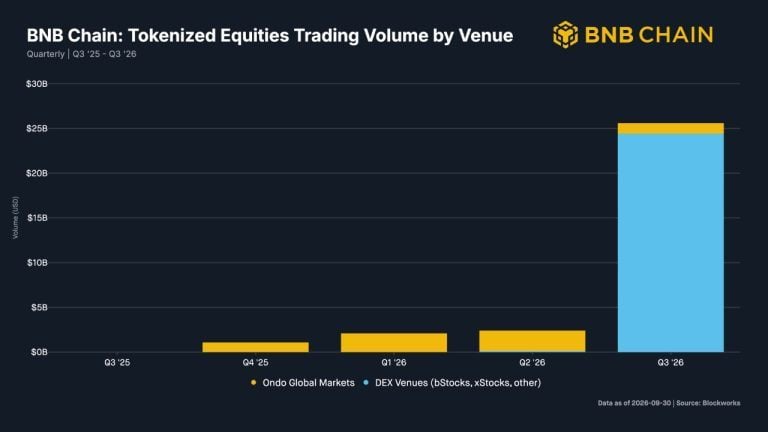
BNB Chain Tops Solana, Robinhood as Equity Volume Jumps 11x to $25.6B
BNB Chain emerged as the leading blockchain for tokenized equities in the third quarter, with trading volume surging to about $25....

Injective CEO meets White House, SEC and CFTC officials on onchain finance
The meetings highlight a potential shift towards regulatory acceptance, potentially paving the way for institutional adoption of D...