Is The $9B $BTC Whale Sale Driven by Quantum Fear? BMIC Offers The Shield
What to Know: $9B $BTC whale sale may signal early institutional de-risking from legacy encryption vulnerabilities ahead of quantum advancements. The ‘Harvest Now, Decrypt Later’ threat means encrypted data is being stol...
Archive context
Older archive item. Useful for background and entity history, but not a fresh market-moving signal.

- $9B $BTC whale sale may signal early institutional de-risking from legacy encryption vulnerabilities ahead of quantum advancements.
- The ‘Harvest Now, Decrypt Later’ threat means encrypted data is being stolen today to be cracked by future quantum computers.
- BMIC provides the first complete financial stack (wallet, staking, payments) secured by post-quantum cryptography and Zero Public-Key Exposure.
- The project utilizes ERC-4337 smart accounts and AI-driven threat detection to secure assets against both current hacks and future quantum decryption.
When $9B worth of Bitcoin moves in a single week, people notice.
Usually, the standard explanations are rolled out. But a quieter, darker narrative is bubbling up in institutional circles: the looming threat of quantum computing.
While the retail market stares at daily price charts, it could be posited that forward-thinking whales might be de-risking from legacy cryptographic standards early.
However, Galaxy Digital denied that it was the case in this instance. Alex Thorn, Galaxy’s Head of Research, posted about the erroneous connection on the social media platform X. Thorn posted in a bid to clarify speculation from other X users who had potentially misinterpreted Galaxy CEO Michael Novogratz in a recent interview.
The anxiety around quantum computing centers on the ‘Harvest Now, Decrypt Later’ (HNDL) strategy. Actors aren’t waiting; they are collecting encrypted blockchain data today to unlock it once quantum processing power matures.
Bitcoin and Ethereum currently rely on Elliptic Curve Cryptography (ECC), a standard that secures assets against classical computers but remains mathematically vulnerable to Shor’s algorithm. If a wallet’s public key has been exposed, which happens after just one outgoing transaction, that address is theoretically compromised in a post-quantum future.
The market has created a vacuum for a solution that bridges current DeFi usability with next-generation security. Into this gap steps BMIC ($BMIC), a project explicitly engineered to immunize digital assets against the inevitable quantum leap.
By integrating post-quantum cryptography (PQC) directly into the wallet and staking layer, the project offers an immediate hedge against the very threats causing unease at the top of the food chain.
BMIC Addresses The ‘Harvest Now’ CrisisMost crypto security solutions obsess over phishing or smart contract bugs, completely ignoring the existential threat of cryptographic obsolescence. BMIC ($BMIC) is different. It offers a platform that combines a wallet, staking interface, and payment rail protected entirely by post-quantum cryptography.
This matters because the HNDL threat is active today; your data is already being scraped. BMIC mitigates this through a ‘Zero Public-Key Exposure’ protocol. It means that even if a quantum computer attacks the network, the mathematical leverage points required to derive a private key simply don’t exist on-chain.
Under the hood, the architecture uses ERC-4337 Smart Accounts paired with proprietary PQC algorithms. This allows you to interact with Ethereum without the legacy vulnerabilities inherent in standard accounts.
For enterprises and developers, the project offers an AI-Enhanced Threat Detection system. It creates a dual-layer defense: AI monitors for behavioral anomalies in real-time, while the cryptographic layer ensures the mathematical integrity of the assets remains unbreakable.
The utility here goes deeper than simple storage. The $BMIC token serves as ecosystem fuel for the first fully quantum-secure finance stack. While Bitcoin relies on soft forks to eventually address quantum threats, a notoriously slow and politically fraught process, BMIC provides a native solution built for that specific purpose.
For investors watching whales move billions, the project represents a technological safe harbor.
CHECK OUT $BMIC ON ITS OFFICIAL PRESALE PAGE
Early Adopters Secure Positions As Presale Crosses $432KThe market’s hunger for infrastructure-level security plays is showing up in the early capital inflows. $BMIC has successfully raised over $432K. This figure indicates a growing divergence.
While retail investors chase meme coins, sophisticated participants are allocating capital toward infrastructure that solves the ‘encryption cliff.’
Right now, the token sits at $0.049474. It’s a relatively low entry point given the project’s positioning at the intersection of two high-growth narratives: Artificial Intelligence and Quantum Security.
The presale structure allows you to acquire a stake in the protocol before the ‘quantum threat narrative hits mainstream news cycles, likely when the first major quantum breakthrough hits the headlines. With security requirements changing, $BMIC could become the best long-term crypto investment.
The tokenomics support a long-term hold thesis, integrating staking and governance that are themselves quantum-secure. This resolves a major paradox in current DeFi: staking often requires hot wallet signatures that expose public keys. By allowing users to stake without exposing these keys, the project unlocks a new tier of institutional participation known as ‘Burn-to-Compute.’
As the presale advances, the focus shifts from concept to deployment, offering a tangible hedge for those concerned that the $9B $BTC movement is just the first tremor of a larger cryptographic shift.
BUY YOUR $BMIC NOW FOR $0.049474
The content provided in this article is for informational purposes only and does not constitute financial advice. You should conduct your own due diligence and before making investment decisions.
Why this matters
Bitcoin is showing up inside the Security Incidents theme, so this story is worth tracking for follow-through rather than treating it as a one-off headline.
Original source
Read on NewsBTCRelated market context
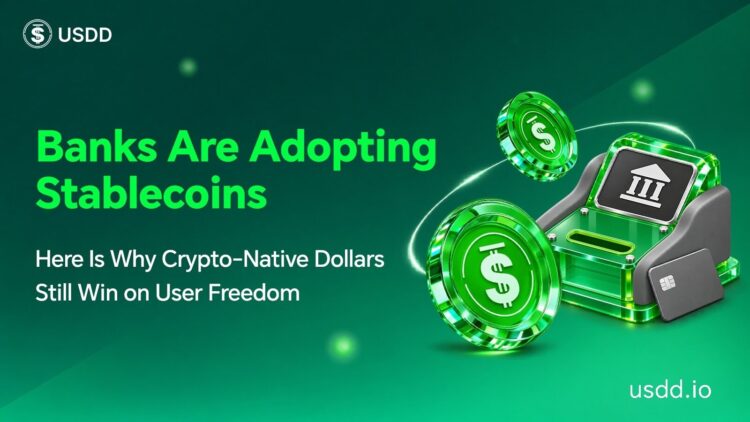
As traditional giants rush into digital dollars, USDD’s Yvonne Chia explains why 24/7 access, self-custody, and transparent yield give decentralized stablecoins an edge banks can’t replicate. 20 November – Road Town, Totorla, British Virgin Islands – Decentralized stablecoin protocol USDD is accelerating its multichain utility across TRON, Ethereum, and BNB Chain—combining automated sUSDD yield via its Smart Allocator with GasFree zero-TRX transfers—as traditional financial giants race to build competing stablecoin rails. In a recent industry interview with instant exchange partner ChangeNOW, USDD Head of Communications Yvonne Chia outlined why self-custody, 24/7 settlement, and transparent onchain reserves give decentralized digital dollars a structural advantage over bank-issued alternatives. 1. Permissionless Access vs. Gatekept Accounts For billions of people globally, opening and maintaining a traditional bank account still involves paperwork, minimum balance requirements, geographic restrictions, and approval delays. Even when banks integrate stablecoin rails behind the scenes, those services remain gated behind legacy compliance walls and intermediary control. Crypto-native stablecoins flip that model on its head. As Yvonne Chia highlighted during the interview: “Compare this to a stablecoin like USDD, where all you need is a phone, a working internet connection, you can immediately start a wallet and you have access to your funds right away.” With USDD, users can access and manage their digital dollars directly through their own wallets, without depending on traditional financial intermediaries. This represents a fundamental shift in financial access: users are no longer limited to the services, operating hours, or account structures of a single institution. Instead, they have the freedom to hold, manage, and transfer their assets on their own terms. Self-custody also gives users greater autonomy over their financial decisions. They can choose which wallets to use, where to transfer their assets, and which supported decentralized applications to interact with, without needing to route every transaction through a centralized financial institution. With USDD, users’ digital dollars can move with them across an open blockchain ecosystem, rather than remaining tied to a particular bank or service provider. 2. 24/7 Global Settlement vs. “Banking Hours” Legacy payment networks still operate on decades-old schedules: weekend cutoffs, bank holidays, and multi-day cross-border settlement delays accompanied by hefty wire fees. Blockchain networks never close. Whether it is a Sunday night or a public holiday, USDD moves globally without depending on traditional banking operating hours or settlement windows. “We are able to have transfers 24/7 and we’re not limited to any traditional banking hours. So I think that in some ways, stablecoins are not just becoming banks, but exceeding what traditional banks can offer to users.” To make everyday transfers even smoother than fintech apps, USDD introduced GasFree integration on TRON, allowing users on supported wallets to pay network fees directly in USDD without needing to hold TRX. This removes another practical barrier to stablecoin adoption: having to acquire and maintain a separate gas token just to transfer digital dollars. With GasFree, eligible users can pay approximately 0.5 USDD per transaction, compared with around 1.5 USDT for a standard USDT transfer under the referenced fee conditions. These improvements matter because the usefulness of a stablecoin is not determined by its peg alone. Low-cost transfers, straightforward wallet experiences, and around-the-clock availability are what make digital dollars practical for everyday payments and global value transfers. 3. Passing Yield Back to Users vs. Bank Spreads Perhaps the sharpest contrast between banks and decentralized stablecoins lies in how yield is distributed. In traditional banking, institutions take customer deposits, deploy them into yield-generating markets, and retain a significant portion of the returns. Everyday depositors may receive relatively low interest rates, while higher-yielding products often come with eligibility requirements, minimum deposits, or fixed maturity periods. Stablecoins introduce another way to participate in digital-dollar opportunities. Rather than keeping capital entirely within a traditional deposit account, users can access onchain yield opportunities through decentralized protocols and transparent investment mechanisms. USDD was built to return that value directly to holders. Through USDD Earn, users can deposit USDD to receive sUSDD, earning automated, competitive yield powered by our Smart Allocator system, with no fixed lock-up periods restricting access to their capital. For users, the distinction is important: USDD Earn provides access to a productive stablecoin while maintaining flexibility, rather than requiring users to commit their capital to a conventional fixed-term product. 4. Onchain Verification vs. Institutional Trust Traditional banks ask customers to trust closed-door balance sheets and periodic regulatory filings—until a crisis proves otherwise. USDD takes a different approach through its “Don’t trust, verify” ethos, emphasizing publicly accessible onchain information and independent verification. Onchain Transparency: Smart contract addresses, collateral reserves, and Smart Allocator deployments are publicly viewable, allowing users to examine relevant information directly on the blockchain. Structured Disclosures: Quarterly Treasury Reports provide additional information about reserve positions, financial performance, and operational developments. Independent Security Reviews: USDD undergoes third-party security audits to assess its smart contracts and identify potential vulnerabilities. Transparency does not eliminate financial or technical risks, but it changes how users can evaluate them. Instead of relying exclusively on an institution’s assurances, users have access to information that can be independently examined and verified. 5. Beyond a Single Network: An Open, Multichain Financial Ecosystem Financial freedom is not just about holding digital dollars. It is also about being able to use them wherever opportunities and applications exist. A stablecoin confined to a single network or limited use case cannot fully realize the potential of open blockchain finance. Following its January 2025 protocol upgrade, USDD expanded natively from TRON onto Ethereum and BNB Chain, extending its reach across multiple blockchain ecosystems. This multichain presence allows USDD to connect with different communities, liquidity environments, and decentralized applications. Its sUSDD product has also expanded into DeFi integrations, including Pendle and Morpho, giving users additional ways to access yield strategies across supported ecosystems. The bigger picture is an interconnected financial ecosystem in which users can move between holding, transferring, exchanging, and deploying their stablecoins according to their own needs. These are not isolated functions. Together, they make stablecoins more useful as everyday financial infrastructure. The Future: Interconnected, Open, and Multichain Banks will undoubtedly continue using stablecoin rails to modernize their back-end settlement. However, true financial freedom comes from open networks where assets flow freely across protocols without intermediaries. For USDD, the opportunity goes beyond offering a dollar-pegged asset. It is about making digital dollars accessible, transferable, and productive across an interconnected financial ecosystem. From self-custody and 24/7 transfers to flexible yield opportunities and multichain DeFi access, these capabilities give users more ways to put their money to work. Banks may be bringing stablecoins into traditional finance. Crypto-native protocols are showing what stablecoins can make possible beyond it.
As traditional giants rush into digital dollars, USDD’s Yvonne Chia explains why 24/7 access, self-custody, and transparent yield...
Researchers Publish Security Analysis of Bitcoin’s Post-Quantum SHRINCS Proposal
Bitcoin Magazine Researchers Publish Security Analysis of Bitcoin’s Post-Quantum SHRINCS Proposal Several researchers have publish...
Coinbase Institutional: US dollar was the lone gainer as Bitcoin and Ethereum led monthly losses
Crypto market volatility highlights investor preference for stability, with institutions consolidating into perceived safer assets...

Ark buys $90 million worth of Anthropic shares on debut, trims Ethereum and Solana staking ETF holdings
Ark Invest bought nearly 1 million Anthropic shares and trimmed its Ethereum and Solana staking ETF holdings.

Ledger CTO Charles Guillemet Exits After Nine Years, Warns AI Is Changing Crypto Security
Key Takeaways: Charles Guillemet, CTO will be exiting the company at the end of 2026. He contributed to the development of Ledger...

Ethereum Devs Lean Toward Shipping Glamsterdam as Is, Push Hoodi Testnet Decision to Next Week
Ethereum’s core developers leaned toward shipping Glamsterdam, the network’s next hard fork, with its contested gas repricing unch...