Liquid For Bitcoiners: Confidential Transactions
Many Bitcoiners hope to one day be able to send bitcoin on-chain in a private manner: for now, Liquid can help with confidential transactions.Hardcore Bitcoiners are understandably skeptical about Blockstream’s Liquid si...
Archive context
Older archive item. Useful for background and entity history, but not a fresh market-moving signal.
Many Bitcoiners hope to one day be able to send bitcoin on-chain in a private manner: for now, Liquid can help with confidential transactions.
Hardcore Bitcoiners are understandably skeptical about Blockstream’s Liquid sidechain. But as the Bitcoin ecosystem grows, we’re going to need more services backed by Bitcoin that the Bitcoin network itself can’t provide. Liquid is a semi-centralized side chain that — crucially — has no unnecessary shitcoin. This blog series will discuss some of the use cases that are now possible through Specter Hardware and Specter Desktop’s integration with Liquid that might interest Bitcoiners the most.
Confidential TransactionsThe possibility of having fully private, on-chain hidden transactions in Bitcoin has been discussed for years. But don’t expect this to come anytime soon — if ever. The Bitcoin ecosystem is wary of experimentation on the Bitcoin base layer. We need to move slowly and be as careful as possible.
Indeed, as Alex Gladstein recounts in his recent article, “The Quest For Digital Cash” for Bitcoin Magazine, cypherpunk Adam Back early on “realized it would be extremely difficult to implement CT [Confidential Transactions on Bitcoin], as the community understandably prioritized security and auditability over privacy.” So Adam Back and Greg Maxwell teamed up to found Blockstream, in large part to implement confidential transactions on a Bitcoin sidechain. That sidechain is called Liquid and has been running since November 2018.
Confidential assets and transactions on Liquid keep the amount and type of assets transferred visible only to participants in the transaction. Yet they still cryptographically guarantee that no more coins can be spent than are actually available.
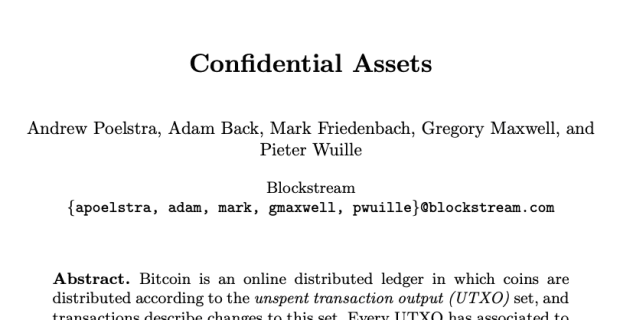
Confidential Assets whitepaper. Just a few recognizable names in that list. Probably nothing.So as CoinJoin will continue to be a powerful tool in the privacy-focused Bitcoiner’s arsenal, it’s worth familiarizing yourself with the privacy features of Liquid confidential transactions. You “peg-in” some bitcoin to Liquid and receive an equivalent amount of L-BTC on the Liquid sidechain. Additionally, a growing number of exchanges will let you easily withdraw your bitcoin as L-BTC. You can then send your L-BTC confidentially to any recipient Liquid wallet. These transactions are inexpensive and very fast. The recipient can then deposit the L-BTC into their own Liquid-supported exchange or “peg-out” back to normal on-chain bitcoin.
Give it a try in Specter with a small test amount. See what information can and cannot be traced as you move from Bitcoin to Liquid and across confidential transactions. You’re not gaining perfect privacy here, but certainly improved privacy.
Someday, hopefully soon (hint, hint developers!) we’ll see a CoinJoin implementation that is built on Liquid confidential transactions. Any amount — of any asset! — go into the mix and whatever comes out would have no deterministic traceable link whatsoever. At this point you maybe would have near-perfect privacy at an even lower cost than current on-chain CoinJjoin implementations.
Privacy Best Practices: Coinjoin, Lightning, LiquidCoinbase and other exchanges know how much bitcoin you bought and on which UTXOs these bitcoin sit. This data is shared with chain surveillance companies that are analyzing on-chain transaction paths, selling their services to malicious players. This data will sooner or later leak out or get hacked and will find its way to a darknet market.
For financial privacy, any working capital operations with bitcoin of a company or an individual should be CoinJoined first and then pushed out for payment operations to Lightning and Liquid. For cold storage, bitcoin should be held in an on-chain wallet and not on the federated sidechain of Liquid. Lightning channels are for facilitating payments, not storing value. Lightning hot wallets have their private keys always online and still need improved hardware backend security. Meanwhile Liquid allows one to move high value amounts of bitcoin with confidential transactions, while keeping keys in air-gapped multisig wallets.
Since the Bitcoin on-chain layer will become very busy and quite expensive to operate on, using Lightning and Liquid will not only be necessary for improved privacy, but also from an economic perspective to optimize for an efficient use of the Bitcoin blockchain. Frequent payment transactions will get pushed out to Lightning and Liquid, while on-chain transactions will happen for high-value hodling, CoinJoin, and settlement purposes.
How To Get Started:- Update to the latest Specter Desktop release v1.7.0
- Run a local Elements “Liquid” node (current chain size: ~17GB)
- Create a hot wallet for Liquid in Specter Desktop
- Or check out the Liquid supporting hardware wallets: Blockstream Jade or Specter's Hardware Wallet
- You can assemble a Specter HWW yourself with off-the-shelf components (see shopping list) or buy pre-assembled kits at SeedSigner’s shop or the DIYnodes shop
This is a guest post by Moritz Wietersheim. Opinions expressed are entirely their own and do not necessarily reflect those of BTC Inc or Bitcoin Magazine.
Why this matters
This bitcoin story adds another data point to the current market tape and is useful when read alongside nearby source coverage.
Original source
Read on Bitcoin MagazineRelated market context

Holders face permanent token destruction with no guarantee of value as deadline looms for Shade’s privacy protocol
Shade Protocol says only SHD burned before 18:00 UTC on Aug. 21 will qualify for a future Feather allocation, leaving holders hour...

Unresolved $11 million liquidity crash leaves pools exposed as attacker still holds 20.83 BTC on Maya Protocol
The suspected Bitcoin address at the center of Maya Protocol’s Aug. 18 exploit still held about 20.8273 BTC with no outgoing spend...

Abraxas Capital builds $783M short positions on Hyperliquid, hedges with $173M in ETH withdrawals
Abraxas Capital's strategy highlights the potential for significant market influence and volatility through large-scale hedging an...

Hyperliquid generates $6M in fees in a day, surpassing top five blockchains
Hyperliquid's fee surge underscores its growing market influence, potentially reshaping blockchain dynamics and investor confidenc...

Trump: CFTC explores legal path for Hyperliquid in US, HYPE surges 41%
The CFTC's exploration of regulatory paths for Hyperliquid could boost crypto market confidence, potentially driving further inves...

Xaman Wallet reportedly eyes minimum fee removal to boost XRP Ledger liquidity
Xaman Wallet's fee removal could democratize access to XRP Ledger, potentially increasing participation and liquidity in the ecosy...