Nothing's Cheaper Than Proof-Of-Work Consensus
All roads lead to proof-of-work because it is the most efficient and fairest way to come to consensus, without having a rich-get-richer problem.This is a transcribed excerpt of the “Bitcoin Magazine Podcast,” hosted by P...
Archive context
Older archive item. Useful for background and entity history, but not a fresh market-moving signal.
All roads lead to proof-of-work because it is the most efficient and fairest way to come to consensus, without having a rich-get-richer problem.
This is a transcribed excerpt of the “Bitcoin Magazine Podcast,” hosted by P and Q. In this episode, they are joined by Paul Sztorc to break down why all roads lead to proof-of-work and how proof-of-stake protocols are fooling themselves by thinking that proof-of-stake technology can stay decentralized and secure.
Watch This Episode On YouTube Or Rumble
Listen To The Episode Here:
P: Start by defining at a high level what we mean when we say proof-of-work versus proof-of-stake. How would you define proof-of-work and how would you define proof-of-stake?
Paul Sztorc: It's fine because it’s the point of my article. Proof-of-work is you do this one type of computation over and over again. So your computer is working very hard. There's no other way to do it, it's just based on quantity. How many times can you do this SHA256 hash? You're doing it really fast, and every two weeks the bottom performers are fired. So basically, since you are just doing a computation a lot, it comes down to the electricity you spend, the money you spend on hardware, physical chips, the money you pump in to cool the chips, and it's basically like you're running your computer, you're making your computer work really hard.
This doesn't happen so much anymore, but in the olden days, you would be using your computer and it would just make little sounds, but then if you fired up a game — something that was intensive — the fan would go crazy and it would start to make more noise because the computer’s working really hard. So that's the work; that poor computer is working really hard instead of doing nothing or only working when you ask it to. It's going 100% trying to just churn out as much as possible.
In proof-of-stake, the idea is in the reality of the cryptosystem, in the reality of the blockchain or in the reality of the coin, in that reality of the full node software, it knows somehow — which is part of the problem, this somehow — but it knows who has which coins and it also knows who stakes which coins. These people put the coins into a sort of hazardous state, a hazardous box. They stake the coins. They say, “I buy in” with a certain amount, and then they join this — what would be — class of miners in their world.
They have a certain amount of coins staked and then there's a complicated lottery system. There are many variants, but in general, it's like the more money you stake, the more likely you are to be chosen. When you're chosen, you have the ability to create the next block and then create the reward because you get a shot of that $10 billion.
Why this matters
This bitcoin story adds another data point to the current market tape and is useful when read alongside nearby source coverage.
Original source
Read on Bitcoin MagazineRelated market context
CoinShares BTF Liquidation Sets Cash Payout And Earlier Options Expiry
TL;DR: CoinShares’ Bitcoin and Ether ETF has reached cash settlement. An OCC notice confirms the payout and brings later-dated BTF...

Blumenthal Asks Tether to Detail Every Payment to Nxum, Bo Hines’ Consulting Firm
Sen. Richard Blumenthal (D-Conn.), the ranking member of the Senate Permanent Subcommittee on Investigations, demanded records on...

Kraken wants to be your bank, but who will protect your money?
Kraken's parent company wants a place in your finances long before you buy Bitcoin and long after you sell it. On Oct. 14, Payward...
Bitcoin’s Fed Week Starts With A Fresh Rise In US Inflation Expectations
TL;DR: US household inflation expectations rose in October while consumer sentiment barely changed. The readings add context ahead...

Keystone Hardware Wallet says website breach exposed customer data
The breach highlights the ongoing vulnerability of customer data in the crypto industry, emphasizing the need for enhanced securit...
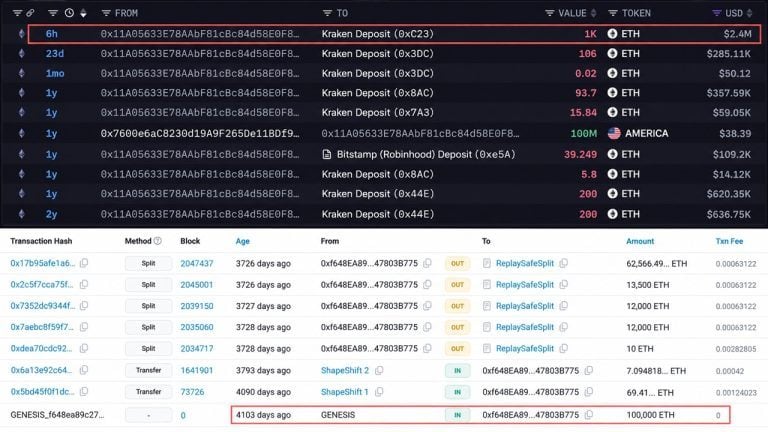
Whale That Bought 100,000 ETH for $0.31 Each Just Sent $2.4M to Kraken
An Ethereum initial coin offering (ICO) buyer who bought 100,000 ETH at $0.31 each just moved another 1,000 ETH, worth about $2.4...