Senate tax bill frees stablecoin spending while Bitcoin stays on IRS forms
A coffee bought with a qualifying dollar stablecoin would avoid gain-or-loss recognition under the ADAPT Act that Sen. Steve Daines released Sept. 30. The same coffee bought with Bitcoin would still trigger the cost-basi...
Archive context
Older archive item. Useful for background and entity history, but not a fresh market-moving signal.
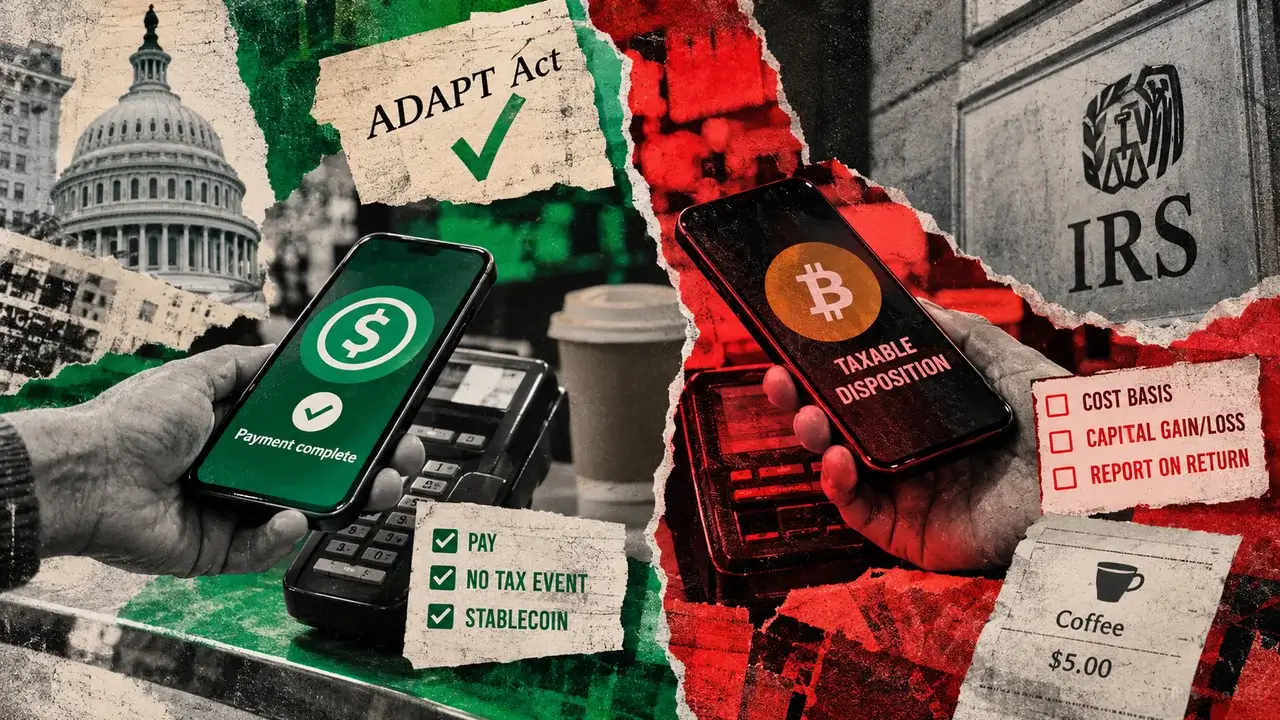
A coffee bought with a qualifying dollar stablecoin would avoid gain-or-loss recognition under the ADAPT Act that Sen. Steve Daines released Sept. 30. The same coffee bought with Bitcoin would still trigger the cost-basis calculation and capital gain or loss reporting that attach to spending digital assets.
Bloomberg Law reported Sept. 25 that Daines had circulated a draft and expected to introduce it the next week. The 56-page text released Sept. 30 carries the title Aligning Digital Assets with Principles of Taxation Act and lists Sens. Cynthia Lummis, Bernie Moreno and Tim Scott of South Carolina as cosponsors.
Under current IRS guidance, paying for goods or services with digital assets in any amount is a disposition. Holders of personal or investment assets must calculate and report capital gain or loss, which depends on the asset's value and cost basis.
A payment can produce a gain, a loss, or a break-even result, and the IRS uses a cup of coffee as its own example. A $5 Bitcoin purchase with an allocated basis of $3 produces a $2 capital gain that belongs on the return.
What qualifies as a covered stablecoinNew section 1034 of the tax code would treat the disposition of covered payment stablecoins to buy products or services as a nonrecognition event. The relief covers gain or loss on the token itself, and sales taxes and other purchase obligations stay in place.
The token must be a qualified US dollar stablecoin, meaning one issued by a permitted payment stablecoin issuer under the GENIUS Act.
A foreign issuer qualifies through OCC registration or a Treasury finding that its home regime is comparable. It must appear in Treasury's most recent report before the payment, and the taxpayer must have acquired it at a price within 3% of $1.00.
Treasury would publish that report at least every three months, listing each qualified stablecoin actively traded within 3% of $1.00 during the 12 months ending the prior month. Users and payment companies would check the latest list when making a purchase.
Traders, brokers, and dealers in qualified dollar stablecoins are excluded, along with taxpayers using a functional currency other than the dollar, and Treasury could extend the trade-or-business exclusion to similar businesses.
Taxpayers must keep records that distinguish eligible payments from other transactions. Covered payments would be exempt from broker information returns under section 6045(i)(1), and brokers could rely on customer certifications and skip verifying the 3% acquisition test for tokens bought elsewhere. The stablecoin provision applies to transactions entered into starting Jan. 1, 2027.
Bitcoin keeps its paperwork, with one fee carve-outSection 1034 covers stablecoins, so a Bitcoin payment at checkout remains a taxable disposition, while Section 11 adds a narrower rule for fees.
Under new section 1044, coins disposed of to pay digital asset transaction costs would escape gain-or-loss recognition when the aggregate value of the assets used for those costs is $10 or less. Base, gas, and priority fees count as costs, and related transactions are aggregated.
Exclusions apply to traders, brokers and dealers, businesses that batch transactions or help validate them for others, and assets under mark-to-market accounting. Anyone who initiated more than 5,000 digital asset transactions in the prior taxable year is also excluded.
The fee exception takes effect for dispositions starting Jan. 1, 2027, the same date as the stablecoin relief. On a Bitcoin coffee, the sliver of BTC paid as a network fee could qualify, and the coins sent to the merchant remain a taxable disposition.
The bill also exempts qualified dollar stablecoins from the wash-sale and constructive-sale rules it extends to other digital assets.
Related Reading Congress wants to make crypto easier to use and still collect $500 million more in taxes Earlier bills used dollar thresholdsEarlier proposals sought to reduce tax friction for qualifying personal crypto transactions through monetary thresholds.
Sen. Ted Budd's S.4171, introduced March 24, would require both transaction value and otherwise recognized gain or loss to be $200 or less. Related transactions would be aggregated, with exclusions including business-property and cash-equivalent exchanges.
Lummis's S.2207, unveiled in July 2025, sets a $300 ceiling on both transaction value and recognized loss and ends further exclusions once qualifying annual gains exceed $5,000.
The House PARITY Act proposed a $200 threshold for stablecoin transactions. Lummis now cosponsors a text that ties relief to eligible stablecoins at any purchase size.
The House has a separate proposal. H.R.10357 was introduced Sept. 14, and Ways and Means announced committee approval by 38-5 on Sept. 16. Its stablecoin redemption-value accounting and qualifying $10 fee relief are distinct mechanisms, and committee approval is a step before any House vote.
What happens next for stablecoin and BitcoinThese remain proposals, and current IRS treatment stays in force. The text leaves Treasury to set the mechanics, including the quarterly list, recordkeeping, and broker reporting rules. It borrows its issuer definitions from the GENIUS Act, so which tokens qualify will follow issuer approvals under that law.
For everyday users, the Daines text draws its line around the asset a customer pays with, at any purchase size. A $5 coffee on a qualifying stablecoin would fall outside gain-or-loss recognition, and the same coffee on Bitcoin would stay in the capital-gains system.
The post Senate tax bill frees stablecoin spending while Bitcoin stays on IRS forms appeared first on CryptoSlate.
Why this matters
Bitcoin is showing up inside the Stablecoins theme, so this story is worth tracking for follow-through rather than treating it as a one-off headline.
Original source
Read on CryptoSlateRelated market context
Square Tech and GOAT Network Sign MOU to Advance AI Agent-Powered Stablecoin Payments in South Korea
Bitcoin Magazine Square Tech and GOAT Network Sign MOU to Advance AI Agent-Powered Stablecoin Payments in South Korea Square Tech...

Shinhan Card, SBI-Affiliated Crypto Firms Plan Yen Stablecoin Tests for In-Store Payments
Shinhan Card, the credit card arm of South Korea’s Shinhan Financial Group, signed a memorandum of understanding with two Japanese...
MoonPay And Dunamu Explore Stablecoin Payments And GIWA Expansion
TL;DR: MoonPay and Dunamu are exploring stablecoin payments, corporate treasury services and broader access to GIWA. Their announc...

TRON Settles $2.2T in Q3, Captures 73% of All Stablecoin Volume as First TRX ETF Launches: CoinDesk and Nansen
Geneva, Switzerland, October 22, 2026 — TRON reinforced its position as a leading blockchain network for stablecoin settlement in...

Tether Backs Peso to Expand USDT Payments Across 4 Major Latin American Markets
Key Takeaways: Tether led the pre-seed investment of Bolivian fintech Peso for the growing USDT payment infrastructure. Today Peso...

Reflect Money launches Create for custom yield-bearing stablecoins on Solana
Reflect Money's Create tool could revolutionize stablecoin utility on Solana, potentially transforming idle assets into active rev...