Starcloud wants to mine bitcoin in space — what could go wrong?
As the AI hype train rumbles on, venture capitalists and private equity are pouring more and more money into sillier and sillier ideas. Recently, Starcloud, a data centers-in-space company, has received nearly half a bil...
Archive context
Older archive item. Useful for background and entity history, but not a fresh market-moving signal.

As the AI hype train rumbles on, venture capitalists and private equity are pouring more and more money into sillier and sillier ideas.
Recently, Starcloud, a data centers-in-space company, has received nearly half a billion dollars in funding and over a $2 billion valuation for an idea that already seems almost impossible to execute — and it just made it even stupider.
Starcloud has decided to begin mining BTC in space.
Whether you like Bitcoin or hate it, this is crazy. One of the most important aspects of BTC mining has been, and always will be, the ability to obtain the cheapest energy for running miners.
Sometimes this means that mining companies will completely abandon previously profitable locations for new locations, sometimes it will mean replacing every miner they’re currently running, and occasionally it means completely altering the type of energy being utilized (instead of solar, resorting to coal or natural gas, using hydro or wind instead of coal, etc).
Running ASICs in space instantly becomes more expensive than running them on Earth because you have to factor in launch costs, how expensive radiating heat is, an inability to change to an alternative form of energy, and maintenance costs in orbit.
So now Starcloud isn’t only pursuing likely impossible goals in regard to data centers, it’s mining the most expensive BTC in the history of cryptocurrency.
Justin Sun is going to space now that his SEC lawsuit is pausedRead more: Bitcoin’s 90-day correlation with gold hits nine-year high
Starcloud data centers in space is already a bad ideaEven without BTC mining, Starcloud’s entire business model appears to have been debunked by the Institute of Electrical and Electronics Engineers (IEEE) and YouTuber Real Engineering.
If it’s going to be able to realize its ambitious goal of creating gigawatts worth of processing power in space, it would take tens of thousands of launches and require a solar array and radiator cluster that’s four kilometers long and nearly one kilometer wide.
For reference, SpaceX is currently conducting just over 100 launches a year and the International Space Station, which took 13 years to build, is only 100 meters by nearly 100 meters.
On top of this, Starcloud has already sent one Nvidia H100 GPU into space. However, it can’t run it at full power because the satellite gets overheated.
None of the issues and problems discussed so far have even touched on other obstacles facing Starcloud that are unsolvable for now.
For example, even data centers on earth need a steady stream of replacement parts and maintenance, which would both be far more expensive to take care of 500 kilometers away from earth.
Additionally, GPUs would be getting bombarded by far more radiation in orbit than they do in a cooled building on Earth.
This hasn’t stopped the CEO from pumping the concept and having rich people cheering him on. In a recent interview with Y Combinator founders and partners, the group of hyper-wealthy investors sitting around Philip Johnston failed to ask him any difficult questions at all while seemingly being ready to hand over more of their own cash to support him.
This is all to say that if Starcloud accomplishes even a fraction of what it’s set out to do, it will take it well over a decade and cost far more than the half billion it’s raised so far.
Got a tip? Send us an email securely via Protos Leaks. For more informed news and investigations, follow us on X, Bluesky, and Google News, or subscribe to our YouTube channel.
The post Starcloud wants to mine bitcoin in space — what could go wrong? appeared first on Protos.
Why this matters
Bitcoin is showing up inside the Regulation theme, so this story is worth tracking for follow-through rather than treating it as a one-off headline.
Original source
Read on ProtosRelated market context
IREN’s Bitcoin Mining Revenue Falls as AI Cloud Sales Nearly Triple
TL;DR: IREN reported $200 million in quarterly AI Cloud revenue, up from $71 million the previous quarter, while Bitcoin mining re...

Tornado Cash-Linked Wallet Sells ETH to Buy Zcash on Hyperliquid
Key Takeaways: In a 20-hour period, a wallet transferred 1,670 ETH valued at around $3.73 million from Tornado Cash to Hyperliquid...
TeraWulf Says AI Leasing Now Generates 83% of Revenue as Bitcoin Mining Recedes
TL;DR: TeraWulf’s November 6 earnings release shows $63 million in third-quarter high-performance-computing lease revenue, around...
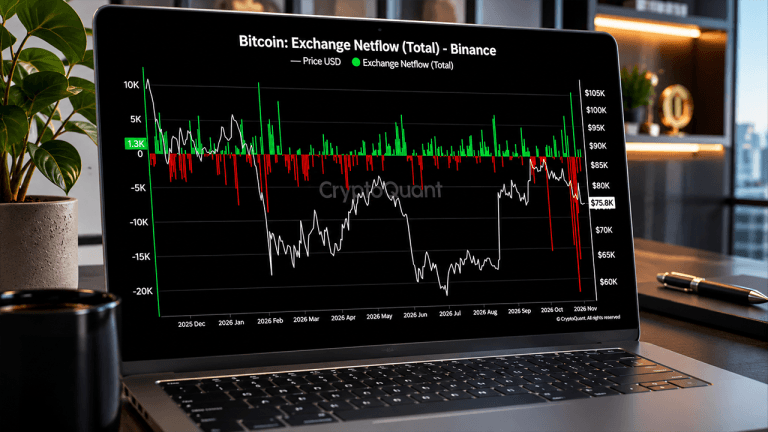
Binance Restores HYPE, APT as Data Reveals Billions in Reserve Outflows
Binance restored withdrawals for the altcoins hyperliquid (HYPE) and aptos (APT) on Sunday, Nov. 8, advancing its recovery from th...
BitFuFu’s October Bitcoin Mining Output Falls Despite Steady Hashrate
TL;DR: BitFuFu produced 137 BTC in October, down from 167 in September, while managed hashrate stayed close to 19.5 EH/s. The mine...

Franklin Templeton Will Use OpenAI ChatGPT to Predict Crypto
In early November 2026, OpenAI published a detailed customer story highlighting how Franklin Templeton, the global asset manager o...