The “China Ban” Is Good For Bitcoin
The Chinese ban of Bitcoin shows that the currency is delivering on its promises to enable freedom, something communism doesn’t appreciate.Today, news surfaced that China had issued a final and complete ban on Bitcoin. H...
Archive context
Older archive item. Useful for background and entity history, but not a fresh market-moving signal.
The Chinese ban of Bitcoin shows that the currency is delivering on its promises to enable freedom, something communism doesn’t appreciate.
Today, news surfaced that China had issued a final and complete ban on Bitcoin. Harsh, it seems, right? Headlines of the likes of “China declares cryptocurrency transactions illegal; Bitcoin price falls” invoke a sense that not only this is big news but also that Bitcoin suffers from it. Well, despite a couple of daily red candles, both are wrong.
China has been trying to ban Bitcoin for years. The first time the Chinese government sought to prohibit the usage of bitcoin in the country took place in 2013, only a few years after Bitcoin was born. Since then, the BTC price in U.S. dollars has catapulted.
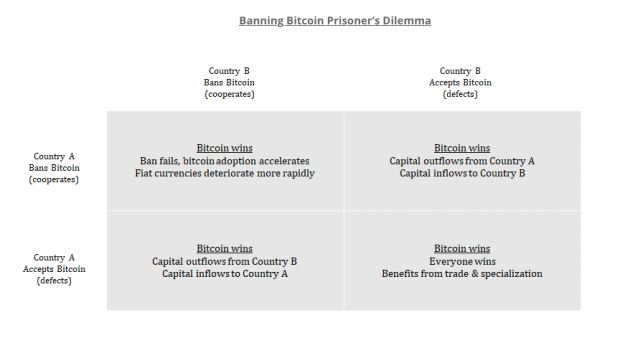
The Chinese Communist Party (CCP) hasn’t understood it yet, but Bitcoin cannot be banned. It is a fool’s errand, not only because Bitcoin is a peer-to-peer, distributed network instead of a centralized, easy-to-be-controlled one, but also because of the game-theoretic aspect of adoption. If one country bans Bitcoin but another welcomes it, capital and people will flock to where they’re treated best. The economic incentives are aligned for a country to accept Bitcoin rather than ban it.
Banning Bitcoin is a fool’s errand — Bitcoin always wins. Image SourceSo why did China take the other route? At the core of the answer is what is perhaps Bitcoin’s main value proposition: individual empowerment in the form of freedom and sovereignty. Unsurprisingly, two qualities that a communist regime despises. Naturally, China’s policies strictly reflect the communist regime’s ability to stay in power and exert overarching influence and control over its people. Anything and everything that threatens these abilities have been and will be suppressed.
The country’s “Great Firewall” has been preventing Chinese people from accessing a wide range of Western websites and platforms for years, including Facebook, Google, and other major tech companies. The strict censorship imposed by communist-ruled China on its people has but one mandate — restrict their access to information and enforce obedience.
Bitcoin is a tool that empowers people. The peer-to-peer network treats everyone equally, regardless of money, power, status, race, religion, or culture. It provides all those who use it with the same sound, censorship-resistant, permissionless monetary system. Bitcoin allows people to store and transact sound money with anyone, anywhere, at any time. Ultimately, Bitcoin enables individual freedom — something communism is far from being fond of.
The news that China has banned Bitcoin shouldn’t — and won’t — hurt the currency, the same way that similar bans to Facebook or Google didn’t hurt them. If anything, it strengthens it. If Bitcoin weren’t suitable to be used as a currency, either as a store of value or a medium of exchange, no government would be going through the trouble to ban it. The fact that China has been taking such severe measures to try and stop Bitcoin and bitcoin mining showcases how powerful this technology is and how scared the CCP is of its potential.
Bitcoin is a tool to fight oppression, and in being so, represents a threat to all governments that seek a high level of control over their citizens. The open-source technology has the potential to dismantle monetary colonialism, unfair policies and restore world peace. By empowering people to reclaim their rights and freedom, Bitcoin is the worst nightmare of all totalitarian governments. It’s no surprise that China has been trying to ban it for so long. But too bad for them; it won’t be this time that they will succeed, Bitcoin will live on.
Why this matters
This bitcoin story adds another data point to the current market tape and is useful when read alongside nearby source coverage.
Original source
Read on Bitcoin MagazineRelated market context

Chamath Palihapitiya Warns Bitcoin Will Hit Zero After Years of Bullish Calls
Chamath Palihapitiya once predicted bitcoin would reach $1 million. Now he says artificial intelligence (AI) will eventually hack...

Parker Lewis: Bitcoin Will Settle 100% of Global Payments
▶Bitcoin Magazine Parker Lewis: Bitcoin Will Settle 100% of Global Payments Parker Lewis says Bitcoin will settle 100% of global p...

Swiss Regulator Approves First Domestic Spot Bitcoin ETF Under Fund Law
TL;DR: Switzerland’s FINMA has authorized a Bitcoin ETF structured as a Swiss-law public investment fund; the approval differs fro...
Dune Adds Real-Time Spot And Perpetual Trade Feeds Across On-Chain Markets
TL;DR: Dune has launched normalized real-time feeds for spot and perpetual DEX trades, designed to help institutional desks compar...

Stand With Crypto Director: The Crypto Vote Will Decide the Midterms | Mason Lynaugh
▶Bitcoin Magazine Stand With Crypto Director: The Crypto Vote Will Decide the Midterms | Mason Lynaugh The midterms are November 3...
China Targets 2030 to Complete National Blockchain Network
As part of a 15-year plan outlined by the Central Cyberspace Affairs Commission, China’s national blockchain network is expected t...