The Hyperinflation of 1971 at the Kindergarten
Bitcoin Magazine The Hyperinflation of 1971 at the Kindergarten I’m pretty sure it was 1971, but it could have been 1972. In any case, it was in kindergarten, and I was five years old. Our teachers had set up a system to...
Archive context
Older archive item. Useful for background and entity history, but not a fresh market-moving signal.
Bitcoin Magazine
The Hyperinflation of 1971 at the Kindergarten
I’m pretty sure it was 1971, but it could have been 1972. In any case, it was in kindergarten, and I was five years old. Our teachers had set up a system to motivate us kids to behave well. They had hung a big board on the wall, with all of our names listed. If you were particularly well-behaved, kind, helpful, or polite, they drew a black dot next to your name. Misbehave, and they gave you a red one. It was all about following the kindergarten rules, and the absolute transparency of it motivated most of us to try our best.
At some point, an extra prize was introduced for exceptionally good behavior: a small piece of fabric. From the group’s standpoint, that was worth much more than the top ranking in a row of black dots. And it was tangible. You could prove your elite status, even out in the sandbox.
Eventually, a trading system developed between us kids. For a scrap of fabric, you could get a bucket of sifted sand. For two, you could get a piece of candy. Suddenly, we could trade labor (sifting sand) for status symbols or sweets.
Then one day, a new teacher arrived. For whatever reason, she much more generously handed out those scraps of fabric. She simply changed the rules governing their distribution. All of a sudden, everyone had them, and you had to spend four for a piece of candy instead of two. Some of the kids started to complain. Their hard-earned scraps of fabric were now worth less, and they demanded more of them.
As you’d expect, the fabric scraps were given out more and more freely. Before long, anyone could take as many as they wanted. Eventually, they were lying around all over the place. They were worthless. No one wanted them anymore. You couldn’t trade them for anything. And so, at just five years old, I experienced genuine hyperinflation.
What does this have to do with Bitcoin?
In kindergarten, the rules were simply changed. The new teacher wanted to be nice, we kids whined, and suddenly more and more fabric scraps were handed out.
The rules of Bitcoin simply cannot be changed.
It’s a completely different story with our fiat currencies. They too have rules. The problem is that no one can ensure those rules are actually followed. Here is an example: the European Central Bank is not allowed to permanently finance governments through bond purchases, yet it does so anyway, brazenly and with no one doing—or even being able to do—anything about it. And who would intervene anyway?
Here’s another example. The Maastricht Treaty’s Stability and Growth Pact stipulated that the budget deficits of EU member states could not exceed 3% of their GDP, although permissible exceptions were built in. However, between 2000 and 2010, the Stability Criteria were repeatedly violated without sanctions—not only by Greece (11 times) but also by larger countries such as Italy (seven times), France (six times), and Germany (five times). According to the Maastricht Treaty, there are clear sanctions for countries that unlawfully fail to adhere to the deficit limit. But not once has such a sanction been imposed. No attempt was ever even made.
This may have been politically expedient and justified for whatever reason, but it shows how difficult it is for us to adhere to the rules. It’s like the New Year’s resolutions that we make with the greatest of convictions, but then usually don’t stick to for very long. The result is what matters. Currencies inflate and, sooner or later, become worthless. The U.S. dollar has lost 97% of its value over the last hundred years. The British pound, which originally represented a pound of silver, has suffered the same fate. All because more and more new dollars, euros, or pounds have been created, or to put it differently, printed.
The outcome is the same: when the fabric scraps become worthless, everyone who holds them loses their wealth.
This cannot happen with Bitcoin. Its rules are fixed, and no one controls the system nor can they simply change those rules.
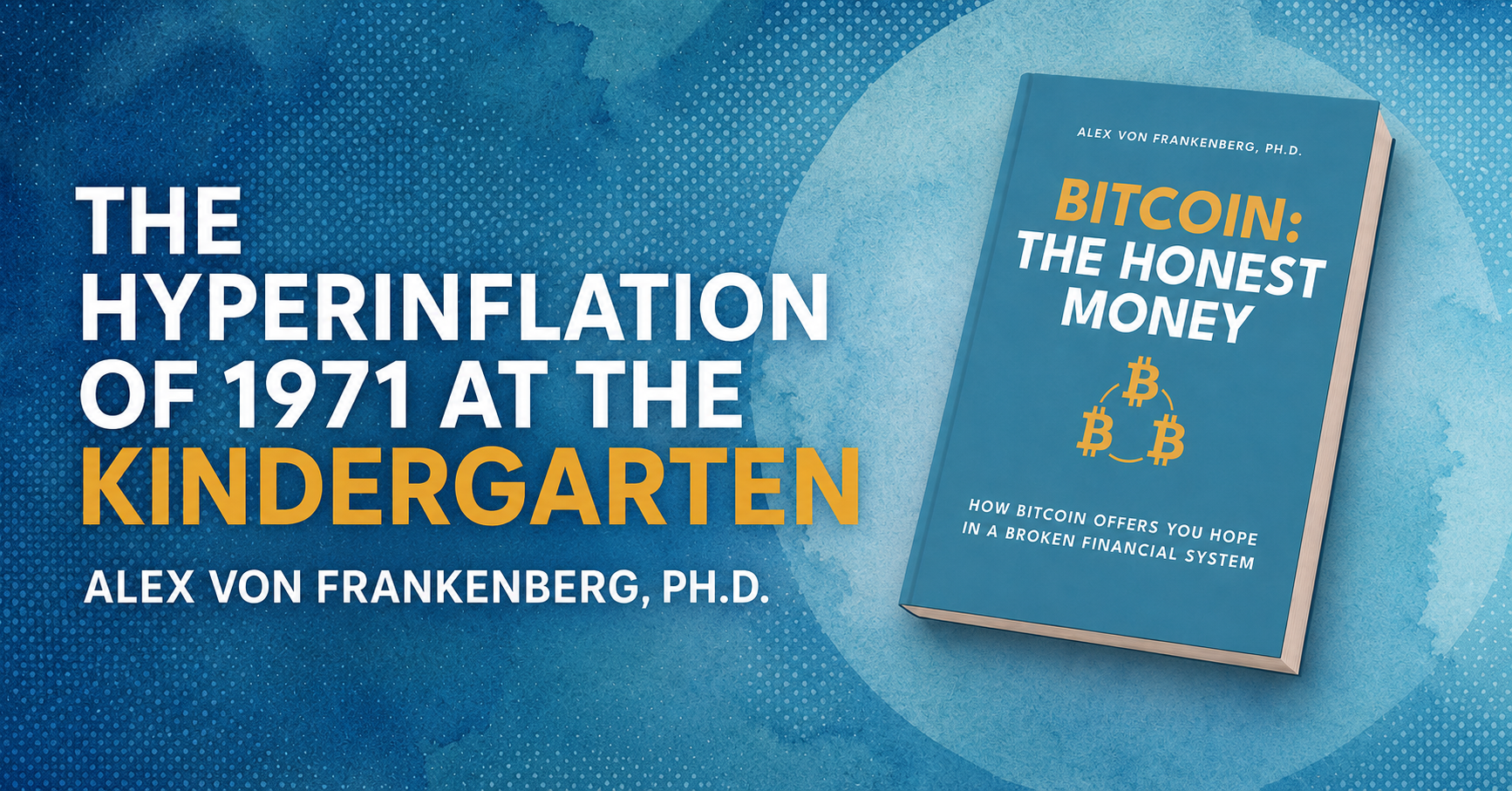
Discover more in Bitcoin: The Honest Money!
This excerpt is just the beginning. Dive deeper into how inflation devalues your money, your savings, and your time in Bitcoin: The Honest Money by Alex von Frankenberg, Ph.D. The paperback is available now.
This post The Hyperinflation of 1971 at the Kindergarten first appeared on Bitcoin Magazine and is written by Alex v. Frankenberg.
Why this matters
Bitcoin is showing up inside the Compliance & Sanctions theme, so this story is worth tracking for follow-through rather than treating it as a one-off headline.
Original source
Read on Bitcoin MagazineRelated market context
Nigeria Sets New Stablecoin Licensing Rules and Capital Requirements
TL;DR: Nigeria’s central bank issued a new framework on November 5 for non-security virtual assets, with separate stablecoin licen...
Elliptic Traces $124M in Bitcoin Swaps From Binance Hack Funds
TL;DR: A November 6 update from blockchain intelligence firm Elliptic says roughly $124 million of assets stolen in the October Bi...

South Korea’s Supreme Court formalizes crypto asset seizure rules
South Korea's formalized crypto seizure rules enhance creditor predictability and compliance but challenge self-custody enforcemen...

Coinbase Explains Cold-Storage Defences After Binance Breach Shakes Crypto Industry
TL;DR: Coinbase says it was not affected by the reported Binance hot-wallet incident and that more than 99% of customer assets are...

Franklin Templeton Will Use OpenAI ChatGPT to Predict Crypto
In early November 2026, OpenAI published a detailed customer story highlighting how Franklin Templeton, the global asset manager o...

OFAC’s sanctions search tool checks crypto wallets, but a clean result isn’t a clearance
OFAC's evolving sanctions list underscores the need for continuous compliance efforts in crypto, as non-matches don't guarantee sa...