The Spiral Scroll: Wallet Clustering Basics
Bitcoin Magazine The Spiral Scroll: Wallet Clustering Basics The Bitcoin transaction graph has various observable patterns, with wallet clustering of highest importance. Some of these patterns have been studied and used...
Archive context
Older archive item. Useful for background and entity history, but not a fresh market-moving signal.

Bitcoin Magazine
The Spiral Scroll: Wallet Clustering Basics
The Bitcoin transaction graph has various observable patterns, with wallet clustering of highest importance. Some of these patterns have been studied and used to link coins from the same wallet, both in theory and practice.
Every transaction consists of a list of inputs (where the sats are taken from) and outputs (where the input sats are distributed). Inputs refer to the outputs of previous transactions, such as connecting transactions. Outputs lock some amount of bitcoin with certain spending conditions (i.e., the “address,” public key, or output script). Linking coins means identifying the entity that controls the keys to a collection of transaction outputs, spent or unspent.
Section 10 of the Bitcoin white paper, “Privacy,” briefly discusses linking:
“A new key pair should be used for each transaction to keep them from being linked to a common owner.”
When the same public key controls more than one coin, these coins are trivially linked since only one entity is supposed to know the private key.
However, address reuse is not the only concern. The paper continues:
“Some linking is still unavoidable with multi-input transactions, which necessarily reveal that their inputs were owned by the same owner.”
This is often referred to as the “common input ownership heuristic,” CIOH, or the “multi-input heuristic.” It’s only a heuristic because, unlike the implication in the quote above, counterexamples exist. Although it isn’t always true, it often is.
Over the years, more sophisticated methods for clustering have been developed, for example, telling apart change outputs from payments or using larger structures in the transaction graph than just individual transactions. Some of these have been described in academic work, while others remain proprietary. Improved methods can link to more coins or avoid so-called “cluster collapse,” where coins belonging to different users are incorrectly connected. Commercial offerings often benefit from additional sources of information, such as KYC data; they don’t necessarily depend on just the privacy leaks that occur in the Bitcoin protocol, but clustering is still the central theme.
This motivates an adversarial framing of privacy, where a deanonymization attack attempts to assign coins to clusters. From this perspective, defending privacy means making it more difficult for the adversary to succeed in correctly assigning coins to clusters. The most notable examples involve collaborative transaction construction, whether it is overtly difficult to guess, as in CoinJoin, or covertly as in PayJoin, or perhaps most prominently, just a part of how the software works as with Lightning node transactions. In all cases, the simplistic assumption of common ownership breaks down, necessitating a more nuanced analysis.
The adversarial framing also makes it explicit that different adversaries have different capabilities, with the appropriate adversarial model depending on the user’s threat model: Are you more worried about surveillance by an oppressive government or snooping by your transactions’ counterparties?
Originally published on the Spiral Substack.
This post The Spiral Scroll: Wallet Clustering Basics first appeared on Bitcoin Magazine and is written by Yuval Kogman.
Why this matters
This bitcoin story adds another data point to the current market tape and is useful when read alongside nearby source coverage.
Original source
Read on Bitcoin MagazineRelated market context
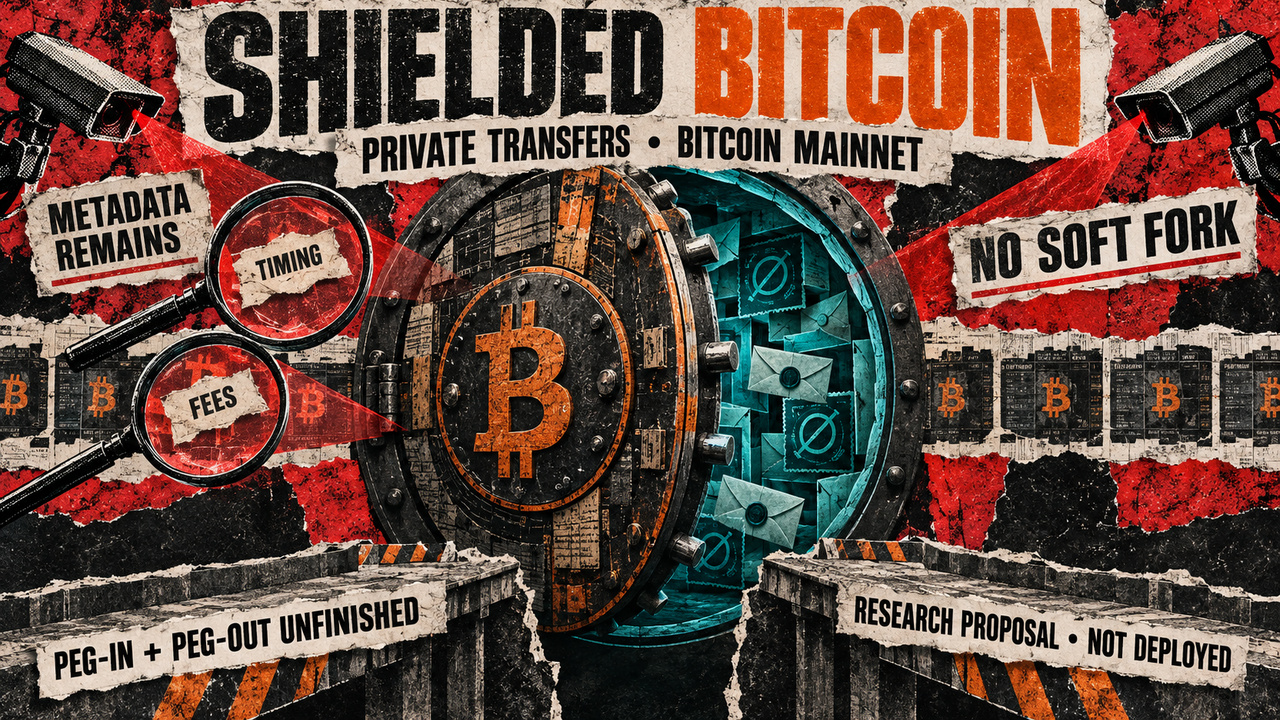
Bitcoin researchers target privacy coins with Zcash-style shielded transfers
Bitcoin researchers have proposed a system for private transfers directly on the network without requiring a soft fork or changes...

Bitcoin Could Get Zcash-Style Private Transactions Without a Soft Fork, Misha Komarov Says
Misha Komarov, founder of [alloc] init, a firm working on ways to add features such as privacy to Bitcoin without changing its cod...

Microsoft Copilot AI Predicts Bitcoin Will Do Something Incredible in Q4 2026
Microsoft Copilot AI predicts a wild move for BTC in Q4 2026, calling it one of the strongest asymmetric risk-reward positions ava...

Bitget Halts Withdrawals After $351.6M Hot Wallet Incident Hits Crypto Exchange
Key Takeaways: Bitget reported unauthorized transactions of about $351.6 million that occurred in a portion of its hot & warm wall...

Brazil Orders Reporting of $10K Self-Custody Crypto Wallet Trades
The new measures aim to strengthen the central bank’s AML/TF oversight over digital asset transactions where wallets are under com...

AI Crypto Coins Revenue Gap Puts Token Value to the Test
The AI coin crypto sector sits at $24-25 billion, with a total crypto market of approximately $2.86 trillion. Anthropic reportedly...