Traders Took $8.2 Million From Polymarket’s Five-Minute Bitcoin Bets, Study Found
Bitcoin Magazine Traders Took $8.2 Million From Polymarket’s Five-Minute Bitcoin Bets, Study Found A new study argued that Polymarket’s five-minute Bitcoin contract became a machine for wealth transfer. It moved money fr...
Archive context
Older archive item. Useful for background and entity history, but not a fresh market-moving signal.

Bitcoin Magazine
Traders Took $8.2 Million From Polymarket’s Five-Minute Bitcoin Bets, Study Found
A new study argued that Polymarket’s five-minute Bitcoin contract became a machine for wealth transfer. It moved money from retail bettors to a small band of manipulators, and it made Bitcoin’s spot price worse in the process.
The paper, “Settlement Manipulation in Prediction Markets” by David Dai, Ruizhe Jia, and Shihao Yu of Stanford and Singapore Management University, studied a product that did not exist before February 12, 2026.
On that date Polymarket launched a binary contract that paid $1 if Bitcoin closed a five-minute window above where it opened, and $0 otherwise. A fresh contract opened every five minutes around the clock.
Within months, Polymarket’s five- and fifteen-minute crypto up/down markets traded more than $4 billion and tripled the platform’s daily volume. The flaw in polymarket was when the contract settled against a Chainlink oracle that averaged Bitcoin’s price across major spot exchanges.
A trader who held the contract could buy or sell real Bitcoin in the closing seconds, drag that reference price across the strike, and win the bet.
The oracle’s blend of exchanges looked like a defense, because moving it seemed to require moving many venues at once. The authors showed it was not much of a defense. Binance, the largest crypto exchange, sat about two and a half basis points from the oracle and moved near one-for-one with it. It finished on the same side of the strike as the resolution about 85%of the time. A push that drove the Binance price a few basis points past the strike carried the outcome.
The pattern was in the Binance data. After the five-minute contract went live, net order flow in the final ten seconds before each close jumped about 50% above the pre-launch level. The spike was sharpest where a push mattered: in the 6% of cycles the market judged near-even, the jump was about 3.9 times the rest.
The reversal gave it away. Real information stays in a price; a manipulative push does not. Within ten seconds the price reverted, by about a quarter in the near-even cycles. The pushes clustered in thin hours, when a dollar of flow moved the price the most: 56% landed overnight and 44%on weekends.
Who won, who paid with these Polymarket betsIn near-even cycles, a push against the favored side flipped the winner 65% of the time, against 41% in normal trading. Even when one side held a 90-to-100% chance before the close, a push against it reversed the outcome 34% of the time, against 1% in cycles with no push. A bet the market treated as near-certain lost one time in three.
Because Polymarket settled on a public blockchain, the authors traced each wallet. Just 821 traders fit the manipulator profile, about one in three hundred of the 243,000 who traded the contract. They took $8.2 million in the pushed cycles and broke even in the rest. Of the losses, 93% fell on retail.
The authors ruled out hedging as the innocent explanation. A binary contract carried little exposure to hedge once one side was near-certain, yet those were the cycles a push flipped. And the trades arrived in one burst in the final fifty seconds, not as a position built over the window.
The remedyThe fix was the contract’s horizon. Manipulation was absent from the fifteen-minute contract, because a longer window took in more ordinary trading before the close and made a fixed push a weaker force. The stakes reached past crypto: Nasdaq and Cboe each filed with the SEC to list binary asset-price contracts on equity indices, which would carry the same risk onto larger markets.
This post Traders Took $8.2 Million From Polymarket’s Five-Minute Bitcoin Bets, Study Found first appeared on Bitcoin Magazine and is written by Micah Zimmerman.
Why this matters
Bitcoin is showing up inside the Prediction Markets theme, so this story is worth tracking for follow-through rather than treating it as a one-off headline.
Original source
Read on Bitcoin MagazineRelated market context

CFTC proposes a divide between prediction contracts and sportsbook wagers
The Commodity Futures Trading Commission announced two actions on Oct. 9 seeking to clarify the federal regulatory boundary betwee...
Ethereum open interest rose 2.3% in ETH on Binance as its dollar value fell 6.6%
Ethereum open interest in Binance’s ETHUSDT futures contract was 2.27% higher in ETH on Thursday, Oct. 8, over the last 48 hours,...

Tether freezes USDT linked to Ledger user thefts near $90 million
The freeze highlights the need for robust supply chain security and raises concerns about the limitations of centralized control i...
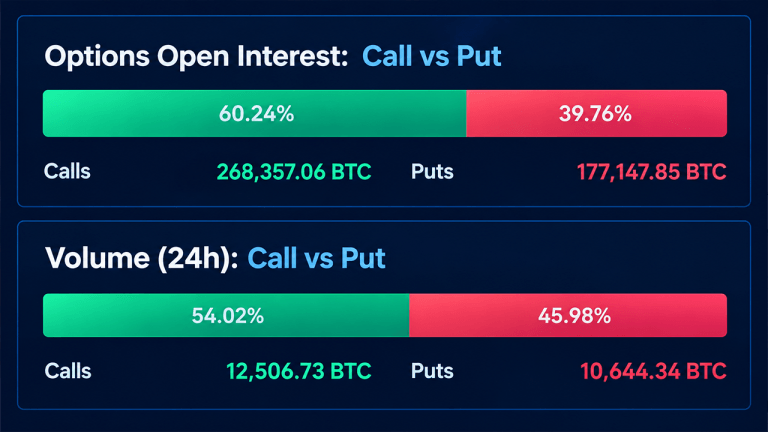
Bitcoin Traders Stack $4.5 Billion in Calls as $95K Bets Take Shape
Bitcoin’s options market is sending a curious message. With bitcoin trading above $82,000, calls account for 60.24% of outstanding...

Bitcoin’s weekend rebound faces an $80,400 test after nearly $730 million in ETF outflows
Bitcoin traded near $82,900 in PerpFinder’s Oct. 10, 09:36 UTC snapshot, with traders watching whether the weekend rebound brings...

XRP Price Prediction: Elliott Wave Setup Points to $3 as XRP Nears a Potential $2 Breakout
XRP Price Prediction: Elliott Wave Setup Points to $3 as XRP Nears a Potential $2 Breakout XRP is approaching a critical technical...