Traditional Banks Are Failing Everyday Savers. Bitcoin Is The Alternative
Savings account interest rates are not reflecting the changes in interest rates. Bitcoin is a hassle-free way to save and take custody of your assets.This is an opinion editorial by Julian Liniger, the co-founder and CEO...
Archive context
Older archive item. Useful for background and entity history, but not a fresh market-moving signal.
Savings account interest rates are not reflecting the changes in interest rates. Bitcoin is a hassle-free way to save and take custody of your assets.
This is an opinion editorial by Julian Liniger, the co-founder and CEO of Relai, a bitcoin-only investment app.
Traditional banks are short-changing customers by failing to reflect inflationary changes in the saving account interest rates they offer. On average, these accounts sit at 0.3% in the U.S. — a nominal rate in the context of today’s economic landscape.
Some might remember that during lockdowns, U.K. households saved an extra £190 billion, but the value of these cash rainy-day funds has eroded fast due to inflation. Inflation is a “silent thief” and its influence means that savers will continue to watch their hard-earned savings deplete in value, or they can look to alternatives with a long-term store of value.
It also could be time to look at alternative investment options and asset classes that are divorced from inflationary fluctuations and are especially resilient to the threat of governmental debasement in times of political or economic turbulence. Bitcoin, when used for long-term saving, is one such alternative, and one that more people will be considering as part of a rounded portfolio designed to beat inflation as well as geopolitical uncertainty.
Investors Lose Out By Saving With Traditional BanksBanking giants are conning everyday investors when they fail to increase interest rates despite central banks raising base rates. For example, the Bank of England raised its base rate to 1.75% in August 2022.
The other problem with savings and investing via traditional banks is that government-issued currency comes with counterparty risk and, on top of that, intrinsically has zero value. Government central banks print based on demand and there’s a risk of value loss due to inflation or becoming worthless when hyperinflation occurs. Bitcoin, on the other hand, has a finite supply and a hard-coded monetary policy, giving the commodity anti-inflationary and store-of-value aspects similar to gold.
Bitcoin has traditionally excelled in zero- or low-interest environments. Since the 1990s, central banks around the world have set low or negative interest rates, and it’s likely that we’ll see a return to this strategy to battle looming recessions.
One substantial lesson shared by investors in these low-interest environments is to forget any wishful thinking that interest rates will increase and to allocate their money accordingly. For this reason, bitcoin is a logical choice as its decentralized and finite properties are practically unaffected by inflation and interest rates set by central banks.
Trust In Traditional Banking Is PlummetingSince the 2008 financial crisis, banks have become somewhat of a boogeyman for many investors. Individuals in the EU are less likely to trust traditional banking institutions, and polling by YouGov suggests that only some Britons still trust traditional banks, with 36% believing that these institutions operate in their interests.
Unsurprisingly, one in four millennials, Generation X and Generation Z investors turn to cryptocurrency as their asset class of choice. These generations have reduced faith in centralized institutions, like banks, due to continuous economic instability experienced in their lifetime. Moreover, bitcoin allows investors to benefit from self-custody, where only they have possession and control of their assets. This isn’t the case for traditional banks and can leave people feeling a lack of control during economic uncertainty — or worse yet — during a financial crash.
This increasing level of distrust for traditional banking institutions coincides with dwindling confidence in national currencies. Countries like Turkey, Lebanon or Argentina are real-world examples of how inflation can get out of control and how people eventually lose trust in their local currencies. A global, borderless, nationless digital currency, like bitcoin, is becoming more appealing as a vehicle to store wealth.
Bitcoin Saving Accounts Are Designed For The Risk-Averse And BeginnersResearch shows that financial insecurity caused by the cost of living means that 46% of Britons have reduced or stopped paying into some form of savings vehicle. What we have now is a lot of risk-averse individuals shying away from investing or looking for ways to save passively.
At Relai, we offer a bitcoin savings plan suited to individuals who prefer an automated hands-off approach to saving in bitcoin.
Passively and regularly investing in bitcoin also allows investors to deploy a strategy called “cost averaging.” This is where individuals regularly purchase bitcoin, while ignoring market conditions and volatility. Individuals with little investment capital can potentially accrue significant gains through this strategy in the long run.
The current economic situation across the globe has highlighted the weakness of fiat currencies and the need for alternative long-term store-of-value options like bitcoin. However, before making any investment decision, it’s important to do your own research and weigh whether the choice is right for you.
This is a guest post by Julian Liniger. Opinions expressed are entirely their own and do not necessarily reflect those of BTC Inc. or Bitcoin Magazine.
Why this matters
This bitcoin story adds another data point to the current market tape and is useful when read alongside nearby source coverage.
Original source
Read on Bitcoin MagazineRelated market context
Bitcoin’s Fed Week Starts With A Fresh Rise In US Inflation Expectations
TL;DR: US household inflation expectations rose in October while consumer sentiment barely changed. The readings add context ahead...
Bloomberg Adds Basel Crypto Exposure Classification For Banks And Asset Managers
TL;DR: Bloomberg has expanded its crypto analytics to classify bank exposure under Basel standards, including indirect holdings hi...
SoFi Launches Yield-Bearing Tokenized Bank Deposit With Stablecoin Conversion
TL;DR: SoFi says its new SOFIE tokenized deposit represents money held at SoFi Bank, advertises 4.40% APY subject to terms, and ca...

Ethereum staking yield is losing to cash rates, so why are investors still lining up?
Put €10,000 into Ethereum staking at a 2.2% annual return and, if ETH's price stays unchanged, you'll earn about €220 over a year....
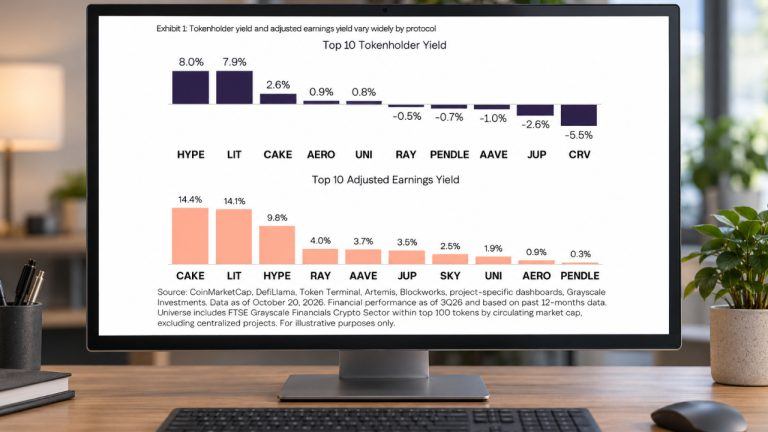
Grayscale Warns Crypto Token Inflation Can Wipe Out Holder Rewards
Crypto applications can generate earnings, yet growing token supplies can reduce the benefits reaching holders. Grayscale’s new an...

Swell Freezes swETH and rswETH Withdrawals Until It Corrects Their Exchange Rates
Holders of Swell‘s swETH and rswETH cannot deposit or withdraw through the protocol after the team said at 2:39 a.m. ET Friday it...