Voltage Now Offers One-Click Inbound Liquidity For Lightning Nodes
Voltage will supply up to 500,000 sats of inbound liquidity from its main node to its customers with one seamless click.Voltage now offers its users inbound liquidity for Lightning nodes with one click. Voltage will supp...
Archive context
Older archive item. Useful for background and entity history, but not a fresh market-moving signal.
Voltage will supply up to 500,000 sats of inbound liquidity from its main node to its customers with one seamless click.
- Voltage now offers its users inbound liquidity for Lightning nodes with one click.
- Voltage will supply 500,000 sats from its main node.
- The company hopes to expand this offering beyond just Voltage customers.
Voltage, a bitcoin infrastructure provider, has released a new and effortless way to find inbound liquidity in order to create a Lightning node, per a blog post from the company.
In just one click, Voltage users can gain 500,000 sats of inbound liquidity, courtesy of the main Voltage node. Voltage intends for this service to quickly help onboard as many merchants, businesses and node runners as possible onto the Lightning Network.
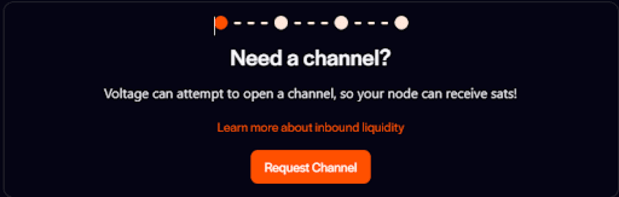
For users looking to utilize this feature, the following widget will be available at the top of Voltage’s dashboard once a node has been onboarded.
Image SourceSimply click on the “Request Channel” and the process is basically done. Voltage will then open a channel with the providing inbound liquidity and will also provide transactional details for users to verify the channel opening. Once the transaction is confirmed three times, the process is certifiably complete. After completion, the above widget will disappear from the dashboard screen.
Furthermore, the Lightning provider noted that while this service is currently only available to Voltage customers, the company looks to expand liquidity services to the broader network.
What Is Inbound Liquidity?The Lightning Network provides scalability to Bitcoin by allowing two or more participating parties to create a channel together, thereby allowing the seamless transfer of satoshis between one another. This is achieved through liquidity which is provided by participating parties which can then be transferred back and forth between the parties, ad infinitum.
However, this brings forth the issue of providing that initial liquidity which allows the parties to trade back and forth. Essentially, inbound liquidity is just funds that can be received from another participating node.
Why this matters
This bitcoin story adds another data point to the current market tape and is useful when read alongside nearby source coverage.
Original source
Read on Bitcoin MagazineRelated market context

Bitcoin (BTC) Price Prediction: $74K Liquidity Gap Puts $80K Support to the Test
Meanwhile, data from Glassnode and Fasanara Digital show that traditional financial assets are capturing a growing share of deriva...
Sygnum Launches Bitcoin Loans With Collateral Keys Shared Across Parties
TL;DR: Sygnum and Debifi have launched MultiSYG, a Bitcoin-backed lending service using segregated multisignature wallets. The arr...

Lido Puts Liquidity Buffers At The Center Of Ethereum ETP Yield Debate
An Ethereum investment product can advertise staking exposure without putting every unit of its ETH to work. Lido’s October 23 com...

Bitcoin Core Ends Long Embargoes for Bugs AI Can Rediscover
Bitcoin Magazine Bitcoin Core Ends Long Embargoes for Bugs AI Can Rediscover Bitcoin Core has changed its security disclosure poli...

Initia Halts L1 and Rollups After $2.7M Exploit Tied to Unauthorized Token Minting
Key Takeaways: After facing a security incident due to unauthorized token mints, Initia has suspended its Layer 1 and has integrat...

Ripple Partners With CryptEscrow to Simplify Crypto-Funded U.S. Real Estate Deals
Key Takeaways: Ripple and CryptEscrow to launch regulated foundations for crypto real estate transactions. Sellers and title compa...