A crypto network just voted to abandon its standalone blockchain and unlock 27% of its token supply
GnosisDAO has approved a plan to retire Gnosis Chain’s standalone Layer 1, a shift that will unlock roughly 350,000 staked GNO. Under GIP-153, Gnosis Chain will become a zero-knowledge-proven Ethereum Economic Zone rollu...
Archive context
Older archive item. Useful for background and entity history, but not a fresh market-moving signal.
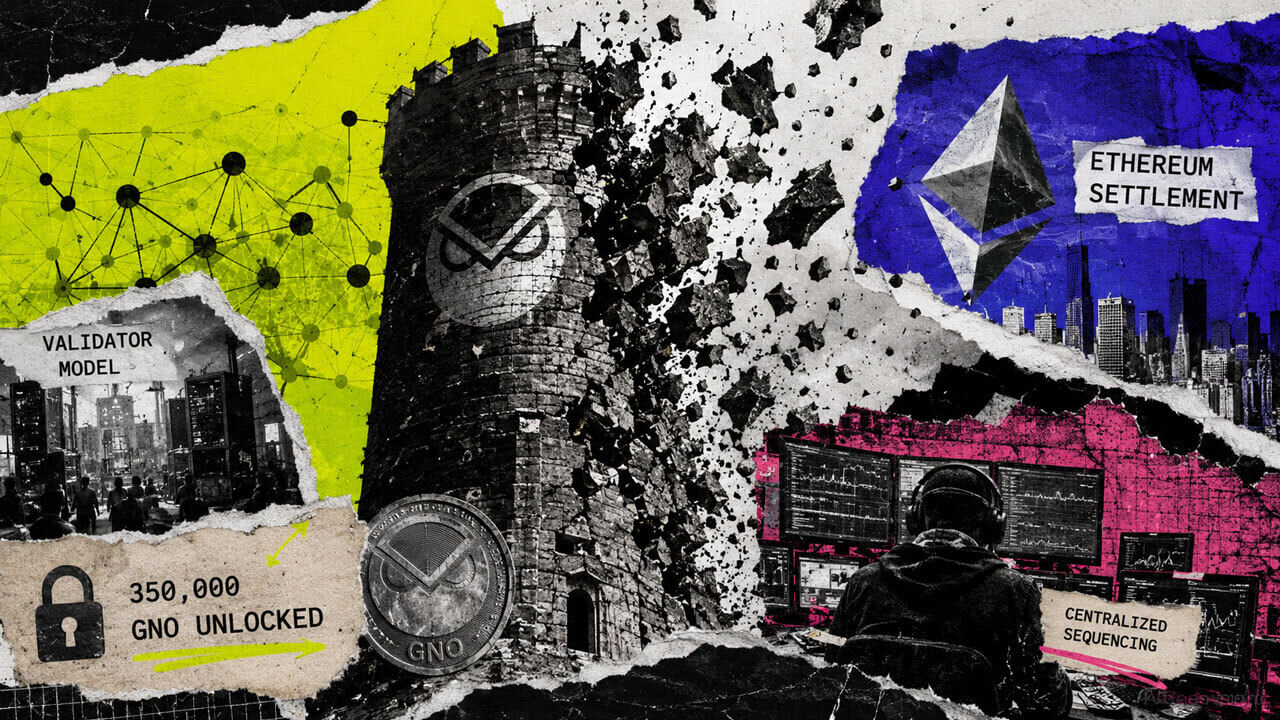
GnosisDAO has approved a plan to retire Gnosis Chain’s standalone Layer 1, a shift that will unlock roughly 350,000 staked GNO.
Under GIP-153, Gnosis Chain will become a zero-knowledge-proven Ethereum Economic Zone rollup that settles directly to Ethereum every block. The network will eventually retire its independent validator set and inherit security from Ethereum validators instead.
That change would unlock about 350,000 GNO currently committed to staking, equivalent to roughly 27% of the token’s circulating supply. The tokens are already counted as circulating supply, but ending staking would make them liquid again and remove their current role in securing Gnosis Chain.
GNO rallied 10% to as high as about $136 around the governance decision, its highest level since May, CryptoSlate data showed. The move came despite the prospect of a sizable increase in liquid GNO and reflected investor attention on Gnosis’ deeper integration with Ethereum.
The approval is a direction-level mandate rather than a final launch decision. GnosisDAO did not approve funding or a completed technical design, and the first EEZ version is targeted for around December 2026 or January 2027, depending on required infrastructure being ready.
GNO loses its staking role as Gnosis turns to EthereumThe transition will also force Gnosis to rethink GNO’s economics after staking disappears.
Gnosis currently pays validator rewards from its treasury because network fees cover only a fraction of its security costs. GIP-153 estimates that model dilutes non-stakers by about 2.3% annually. Once the validator set is retired, the staking subsidy would end and Gnosis intends to link GNO instead to revenue generated by the rollup.
The exact mechanism remains unresolved. Gnosis is considering options including fee sharing or GNO buybacks tied to network revenue, with a separate governance proposal expected after the economics of operating the rollup become clearer.
The broader bet is that Gnosis can give applications direct access to Ethereum’s liquidity without requiring users to bridge assets between separate networks. Its planned synchronous composability would allow a Gnosis contract to call an Ethereum contract and use the result within the same atomic transaction.
Martin Koeppelmann, Co-Founder and CEO, told CryptoSlate:
“Ethereum is not scaling into one economy; it's scaling into a hundred islands. This proposal is Gnosis choosing the other path. After the transition, anyone with a mainnet wallet will be able to use a Gnosis dapp in a single transaction, and a Gnosis account will be able to use anything on Ethereum. Same block, no bridges.”
Notably, several DeFi projects, including Aave, Spark, Fluid, CoW Swap, Safe, Centrifuge and other projects have committed to building consumer-focused products in the environment.
The transition comes with a decentralization trade-off. Gnosis Ltd. is expected to operate the sequencer that initially orders transactions and produces blocks, while proofs and settlement move to Ethereum. GIP-153 explicitly describes the move toward a less decentralized execution layer as deliberate.
For GNO holders, the change therefore replaces one established source of token utility with an unfinished revenue model while simultaneously releasing a large block of staked tokens back into liquid markets.
The post A crypto network just voted to abandon its standalone blockchain and unlock 27% of its token supply appeared first on CryptoSlate.
Why this matters
Ethereum is showing up inside the DeFi theme, so this story is worth tracking for follow-through rather than treating it as a one-off headline.
Original source
Read on CryptoSlateRelated market context

STRK rallies as Starknet weighs a move from Ethereum layer 2 to its own layer 1
Starknet's potential shift to layer 1 could redefine blockchain security priorities, challenging Ethereum's timeline and reshaping...

Sui’s Hashi Launches With $500M to Turn Bitcoin Into Productive DeFi Collateral Markets
Key Takeaways: With more than $500 million in locked-in tokens, Hashi will launch its phased mainnet launch. The protocol enables...

China calls for national blockchain network in new technology push
China's blockchain initiative could redefine global data markets, emphasizing state control and potentially influencing internatio...

Ripple Custody Adds Canton Network Support, Bringing CC and CIP-56 Into One Vault
Key Takeaways: Ripple Custody 1.43 adds support for Canton Network, CC and CIP-56 tokens. Institutions can be given the same custo...

Chinese Communist Party Calls for a National Blockchain Network
The Central Committee of the Chinese Communist Party (CCP) has called for the creation of a national blockchain network to foster...

Brazil’s BRL 22T CSD BR Moves Fund Records to XRP Ledger in Live Tokenization Push
Key Takeaways: CSD BR is leveraging the XRP Ledger to reflect real-time fund holdings. Over BRL 22 trillion in registered assets i...