Aave V4’s Arc market is swimming in $76 million of USDC nobody is borrowing
Aave V4 went live on the Arc Layer-1 network on Sept. 16 and attracted USDC almost immediately. By Sept. 17, point-in-time Aavescan data showed roughly $76 million supplied, less than $100,000 borrowed, and utilization n...
Archive context
Older archive item. Useful for background and entity history, but not a fresh market-moving signal.
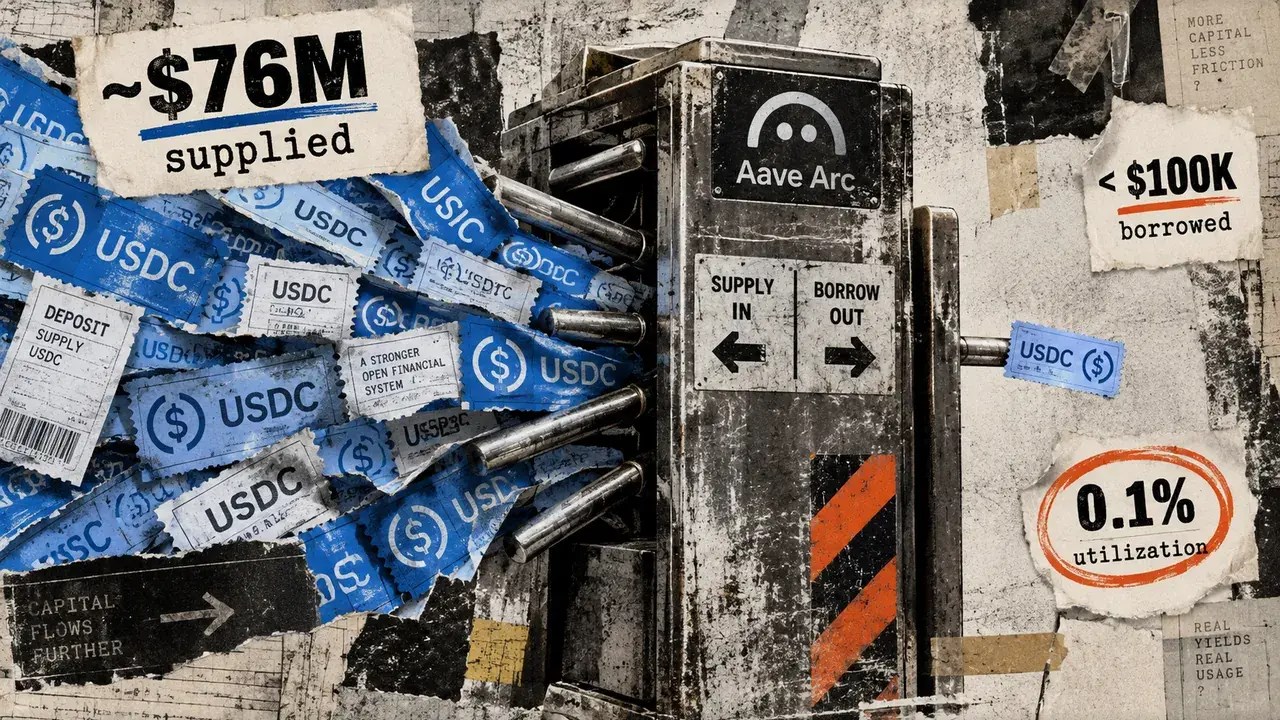
Aave V4 went live on the Arc Layer-1 network on Sept. 16 and attracted USDC almost immediately. By Sept. 17, point-in-time Aavescan data showed roughly $76 million supplied, less than $100,000 borrowed, and utilization near 0.1%.
Suppliers quickly filled the market’s initial capacity, but borrowers had put almost none of that liquidity to work.
LlamaRisk responded to the deposit rush by proposing an increase in the Arc Main Spoke’s USDC add cap from 56 million to 150 million tokens. The balance later moved above the former ceiling, showing that 56 million was no longer binding.
However, the governance post and live market page did not identify the exact replacement setting as executed.
What Arc’s full cap actually measuredAave V4 organizes liquidity through hubs and spokes. A hub holds liquidity, while spokes define how users interact with it. An add cap limits how much of an asset a spoke can supply into its hub.
Aave’s technical analysis describes them as the V4 equivalents of supply and borrow caps.
Arc’s Main Spoke launched with a 56 million USDC add cap and a 51 million USDC draw cap. LlamaRisk reported that the add cap reached 100% within hours, with 56 million USDC valued at about $55.99 million in its Sept. 16 snapshot.
The launch figures separate supply-side capacity from credit use:
Measure Launch or Sept. 17 reading Signal Initial Main Spoke add cap 56 million USDC Maximum supply through the spoke Main Spoke draw cap 51 million USDC Maximum borrowing through the spoke USDC supplied Roughly $76 million Liquidity deposited into Arc Core V4 USDC borrowed Less than $100,000 Credit drawn from that liquidity USDC utilization About 0.1% Share of liquidity in use Arc’s USDC market held roughly $76 million in supplied liquidity but less than $100,000 borrowed, leaving utilization near 0.1%.This also explains why Aave’s broader V4 deposit figures cannot be treated as Arc growth alone. LlamaRisk said deposits increased from $577.1 million to $708.6 million between its Round 16 and Sept. 16 snapshots, but that total covered six hubs.
Arc Core accounted for about $57.56 million at that point, and the later Aavescan reading was both newer and specific to Arc’s USDC balance.
Related Reading Circle processed $32 trillion in USDC transfers, yet 95% of its revenue relies entirely on interest ratesAave’s interest-rate framework prices hub liquidity according to utilization. When little capital is borrowed, liquidity remains abundant, and base rates stay low. The Arc snapshot fit that pattern: Aavescan displayed 0.00% supply and borrow APRs during Sept. 17 checks.
Those displayed rates describe the protocol view at that moment, while public launch data did not disclose whether separate rewards existed or whether a few addresses supplied most of the USDC.
Borrowing is now the adoption testMore add-cap capacity gives deposits room to grow, but the proposed move to 150 million USDC would nearly triple the original supply-side ceiling while leaving the 51 million USDC draw cap unchanged.
It would expand the amount of USDC that could enter through the Main Spoke without increasing the maximum that could be borrowed through it.
The next evidence of adoption will come from the demand side: a sustained rise in borrowed USDC, utilization, and rates.
If those measures increase as capacity expands, Arc will be developing into an active credit market. If they stay near launch levels, the market will remain a large pool of mostly idle liquidity.
More room for deposits can improve the market’s ability to serve future borrowers, but only actual draws can show whether users value that capacity as credit rather than as a place to park USDC.
For now, Arc has not yet proved that borrowers will follow the USDC liquidity it attracted.
The post Aave V4’s Arc market is swimming in $76 million of USDC nobody is borrowing appeared first on CryptoSlate.
Why this matters
Aave is showing up inside the Stablecoins theme, so this story is worth tracking for follow-through rather than treating it as a one-off headline.
Original source
Read on CryptoSlateRelated market context

Circle minted another 750 million USDC on Solana in the last 24 hours
Increased USDC liquidity on Solana may boost SOL demand, but its market impact depends on active circulation and broader crypto tr...

Circle mints 250M USDC on Solana, boosting liquidity and network potential
Increased USDC supply on Solana may enhance network activity and adoption, but market caution persists regarding significant price...

Bitcoin companies are learning that holding forever takes cash
Metaplanet sold 10,000 BTC and bought back 11,000 at a higher average price to show it was willing to sell its Bitcoin. The Japane...

Luxor’s reported 6–13% annualized Bitcoin yield depends on mining delivery
Luxor, a Bitcoin mining derivatives provider, reported a 6–13% annualized Bitcoin financing spread in its September lookback, publ...

Bitcoin’s weekend rebound faces an $80,400 test after nearly $730 million in ETF outflows
Bitcoin traded near $82,900 in PerpFinder’s Oct. 10, 09:36 UTC snapshot, with traders watching whether the weekend rebound brings...

One year after 10/10, Bitcoin and Ether liquidity is back while altcoins lag
The crypto market's bifurcation highlights Bitcoin and Ether's institutional appeal, while altcoins face volatility and limited gr...