AI, Blockchain, and Quantum Computing Are Catalysts for Organized Crime – Europol
Europol released a report on Tuesday detailing how advanced technologies—including artificial intelligence (AI), blockchain technology, and quantum computing—have fueled organized crime across the European Union. New Rep...
Archive context
Older archive item. Useful for background and entity history, but not a fresh market-moving signal.

Europol released a report on Tuesday detailing how advanced technologies—including artificial intelligence (AI), blockchain technology, and quantum computing—have fueled organized crime across the European Union.
New Report! #SOCTA25: The changing DNA of serious and organised crime.
This is one of the most thorough analyses on the threats of serious and organised crime, designed to assist decision-makers in the prioritisation of threats in Europe.
Read: https://t.co/Riuuswlfvi
The report described how organized crime has eroded trust in the EU’s economy, rule of law, and society by generating illicit profits and spreading violence.
It also noted that criminal activities have increasingly been used to support the political objectives of foreign actors, posing additional threats to stability.
AI and Blockchain Lower Barriers for CriminalsEuropol reported that organized crime networks now primarily operate online, using the internet both as a tool and as a target for data theft, often eliminating the need for physical presence.
Criminal groups increasingly rely on AI-driven systems, including large language models (LLMs) and generative AI, to simplify digital crimes.
They use generative AI to craft multilingual phishing messages, target victims globally, develop advanced malware, and produce child sexual abuse material.
Europol also noted that criminals create realistic synthetic media—including deepfakes and voice cloning—to carry out fraud, extortion, and identity theft schemes.
Alongside AI, another emerging threat stems from quantum computing.
Europol warned that criminal groups have adopted a “store now, decrypt later” strategy, collecting encrypted data with plans to decrypt it once quantum computing capabilities advance, potentially compromising sensitive information.
Blockchain and Cryptocurrency Exploited for Illicit FinanceCriminal networks also exploit blockchain technology and cryptocurrencies to facilitate payments and launder illicit proceeds, often relying on decentralized systems and unregulated exchanges.
According to the report, cryptocurrencies are used in crimes beyond cybercrime, including drug trafficking and migrant smuggling.
Activities such as cryptocurrency theft, NFT theft, and cryptojacking have become widespread. Criminals also use privacy coins, chain hopping, and decentralized finance (DeFi) exchanges to launder money.
Europol stated: “Virtual currencies are increasingly used to launder money, offering borderless, instant transactions when layered with privacy-enhancing technologies.
While cash still plays a major role, the rise of cryptocurrencies, DeFi platforms, and AI-driven automation has reshaped illicit finance by providing a digital shield to conceal laundering.”
Criminals further leverage cryptocurrencies, DeFi platforms, and AI-driven automation to mask transactions and evade detection.
Europol cited the takedown of ChipMixer, an unlicensed cryptocurrency mixer used to launder billions of euros in crypto assets, as a recent example.
New Technologies Aid Sanctions Evasion Through BlockchainEuropol warned that criminal groups have turned to new technologies to bypass sanctions, particularly amid the war in Ukraine.
Networks utilize encrypted communications, anonymized financial transactions, and blockchain to circumvent trade restrictions.
The agency mentioned the arrest of individuals involved in exporting military-grade goods to Russia in violation of EU sanctions, showing how sanctions evasion is linked to the proliferation of strategic goods.
Europol analysts believe that sophisticated money laundering methods tied to sanctions evasion—often based on complex ownership structures—are expected to become more common.
These goods are now increasingly being obtained through intermediary countries acting as transit points, with West and Central Asia playing a key role in this process.
Stricter sanctions and growing demand for strategic goods among sanctioned nations have accelerated this trend, according to Europol.
The post AI, Blockchain, and Quantum Computing Are Catalysts for Organized Crime – Europol appeared first on Cryptonews.
Why this matters
This blockchain story adds another data point to the current market tape and is useful when read alongside nearby source coverage.
Original source
Read on CryptonewsRelated market context
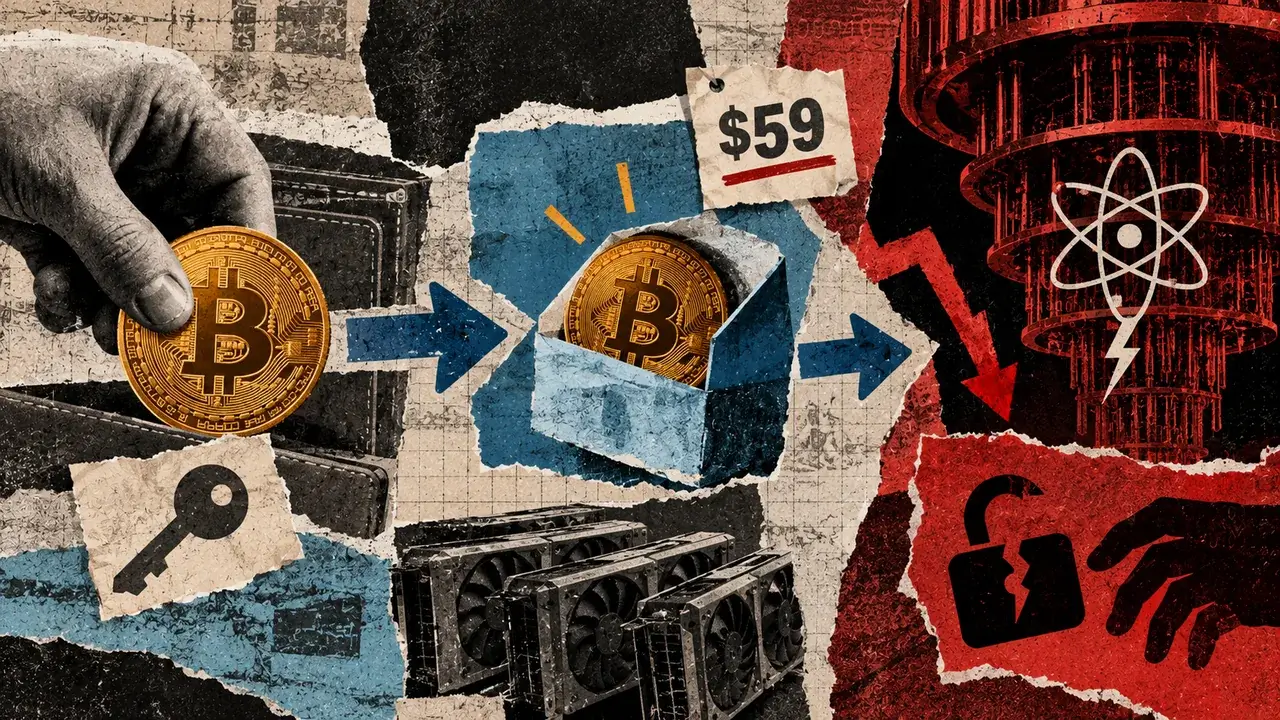
Bitcoin’s quantum-safe protection gets 82% cheaper as researchers race to secure 6 million exposed BTC
Researchers have cut the estimated computing cost of a specialized quantum-safe Bitcoin transaction by 82% to $59. Data from the Q...

Coinbase Calls for Early Bitcoin Migration to Quantum Security
Coinbase, which safeguards 5% of all Bitcoin for clients including banks, asset managers, and hedge funds, wants the network to be...

Coinbase Maps Bitcoin’s Quantum Risks While Safeguarding 5% of BTC
Coinbase, which says it safeguards roughly 5% of all bitcoin, has laid out the technical and operational hurdles bitcoin must clea...

Bitcoin’s Quantum-Resistant Upgrade Has to Work for Big Custodians, Coinbase Tells Developers
Coinbase set out what it wants from Bitcoin‘s shift to signatures that can resist a future quantum computer, and much of its list...

Researchers Build First Working Post-Quantum Defense for Bitcoin’s Lightning Network
Bitcoin Magazine Researchers Build First Working Post-Quantum Defense for Bitcoin’s Lightning Network Whether or not quantum compu...

Kalshi and Polymarket won’t be part of FTC sports gambling probe, report
Rival prediction markets Kalshi and Polymarket will reportedly be excluded from the Federal Trade Commission’s (FTC) probe into de...