Base Network Outage Raises Red Flags Over Centralized Sequencer Design
Key Takeaways: Base blockchain halted block production for nearly 30 minutes on August 5, disrupting transaction flow and triggering concerns across the crypto community. The outage exposes centralization risks, as Base...
Archive context
Older archive item. Useful for background and entity history, but not a fresh market-moving signal.
Key Takeaways:
- Base blockchain halted block production for nearly 30 minutes on August 5, disrupting transaction flow and triggering concerns across the crypto community.
- The outage exposes centralization risks, as Base relies on a single sequencer operated by Coinbase.
- This is the second major incident in two years, reigniting discussions around decentralized failover mechanisms for Layer 2 networks.
In the early hours of August 5, Base, Coinbase’s Ethereum Layer 2 network experienced a significant block production halt. Although the network resumed operations shortly after, the incident renewed concerns about centralization risks and network reliability. Here’s a breakdown of what happened and why it matters.
Read More: JPMorgan Unleashes JPMD on Base: The $4T Banking Giant’s Bold Leap into Public Crypto Rail
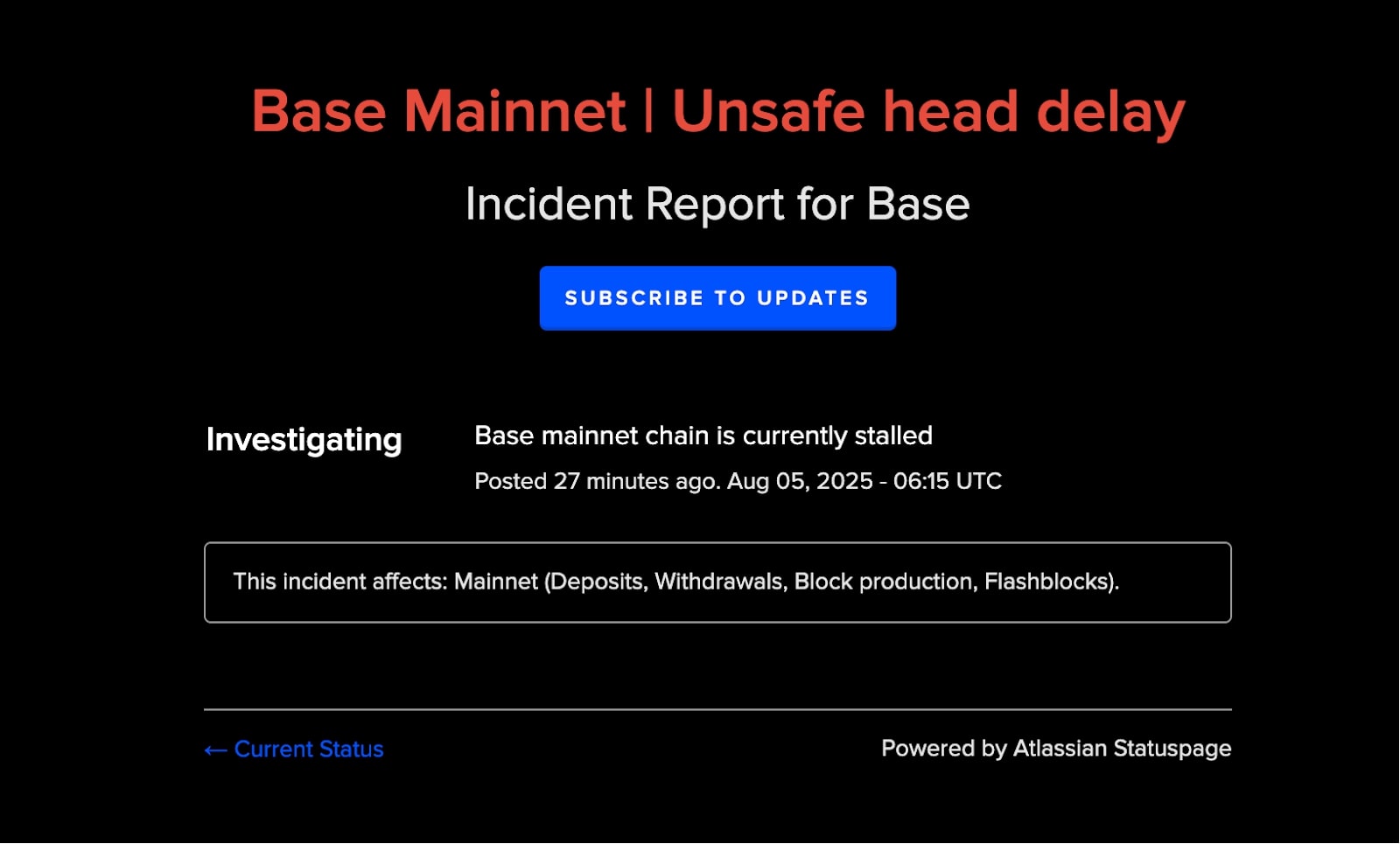
What Caused the Base Outage?At approximately 06:15 UTC, Base suddenly stopped producing new blocks, as confirmed by data from BaseScan and Oklink. The last observed block height remained stuck at 33,792,704, with no updates for over 29 minutes.
While Base’s status page later flagged an “unsafe head delay” as the root cause, specific technical explanations remain vague. Coinbase has yet to publish a full post-mortem or address whether recent upgrades such as Flashblocks, its new preconfirmation feature, played a role in the disruption.
The outage ended at 06:44 UTC, and full functionality was restored. No user funds were lost, but transaction throughput and DeFi dApps were temporarily affected, with pending transactions clogging the pipeline.
The Sequencer Single Point of Failure Centralized Sequencer – A Ticking Time Bomb?Base operates with a single centralized sequencer, controlled exclusively by Coinbase. In contrast to Ethereum mainnet’s decentralized validator set, sequencer-based Layer 2 solutions rely on a single operator to order and bundle transactions.
When that sequencer fails as it did today, the entire block production process grinds to a halt.
This raises two key issues:
- Lack of fault tolerance: Without a backup or failover sequencer, the network has no fallback.
- Increased trust assumptions: Users are forced to trust that a single entity won’t make errors or be compromised.
While centralized sequencers enable faster throughput and better UX, they sacrifice resilience and decentralization, two of crypto’s core values.
Not the First Incident: Pattern Emerging?This marks the second major outage for Base in less than two years. The previous occurred on September 5, 2023, when a 43-minute block halt was attributed to an internal infrastructure issue.
That 2023 incident was downplayed by Coinbase, but with this latest failure, confidence is eroding.
Critics, including industry researchers, have long pointed out that Ethereum Layer 2 rollups like Base still rely heavily on centralized infrastructure, unlike the Ethereum mainnet, which is secured by thousands of validators and open protocol design.
The Decentralization Imperative for L2 NetworksAs Base grows to become a critical piece of Ethereum’s L2 ecosystem supporting large DeFi protocols and handling millions in daily trade volume, these failures take on more weight.
The outage has:
- Halted DeFi operations, causing momentary transaction congestion.
- Shaken user trust, as Reddit, X (formerly Twitter), and Telegram groups lit up with memes, speculation, and calls for change.
- Exposed systemic risk, especially as Base becomes integrated into cross-chain apps and larger infrastructure stacks.
Developers and users alike are calling for implementation of decentralized or rotating sequencer systems, like those being explored by competitors such as Arbitrum, Optimism, and zkSync.
Read More: Shopify Unlocks USDC Payments via Base—$1 Trillion Stablecoin Surge Hits Mainstream Checkout
These alternatives are actively testing mechanisms like:
- Fallback sequencer networks
- Sequencer auctions
- Validator rotation models
Such redundancy would significantly reduce the risk of downtime and central points of failure.
Flashblocks, Rapid Scaling & Hidden RisksJust weeks prior to the incident, Base rolled out a new feature – Flashblocks, developed by Flashbots which allows apps to detect preconfirmation blocks every 200 milliseconds.
Though Flashblocks aimed to achieve UX and dApp responsiveness, the extent or degree in which Flashblocks touched the sequencing logic do not seem to have helped the failure. The down time and the phase of the upgrade is getting people to speculate.
Alongside its launch in 2023, Base has experienced high growth with sustained liquidity levels, development of the ecosystem and synergies with the massive retail user base of Coinbase.
But rapid growth without sufficient decentralization planning is proving to be a critical blind spot.
Following the outage, developers assured the community that no funds were at risk and that they were actively monitoring for follow-up issues. However, no timeline was provided for a detailed post-mortem.
The post Base Network Outage Raises Red Flags Over Centralized Sequencer Design appeared first on CryptoNinjas.
Why this matters
This blockchain story adds another data point to the current market tape and is useful when read alongside nearby source coverage.
Original source
Read on CryptoNinjasRelated market context

Taiwan Blocks Coinbase and Kalshi Over Bets on Its November Elections
Taiwan has blocked the websites of Coinbase and Kalshi under a court order sought by police investigating election betting, six we...

Taiwan blocks Coinbase and Kalshi websites over election betting concerns
Taiwan's action highlights the tension between innovation in prediction markets and regulatory frameworks prioritizing election in...

Coinbase, Marqeta expand partnership for stablecoin-backed enterprise cards
The partnership could accelerate blockchain integration in finance, potentially boosting Ethereum's role and price in the crypto e...

Coinbase to power stablecoin-backed cards for Marqeta customers
The expanded partnership builds on Marqeta’s work powering Coinbase’s U.S. debit card offering in 2020.

Coinbase and Marqeta Expand Partnership for Enterprise Stablecoin Cards
The planned offering would let businesses fund card programs around the clock, with Coinbase holding balances and Base providing o...

Coinbase and Marqeta expand partnership to launch stablecoin-backed cards for enterprises
The partnership could accelerate stablecoin adoption in enterprise payments, enhancing transaction efficiency but facing regulator...