Binance's Web3 Wallet: Is Multi-Party Computation the Solution?
In the ever-evolving world of cryptocurrency, Binance has taken a significant step by introducing a Web3 wallet designed to interact with the decentralized finance (DeFi) ecosystem. This announcement was made during the...
Archive context
Older archive item. Useful for background and entity history, but not a fresh market-moving signal.

In the ever-evolving world of cryptocurrency, Binance has taken a significant step by introducing a Web3 wallet designed to interact with the decentralized finance (DeFi) ecosystem. This announcement was made during the Binance Blockchain Week conference in Istanbul and marks a remarkable shift towards more secure and user-friendly solutions in the crypto space.
Web3 wallets are a pivotal element of the Web3 framework, enabling individuals to experience self-sovereign finance, offering greater control and security.
Wallet features:
What sets Binance's Web3 wallet apart is its compatibility with 30 blockchain networks, a feature that makes it exceptionally versatile and powerful. Binance aims to compete directly with other well-known Web3 wallet providers such as MetaMask and Trust Wallet. The latter was acquired by Binance in 2018, reflecting the industry's drive to expand and diversify.
One of the most significant concerns associated with Web3 wallets has been their vulnerability to hacking and scams. Scammers have exploited various techniques to steal users' crypto assets, and some of these attacks require nothing more than knowledge of the victim's wallet address. This type of exploit, known as "ice phishing," can lead to users unknowingly signing malicious transactions that grant attackers access to their wallets, subsequently resulting in the loss of their funds.
Moreover, a variation of this attack involves tricking users into sending native assets directly to scammers. These scams may appear convincing, and unsuspecting users can easily fall prey to them.
Multi-Party Computation: A Sophisticated Approach
To counter these threats, Binance's Web3 wallet incorporates multi-party computation (MPC) as a security measure. MPC eliminates the need for users to memorize seed phrases while still ensuring the benefits of security and self-custody. With MPC, the private key is divided into three parts called key shares, with the wallet owner controlling two of these shares, making it significantly more challenging for hackers to gain access.
MPC’s Gamble
MPC addresses the shortcomings of hot wallets, cold wallets, and hardware wallets. It offers both operational and institutional security requirements for safely storing private keys without hindering operational efficiency. However, this raises a crucial question: does the use of MPC go against the very essence of decentralization?
The introduction of MPC can be seen as a trade-off, enhancing security but introducing a level of centralization, albeit in a multi-party form. This sparks a debate in the crypto community as to whether such security measures undermine the core principle of decentralization.
As the digital asset space continues to evolve, finding a delicate balance between security and decentralization becomes increasingly important. While MPC offers robust security for private keys, it raises essential questions about the future direction of the crypto industry and the values it upholds.
The Battle Rages on
While Binance's entry into the world of Web3 wallets signifies a significant step toward the decentralization of finance, it also highlights the urgent need for comprehensive security measures. The rise in crypto wallet adoption rates has further intensified the crypto industry's battle against scams and hacks.
In this rapidly changing landscape, the introduction of Binance's Web3 wallet with its enhanced security features is a step in the right direction. It represents a commitment to providing users with a safe and user-friendly environment for engaging in the decentralized finance ecosystem. As the battle for trust and security in the crypto world intensifies, such innovations will play a crucial role in ensuring the safety and longevity of the crypto space. The shift towards Web3 wallets and their accompanying security measures offers a glimmer of hope in the ongoing fight against crypto scams and hacks.
This article was written by Pedro Ferreira at www.financemagnates.com.Why this matters
This blockchain story adds another data point to the current market tape and is useful when read alongside nearby source coverage.
Original source
Read on Finance MagnatesRelated market context
A new XRPL upgrade could concentrate XRP ownership inside banks instead of retail wallets
A proposed XRP Ledger (XRPL) upgrade could let banks and fintechs absorb XRP costs so customers never need to hold the token. The...
The biggest vulnerability in your Bitcoin wallet might be the shipping label
Hardware wallets might be able to protect your keys, but the paperwork from buying them could expose your identity. To buy a hardw...

XRP News: XRPL Records 2K Transactions from 20 Wallets
The XRP Ledger processed a record 3,254 transactions in ledger 106,965,249 yesterday, but 2,000 of the news came from just 20 acco...
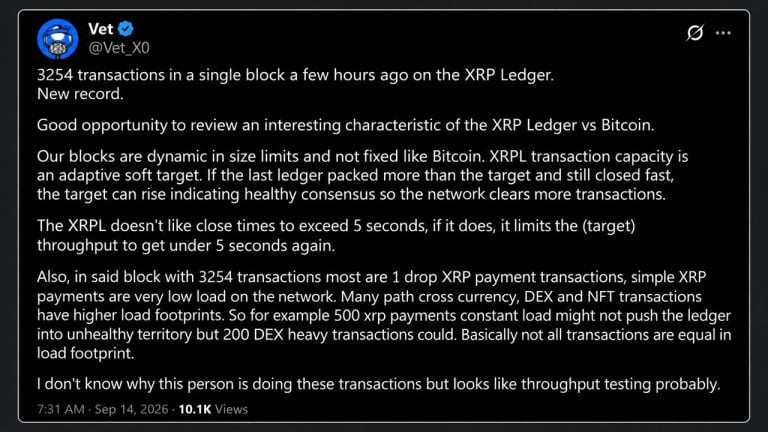
XRP Ledger Broke Its Transaction Record, and 20 Wallets Did Most of It
The XRP Ledger crammed a record 3,254 transactions into one ledger on Sept. 13, yet 2,000 of them were identical 1-drop payments f...

Securitize president flags unanswered voting rights question for tokenized stocks in non-KYC wallets
The unresolved voting rights issue in tokenized stocks could undermine corporate governance, prompting regulatory intervention and...
Thailand’s stablecoin proposal would block transfers to other people’s wallets
Thailand’s Securities and Exchange Commission has proposed a same-owner requirement for stablecoin transfers that would sharply na...