BitGo Brings Gold, Real Estate And Fine Art Tokenization To Core Chain
BitGo has partnered with Core Chain to introduce a tokenization framework for real-world assets, including physical gold, real estate, and fine art. The move puts another institutional custody name into the fast-growing...
Archive context
Older archive item. Useful for background and entity history, but not a fresh market-moving signal.

BitGo has partnered with Core Chain to introduce a tokenization framework for real-world assets, including physical gold, real estate, and fine art.
The move puts another institutional custody name into the fast-growing RWA market, where crypto infrastructure is being used to represent traditional assets on-chain. BitGo’s role is important because tokenization does not work on technology alone. The legal and custody layer matters just as much as the chain where the asset is issued.
That is especially true when the assets involved are physical.
Gold, property, and fine art are not like native crypto tokens. They require custody, documentation, valuation, legal rights, and rules around who can access or trade the tokenized version. BitGo’s involvement gives the Core Chain launch a stronger institutional angle than a simple token launch.
For more details, visit the official Blog platform.
TL;DR- BitGo and Core Chain are launching a real-world asset tokenization framework.
- The assets named include physical gold, real estate, and fine art.
- The story is about custody-backed tokenization, not free global trading of physical assets.
Tokenizing a real-world asset sounds simple in theory.
Take an asset, create a token that represents it, and move that token on-chain. In practice, it is much harder. Someone has to hold or verify the asset. Someone has to define what token ownership means. Someone has to handle redemption, transfer rules, compliance, and disputes.
That is why custody sits at the center of serious RWA projects.
If the underlying asset is not properly held, protected, or documented, the token can become little more than a digital claim with weak backing. For physical gold, real estate, and fine art, that backing is the whole product.
BitGo’s participation points to that custody-first approach.
Core Chain Gets An Institutional RWA PushFor Core Chain, the partnership adds another institutional use case beyond ordinary crypto trading.
RWA tokenization has become one of the more durable narratives in digital assets because it connects blockchain rails to assets investors already understand. Treasuries, credit, funds, commodities, property, and equities have all become part of that conversation.
Core Chain now wants a place in that market.
The partnership gives it a way to present itself as infrastructure for tokenized assets rather than only another blockchain competing for DeFi deposits and token speculation.
Physical Assets Are DifferentThe asset mix is notable.
Tokenized gold is easier for many investors to understand because gold already trades through financial wrappers, vaulting arrangements, and custody systems. Real estate is more complex because ownership rights, local law, liquidity, and transfer restrictions can vary sharply. Fine art adds another challenge because valuation, authenticity, storage, and market access are all specialized.
That means the framework will need strong guardrails.
A tokenized version of a physical asset does not automatically give a holder the same rights as holding the asset directly. It depends on the structure.
That is the part investors need to read carefully.
RWA Demand Keeps BuildingThe broader market backdrop is supportive.
Institutions are increasingly looking at tokenization as a way to improve settlement, collateral management, transparency, and distribution. Crypto-native users are looking for assets beyond volatile tokens. Networks are looking for real use cases that can survive outside speculative cycles.
RWA sits at that intersection.
It is not always exciting in the short term. But if it works, it can make blockchain infrastructure useful to traditional finance in a way that pure token speculation cannot.
The Balanced ViewBitGo and Core Chain’s RWA partnership is another sign that tokenization is moving into more serious territory.
The opportunity is clear: put traditional assets on programmable rails with institutional custody behind them. The risk is also clear: the legal and operational structure has to be strong enough for the token to mean something.
For now, the story is not that every gold bar, building, or artwork is suddenly liquid on-chain.
It is that institutional custody providers and blockchain networks are still building the rails that could make those markets more accessible over time.
This article draws on Core Chain’s announcement relating to its RWA partnership with BitGo.
This article was written by the News Desk and edited by Samuel Rae.
Why this matters
This maps to the Institutional Adoption hub, so it can help confirm whether that theme is gaining breadth across the crypto news cycle.
Original source
Read on NewsBTCRelated market context
Why RWA Tokenization and Onchain Credit Could Boost XRP Demand
Despite XRP’s sharp decline from its mid-2025 peak, institutional adoption and developer activity on the XRP Ledger remain resilie...

Morgan Stanley Builds Crypto Lab to Test Stablecoins, Tokenization and DeFi at Scale
Key Takeaways: Morgan Stanley has opened a Digital Asset Lab dedicated to blockchain technologies. The test is to be applied to th...

Goldman Sachs CEO Sees Tokenization as Wall Street’s Next Act
Goldman Sachs CEO David Solomon sees tokenization reshaping financial markets, potentially opening new revenue opportunities rathe...
More Holders, Little Trading: The RWA Liquidity Problem Is Worse Than You Think
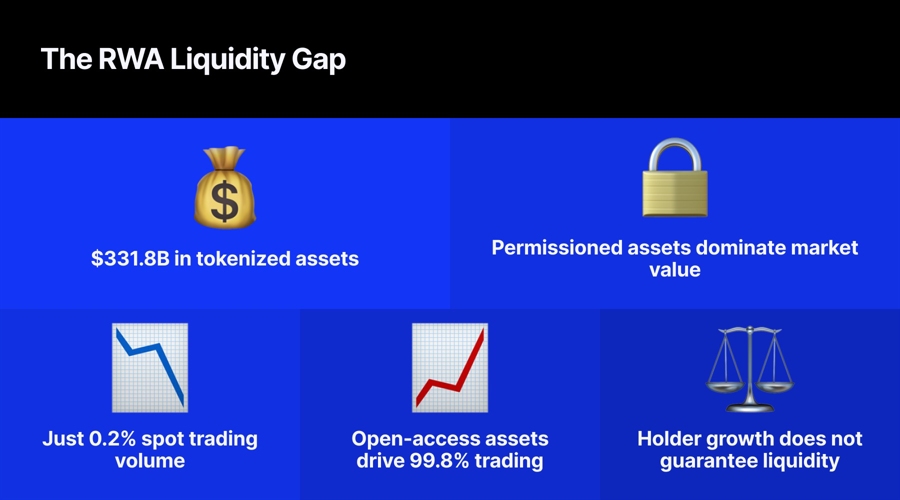
Let me ask you something straight. Does real-world asset trading on crypto exchanges feel like a genuine revolution, or does it fe...

Solana’s Tokenized Asset Market Grows More Than Sixfold In A Year
TL;DR: Research attributed to Castle Labs puts Solana’s real-world asset market at about $4.3 billion, versus $700 million a year...

JPMorgan Takes JPM Coin To Ethereum As Banks Test Public-Chain Settlement
JPMorgan is taking its bank-issued deposit token onto public Ethereum, an expansion that puts an established Wall Street payments...