DAO To Make Jodorowsky’s Dune Manuscript Public: Member Won $3M Bid
Following Constitution DAO’s lead, a group called Dune DAO went for a copy of the mythological Frank Herbert and Alejandro Jodorowsky’s Dune manuscript, wanted by many and seen by few. A plot almost as interesting as the...
Archive context
Older archive item. Useful for background and entity history, but not a fresh market-moving signal.

Following Constitution DAO’s lead, a group called Dune DAO went for a copy of the mythological Frank Herbert and Alejandro Jodorowsky’s Dune manuscript, wanted by many and seen by few. A plot almost as interesting as the saga took over Christie’s auction, where the DAO won the final bid, but with a twist.
Just a few days after ConstitutionDAO made history crowd-raising over $46M in an attempt to buy a rare printing of the U.S. constitutions, other groups are following their steps to purchase valuable objects in hopes to make them accessible to the public.
This time, DuneDAO aimed to bid for a copy of Alejandro Jodorowsky’s Dune manuscript at a Christie’s auction. They hoped for a total of $500,000 in contributions and actually hit $700,000. Although the final price was way higher, they still managed to secure it.
Christie’s had valued the manuscript’s copy between €25,000 ($28,100) and €35,000 ($39,345), but it sold for over $3 million. They admitted to failing at recognizing the interest that the newest film based on Dune raised, reported The Guardian.
Related Reading | Bleeple’s “Human One,” A Sculpture + NFT Hybrid, Sold For $28.9M At Christie’s
The group had stated before the auction:
Dune DAO intends to crowdraise the purchase, and then collectively explore options to digitally preserve the manuscript and make it accessible to the public for the very first time, such as through public viewings and digital lending (to the extent permitted by law).
Since distribution rights are not granted with the purchase, DuneDAO must investigate carefully legal ways to make this copy accessible.
The group used the same platform as ConstitutionDAO, contributions were “handled via JuiceBox”. Each contributor got governance tokens ($SPICE) accordingly to the donated amount. The $SPICE token gives each a vote in the future of the money, the manuscript. It does not mean a fractionalized ownership of it.
Why Dune Dao Wants The $SPICEIn a few words, Jodorowsky did compare the original Herbert’s novel to Proust.
As explained in Frank Pavich’s documentary Jodorowsky’s Dune, this was one of the most ambitious projects in cinematic history, but it never saw light because they lacked $5M to meet the $15M total budget.
Its manuscript, however, records the dreams behind a 15-hour movie-to-be that created a landmark and allegedly inspired many famous movies to follow -like Star Wars, Alien, and Blade Runner.
It features art from a few of the most renowned artists at the time, including Jean “Moebius” Giraud’s storyboard with over 3,000 illustrations, H.R. Giger’s concept art, Chris Foss starships’ designs. Pink Floyd was to contribute to the soundtrack.
Orson Welles was to impersonate “Baron Harkonnen” and Salvador Dalí “The Emperor”. The list of ambitious ideas keeps going, explaining the reason for not meeting the budget, but also what makes fans call “the Dune Bible” a mythical sci-fi object.
What Went Down At The AuctionBased on the price previously valued by Christie’s, DuneDAO thought they would secure the auction raising over $750k. However, as the price went higher, a core member gave the rest of the money himself, roughly $2.3M.
Reportedly, only three years ago another copy sold for around $42,500. Besides Christie’s claims on the unexpected 50x raise, a Twitter user alleged another bidder had “publicly let their top price slip”. The manuscript’s winning bid was $2,4M plus 20% christies auction fee, plus 5.5% VAT, for a total of $3,160,062, the group stated.
“I just want people to experience it,” said the core member who contributed the winning amount. Now, the money is meant to be raised and reimbursed so the DAO can obtain the copy. They are “figuring out how to navigate the maze of legal issues” before paying him back.
DuneDAO has 30 days to settle payment, which they hope will give time to debate and vote on future plans for the physical object. They have now raised their target to $4,200,000, taking into account additional costs for storage, maintenance fees, digitization, and more.
Related Reading | Miramax Sues Quentin Tarantino Over “Pulp Fiction” NFTs. Tarantino Moves Forward
Ethereum trading at $4,036 in the daily chart | ETHUSD on TradingView.comWhy this matters
This blockchain story adds another data point to the current market tape and is useful when read alongside nearby source coverage.
Original source
Read on NewsBTCRelated market context
As traditional giants rush into digital dollars, USDD’s Yvonne Chia explains why 24/7 access, self-custody, and transparent yield give decentralized stablecoins an edge banks can’t replicate. 20 November – Road Town, Totorla, British Virgin Islands – Decentralized stablecoin protocol USDD is accelerating its multichain utility across TRON, Ethereum, and BNB Chain—combining automated sUSDD yield via its Smart Allocator with GasFree zero-TRX transfers—as traditional financial giants race to build competing stablecoin rails. In a recent industry interview with instant exchange partner ChangeNOW, USDD Head of Communications Yvonne Chia outlined why self-custody, 24/7 settlement, and transparent onchain reserves give decentralized digital dollars a structural advantage over bank-issued alternatives. 1. Permissionless Access vs. Gatekept Accounts For billions of people globally, opening and maintaining a traditional bank account still involves paperwork, minimum balance requirements, geographic restrictions, and approval delays. Even when banks integrate stablecoin rails behind the scenes, those services remain gated behind legacy compliance walls and intermediary control. Crypto-native stablecoins flip that model on its head. As Yvonne Chia highlighted during the interview: “Compare this to a stablecoin like USDD, where all you need is a phone, a working internet connection, you can immediately start a wallet and you have access to your funds right away.” With USDD, users can access and manage their digital dollars directly through their own wallets, without depending on traditional financial intermediaries. This represents a fundamental shift in financial access: users are no longer limited to the services, operating hours, or account structures of a single institution. Instead, they have the freedom to hold, manage, and transfer their assets on their own terms. Self-custody also gives users greater autonomy over their financial decisions. They can choose which wallets to use, where to transfer their assets, and which supported decentralized applications to interact with, without needing to route every transaction through a centralized financial institution. With USDD, users’ digital dollars can move with them across an open blockchain ecosystem, rather than remaining tied to a particular bank or service provider. 2. 24/7 Global Settlement vs. “Banking Hours” Legacy payment networks still operate on decades-old schedules: weekend cutoffs, bank holidays, and multi-day cross-border settlement delays accompanied by hefty wire fees. Blockchain networks never close. Whether it is a Sunday night or a public holiday, USDD moves globally without depending on traditional banking operating hours or settlement windows. “We are able to have transfers 24/7 and we’re not limited to any traditional banking hours. So I think that in some ways, stablecoins are not just becoming banks, but exceeding what traditional banks can offer to users.” To make everyday transfers even smoother than fintech apps, USDD introduced GasFree integration on TRON, allowing users on supported wallets to pay network fees directly in USDD without needing to hold TRX. This removes another practical barrier to stablecoin adoption: having to acquire and maintain a separate gas token just to transfer digital dollars. With GasFree, eligible users can pay approximately 0.5 USDD per transaction, compared with around 1.5 USDT for a standard USDT transfer under the referenced fee conditions. These improvements matter because the usefulness of a stablecoin is not determined by its peg alone. Low-cost transfers, straightforward wallet experiences, and around-the-clock availability are what make digital dollars practical for everyday payments and global value transfers. 3. Passing Yield Back to Users vs. Bank Spreads Perhaps the sharpest contrast between banks and decentralized stablecoins lies in how yield is distributed. In traditional banking, institutions take customer deposits, deploy them into yield-generating markets, and retain a significant portion of the returns. Everyday depositors may receive relatively low interest rates, while higher-yielding products often come with eligibility requirements, minimum deposits, or fixed maturity periods. Stablecoins introduce another way to participate in digital-dollar opportunities. Rather than keeping capital entirely within a traditional deposit account, users can access onchain yield opportunities through decentralized protocols and transparent investment mechanisms. USDD was built to return that value directly to holders. Through USDD Earn, users can deposit USDD to receive sUSDD, earning automated, competitive yield powered by our Smart Allocator system, with no fixed lock-up periods restricting access to their capital. For users, the distinction is important: USDD Earn provides access to a productive stablecoin while maintaining flexibility, rather than requiring users to commit their capital to a conventional fixed-term product. 4. Onchain Verification vs. Institutional Trust Traditional banks ask customers to trust closed-door balance sheets and periodic regulatory filings—until a crisis proves otherwise. USDD takes a different approach through its “Don’t trust, verify” ethos, emphasizing publicly accessible onchain information and independent verification. Onchain Transparency: Smart contract addresses, collateral reserves, and Smart Allocator deployments are publicly viewable, allowing users to examine relevant information directly on the blockchain. Structured Disclosures: Quarterly Treasury Reports provide additional information about reserve positions, financial performance, and operational developments. Independent Security Reviews: USDD undergoes third-party security audits to assess its smart contracts and identify potential vulnerabilities. Transparency does not eliminate financial or technical risks, but it changes how users can evaluate them. Instead of relying exclusively on an institution’s assurances, users have access to information that can be independently examined and verified. 5. Beyond a Single Network: An Open, Multichain Financial Ecosystem Financial freedom is not just about holding digital dollars. It is also about being able to use them wherever opportunities and applications exist. A stablecoin confined to a single network or limited use case cannot fully realize the potential of open blockchain finance. Following its January 2025 protocol upgrade, USDD expanded natively from TRON onto Ethereum and BNB Chain, extending its reach across multiple blockchain ecosystems. This multichain presence allows USDD to connect with different communities, liquidity environments, and decentralized applications. Its sUSDD product has also expanded into DeFi integrations, including Pendle and Morpho, giving users additional ways to access yield strategies across supported ecosystems. The bigger picture is an interconnected financial ecosystem in which users can move between holding, transferring, exchanging, and deploying their stablecoins according to their own needs. These are not isolated functions. Together, they make stablecoins more useful as everyday financial infrastructure. The Future: Interconnected, Open, and Multichain Banks will undoubtedly continue using stablecoin rails to modernize their back-end settlement. However, true financial freedom comes from open networks where assets flow freely across protocols without intermediaries. For USDD, the opportunity goes beyond offering a dollar-pegged asset. It is about making digital dollars accessible, transferable, and productive across an interconnected financial ecosystem. From self-custody and 24/7 transfers to flexible yield opportunities and multichain DeFi access, these capabilities give users more ways to put their money to work. Banks may be bringing stablecoins into traditional finance. Crypto-native protocols are showing what stablecoins can make possible beyond it.
As traditional giants rush into digital dollars, USDD’s Yvonne Chia explains why 24/7 access, self-custody, and transparent yield...
CLARITY Act Likely Dead Until 2027, Top Crypto Lawmakers Warn
Bitcoin Magazine CLARITY Act Likely Dead Until 2027, Top Crypto Lawmakers Warn House Financial Services Committee Chairman French...

SEC Nominee Kristin Johnson Wants Tokenized Stock Exemption Put Through Public Comment
The SEC’s tokenized stock “innovation exemption” should go through formal public comment, Democratic nominee Kristin Johnson told...

Bitcoin slips below its 200-week average for the first time since October 2023
Bitcoin's dip below its 200-week average signals potential volatility, highlighting the asset's sensitivity to ETF flows and tradi...
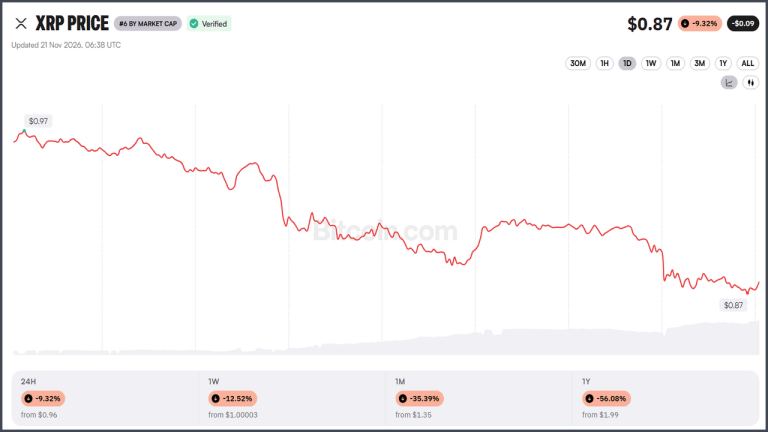
XRP Slips Below $0.90 For The First Time Since 2024 as ETFs Bleed
XRP slipped below $0.90 on Nov. 21 and hit $0.87, its lowest level since November 2024, as U.S. spot XRP exchange-traded funds (ET...

Bitwise ETF clients sell $5M in XRP amid cautious market sentiment
The $5M XRP sell-off by Bitwise ETF clients highlights growing caution and could signal broader market skepticism towards XRP's fu...