IOTA to Release Smart Contract Network ‘Assembly’ And Distribute ASMB Token
The ledger IOTA aims to become “a fully decentralized, feeless multi-asset ledger” by launching Assembly in 2022, a governance layer one for permissionless smart contracts, along with the native token ASMB that will open...
Archive context
Older archive item. Useful for background and entity history, but not a fresh market-moving signal.

The ledger IOTA aims to become “a fully decentralized, feeless multi-asset ledger” by launching Assembly in 2022, a governance layer one for permissionless smart contracts, along with the native token ASMB that will open the doors for the network’s main stakeholders, who would be democratizing Assembly.
IOTA’s founders say the ledger is a “public permission-less backbone for the Internet of Things that enables interoperability between multiple devices.” It aims to provide decentralized transactions accessible for everyone, without the need for miners or blocks, offering solutions for the cost fees, increasing scalability, and staying secure by using the Tangle network.
As the Shimmer network was released only two weeks ago along with its own token -with real monetary value, most likely to be traded on crypto exchanges- to stake, some skeptical users questioned the actual need for Assembly, but enthusiasts have compared to a scalable Ethereum without imposed fees.
Smart contracts will be allowed to run for free, but there is an option to put a price when high computing power is needed, in which cases supply and demand will determine prices.
Smart contract chains can be fully run from Assembly’s own network, which is the reason for all activities to be anchored to the IOTA Tangle to provide trust by “making them fully immutable and secure”.
Related Reading | IOTA Smart Contracts Enter Beta Phase To Circumvent Network Flaws
The Staking Of Assembly (ASMB) TokenProof of Stake also works to provide trust. As a decentralized network, of course, Assembly has no central system to reach if a user requires assistance, so staking comes to play as a wide community is meant to be built through the ASMB token, with members who care about the safety and maintenance of the network: validators.
If validators do not play the role of making sure the rules are followed, they get penalized. Just as well, playing by the rules generates revenue for validators in form of more tokens. All that is required to deploy smart contract chains or become a validator is to run a node or own “a small amount” of the ASMB token “to stake as a security deposit”.
The ASMB token will have “70% going to the community”. In the beginning, tokens will be created during a 90-day period when users will be able to “stake IOTA tokens in order to earn ASMB tokens.” -by locking IOTA on the Firefly wallet-, then tokens will be able to get claimed for free, and there will be a period 2 years for users to get their staking rewards.
20% of the initial token supply will go to IOTA holders. Afterward, there will be more staking periods for the ASMB token distribution. Assemble was further described by Dominik Schiener, IOTA’s co-founder, as:
A fully decentralized, permissionless network. It’s an extension of the Smart Contracts framework (live in Beta), and adds a validator pool, the ASMB token, staking and slashing. Anyone can deploy fully sharded smart contract networks on Assembly, while benefitting from the shared security, trustless interoperability, and feeless transactions.
No more bridges, relays or M-of-N multisigs. We’re here to connect smart contracts. … What makes Assembly so unique is that you can customize fees and incentives.
He also stated the Assembly’s journey is only starting and they will be sharing more details on the Builders Program and the support that teams building on Assembly and IOTA will receive. “Hint: It involves a lot of financial support”, he said.
Related Reading | How IOTA Could Reach $1B In Tokens Locked Before Chrysalis 2.0
IOTA trading at $1.3910 in the daily chart | Source: IOTAUSD on TradingView.comWhy this matters
This blockchain story adds another data point to the current market tape and is useful when read alongside nearby source coverage.
Original source
Read on NewsBTCRelated market context
A Crypto Project Hasn’t Delivered Your Tokens. What Can You Do?
Law and Ledger is a news segment focusing on crypto legal news, brought to you by Kelman Law – A law firm focused on digital asset...

Kalshi, Coinbase win partial ruling on Illinois sports contracts
The ruling highlights ongoing jurisdictional tensions between state and federal authorities, impacting the future of prediction ma...

Forward Industries adds 948,601 SOL, lifting its Solana treasury to 8.5 million tokens
Forward Industries' significant Solana holdings could influence market dynamics, highlighting risks of concentrated ownership and...

Authors Withdraw Ethereum Staking Reward Burn Plan From Hegota Upgrade, Seek Separate Process
A proposal to burn a growing share of Ethereum staking rewards will not be part of the network’s Hegota upgrade. Ethereum France p...
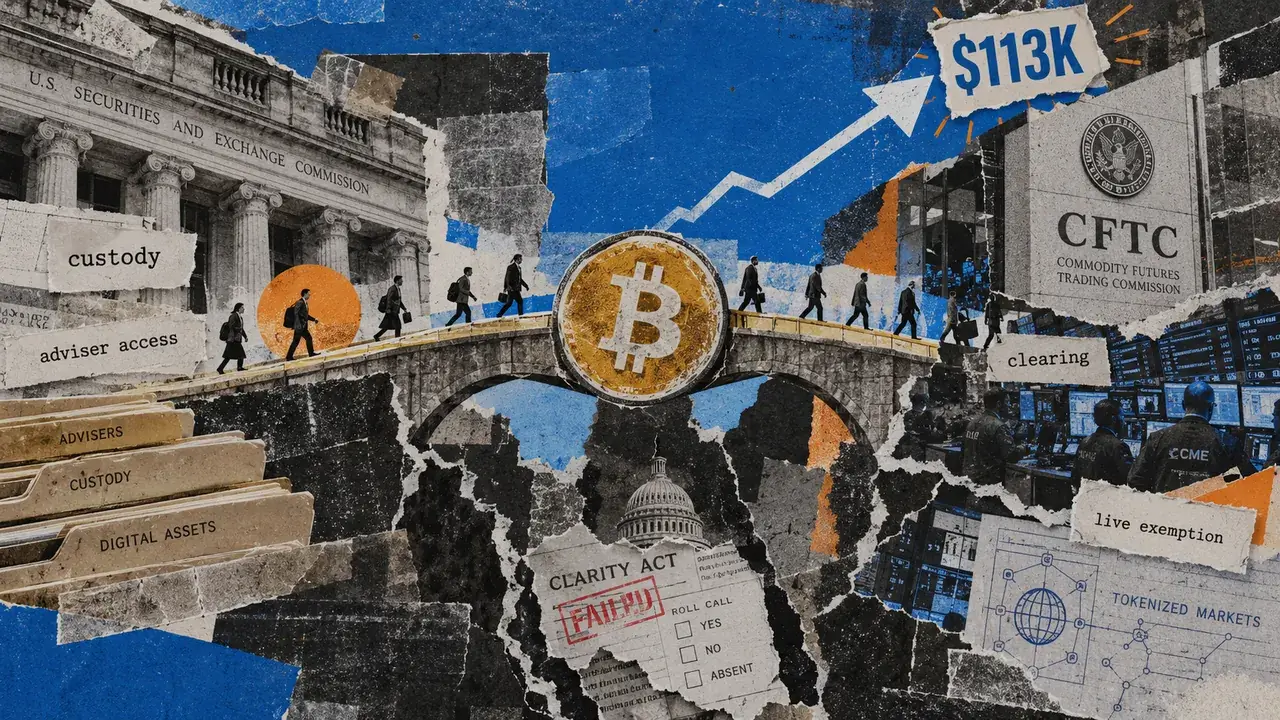
Bitcoin’s $113,000 case strengthens as US regulators push 9 crypto actions
The US Securities and Exchange Commission (SEC) proposed a custody framework on Oct. 1 that would let investment advisers and regu...

Elon Musk Grok AI Predicts a Wild End to 2026 for Bitcoin
Elon Musk’s Grok AI predicts the next three months will be unusually consequential, projecting Bitcoin could hit an impressive 2x...