Only 10% of American Voters Show Enthusiasm for Crypto Investments
Key Takeaways: Most U.S. voters don’t support the creation of a government-backed crypto strategic reserve. Cryptocurrency and blockchain development are the lowest-rated potential federal funding priorities, with just 1...
Archive context
Older archive item. Useful for background and entity history, but not a fresh market-moving signal.
Key Takeaways:
- Most U.S. voters don’t support the creation of a government-backed crypto strategic reserve.
- Cryptocurrency and blockchain development are the lowest-rated potential federal funding priorities, with just 10% of voters supporting increased investment in the sector.
- Republicans are more likely than Democrats to support crypto initiatives, but overall enthusiasm remains limited.
A survey of 1,169 likely U.S. voters leaves little doubt that a large majority remains skeptical about government involvement in cryptocurrency, particularly regarding the establishment of a “Crypto Strategic Reserve”. In fact, voters consistently prioritize traditional social programs and infrastructure investments over increased federal funding for cryptocurrencies.
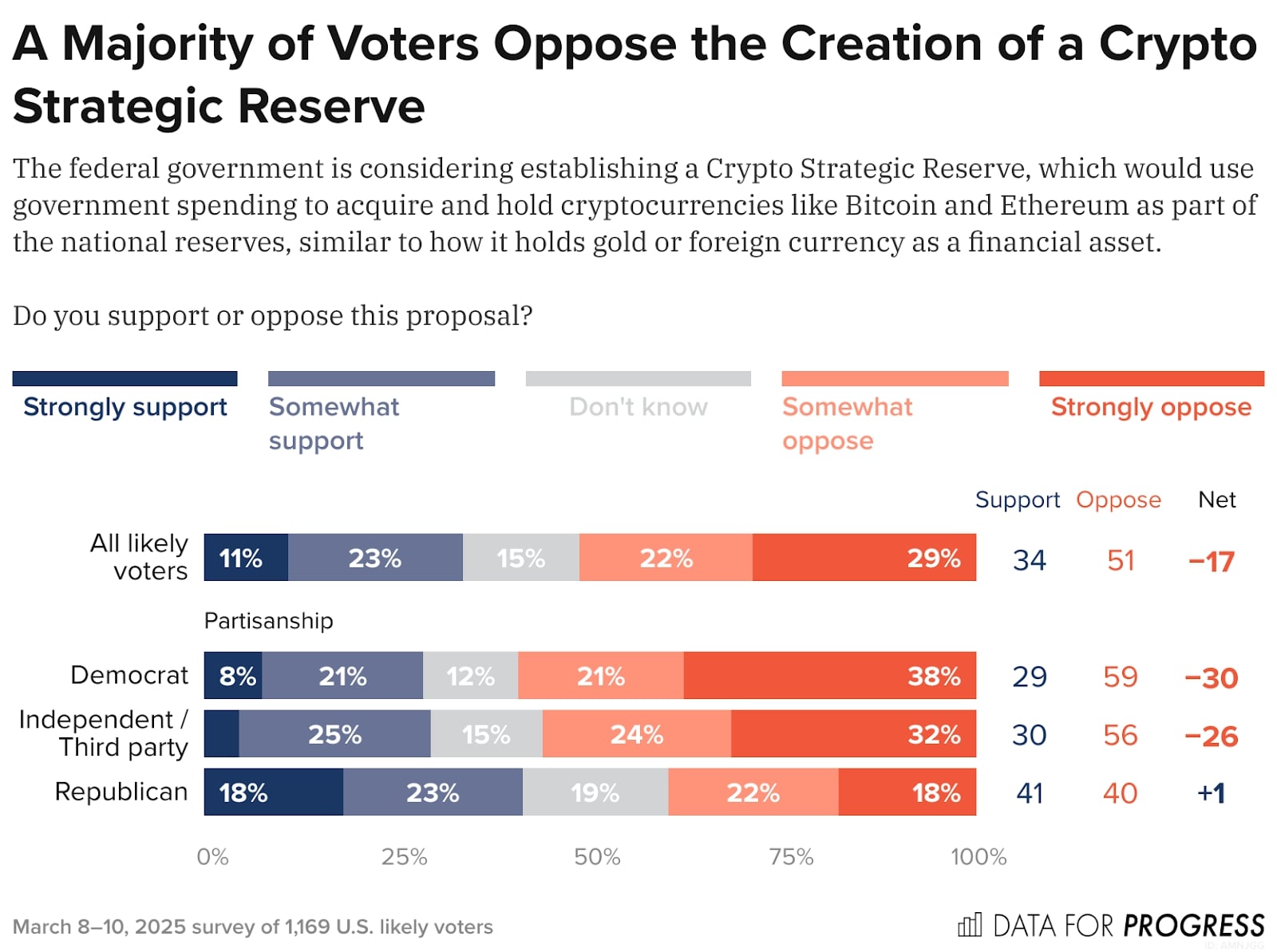
Public Resistance to the Crypto Strategic ReserveHowever, significant resistance from the people has met President Trump’s executive order, which suggested establishing a Crypto Strategic Reserve that would have involved the government’s purchasing and owning cryptocurrencies, such as Bitcoin and Ethereum. More than half (51%) of survey respondents opposed the plan. The opposition is driven by Democrats (59%) and Independents (56%); Republicans are narrowly in favor, highlighting the stark partisan divide on the issue.
Examining the data, 29% of all voters said they did not support the plan, while 11% strongly supported it. This means that support is more fragile than opposition.
The backlash is widespread, making it difficult for the Trump administration to gain public support for such a reserve.
An Afterthought: Federal Funding for CryptoPerhaps the most telling result of the Data For Progress survey is that cryptocurrency and blockchain development ranked dead last among nine federal funding priorities. Only 10% of voters thought this sector should get more federal dollars. By contrast, voters supported increased spending for:
- Social Security (65%)
- Medicare (64%)
- Roads, Bridges and Transportation (63%)
- Medicaid (53%)
- Public Education (52%)
- Renewable Energy (45%)
- Space exploration had 24% and Artificial Intelligence had 20% respectively.
These findings illustrate that voters place a higher priority on social services and infrastructure compared to cryptocurrency investments.
Republican voters, who are typically more receptive to market-based solutions, were largely opposed to government funding for cryptocurrency. According to the survey data, 36% of Republican respondents thought government funding for cryptocurrency and blockchain development should be reduced, compared to just 12% looking for an increase. 31% believed funding levels should stay the same.
A Glimmer of Hope for Crypto? Generational DifferencesThough support for government funding of cryptocurrency was small overall, the survey found a substantial generational gap. Support for increased federal funding for cryptocurrency development was nearly three times as high among voters under 45 (18%) as it was among those over 45 (6%).
This indicates that younger generations, who are more familiar with digital technologies and cryptocurrencies, show greater openness to government support for the sector. However, support remains relatively low even among younger voters, meaning broader public acceptance will require time and effort.
Key Numbers of Support and Opposition- 51% of respondents say they oppose the Crypto Strategic Reserve
- 34% of respondents support the Crypto Strategic Reserve
- 10% of voters believe the U.S. should increase federal funding for cryptocurrency
- 65% of voters agree the U.S. should boost federal funding for Social Security
- 29% of the voters believe funding for cryptocurrency should remain unchanged.
This new Data for Progress survey shows that the public remains generally skeptical about government involvement in the cryptocurrency sector. Voters prefer to spend money for more traditional social programs and infrastructure investments, and they are reluctant to spend federal money on a market they see as volatile and speculative.
More News: Memecoin Holders Surpass Bitcoin: What Does This Mean for Crypto?
The post Only 10% of American Voters Show Enthusiasm for Crypto Investments appeared first on CryptoNinjas.
Why this matters
This blockchain story adds another data point to the current market tape and is useful when read alongside nearby source coverage.
Original source
Read on CryptoNinjasRelated market context

MEXC Releases October 2026 Proof of Reserves, Reinforcing User Trust Through Verifiable Transparency
Mutsamudu, Comoros, October 16, 2026 – MEXC, a pioneer in 0-fee digital asset trading, has released its October 2026 Proof of Rese...

Grayscale Opens 3 Crypto Funds on Republic With $2,500 Minimum for Eligible Investors
Key Takeaways: Grayscale has introduced three crypto-investment products to Republic. A minimum investment of $2,500 is required f...

Google Gemini AI Predicts Bitcoin to Hit $175K by 2027
When prompted, Google Gemini AI predicts that by January 1, 2027, Bitcoin could be trading for $175,000. It gives a hypothetical c...

USDC’s EU Reserves and Capital Shift to EBA Supervision in MiCA’s First ‘Significant’ Call
Circle’s European USDC issuer will answer to the European Banking Authority (EBA) on reserves, liquidity and capital from Nov. 12,...

Russia Crypto: Diesel Deal Falters as Zelensky Resumes Refinery Strikes, What Now for Oil Bitcoin?
In Russia crypto news, Donald Trump’s announced plan to release 300,000 tonnes of Russian diesel to the US and global markets face...

MSCI Tightens Index Rules As Strategy And Other Bitcoin Treasury Firms Face Fresh Scrutiny
TL;DR: MSCI has revised its methodology for classifying non-operating companies, putting Bitcoin-heavy treasury businesses under c...