Oracle Connects Bank Payment Systems To Swift’s Blockchain Ledger
TL;DR Oracle is integrating its banking and blockchain infrastructure with Swift’s shared ledger for tokenized deposits. Banks can connect their own tokenized-deposit systems to cross-bank payment flows while retaining c...
Watchlist
Published in the last two hours. It maps to a high-priority topic hub.

- Oracle is integrating its banking and blockchain infrastructure with Swift’s shared ledger for tokenized deposits.
- Banks can connect their own tokenized-deposit systems to cross-bank payment flows while retaining control of the underlying assets.
- Oracle Banking Payments will link those digital-asset flows with existing ISO 20022 processing.
Oracle is building a bridge between the systems banks already use to move money and Swift’s emerging blockchain ledger.
The company announced the integration at Sibos in Miami on September 28, giving financial institutions another route into tokenized-deposit payments without requiring them to replace their existing core infrastructure.
Banks Keep Their Own DepositsSwift’s ledger is not designed to become one enormous bank balance sheet.
Individual institutions still maintain their own tokenized-deposit infrastructure.
The shared ledger coordinates payment commitments between those institutions so the digital representations of commercial bank money can work across bank boundaries.
Oracle’s integration is designed to connect the two sides.
Oracle Blockchain Platform can host the smart contracts needed to interact with the Swift ledger, while its Digital Assets Data Nexus provides the surrounding digital-asset infrastructure.
Oracle Banking Payments then links those blockchain events with conventional ISO 20022 payment processing.
The result is intended to let a bank handle ordinary payments and tokenized-deposit payments through the same operating model.
Tokenized Deposits Need Interoperability To MatterA bank creating its own blockchain deposit token is only useful up to a point.
If the token works inside one institution but cannot interact cleanly with money at another bank, much of the advantage disappears.
That is why interoperability has become one of the central questions around bank-issued digital money.
Swift is approaching that problem as a coordination layer.
Oracle is approaching it from the bank’s internal systems.
The integration supports payment orchestration, custodial wallets, signing infrastructure and the connection between blockchain transactions and a bank’s existing payment stack.
Oracle says banks remain in control of their own tokenized-deposit systems rather than handing that role to Swift.
That distinction will matter to institutions that want faster settlement without surrendering control of customer deposits or their compliance framework.
The broader trend is becoming increasingly clear.
Banks are not waiting for stablecoins to replace their existing infrastructure.
They are trying to make regulated bank money programmable and interoperable too.
Oracle’s role is not to issue that money.
It is to make the old and new systems talk to each other.
This article was written by the News Desk and edited by Samuel Rae.
Why this matters
This maps to the Institutional Adoption hub, so it can help confirm whether that theme is gaining breadth across the crypto news cycle.
Original source
Read on NewsBTCRelated market context
Citi And Coinbase Bring Stablecoin Payments Into Corporate Banking
TL;DR Citi and Coinbase have expanded their partnership with new stablecoin and fiat payment infrastructure for businesses. Citi c...

Citi, Coinbase partner to integrate stablecoin payments into US banking
This partnership could accelerate stablecoin integration into mainstream finance, potentially reshaping the crypto landscape and b...

US bank group taps Quant for tokenized deposits, but QNT’s role is left in doubt
Bank-owned US payments operator The Clearing House has chosen Quant to supply software for a planned network for tokenized bank de...

Citi and Coinbase Working Together To Build Stablecoin Infrastructure for Businesses
Bitcoin Magazine Citi and Coinbase Working Together To Build Stablecoin Infrastructure for Businesses Citigroup is working with Am...

Citi Clients Can Now Take Stablecoin Payments Through Coinbase—Without Touching Crypto
Coinbase and Citi expanded an existing deal so Citi's institutional clients can accept stablecoin payments, while Coinbase busines...
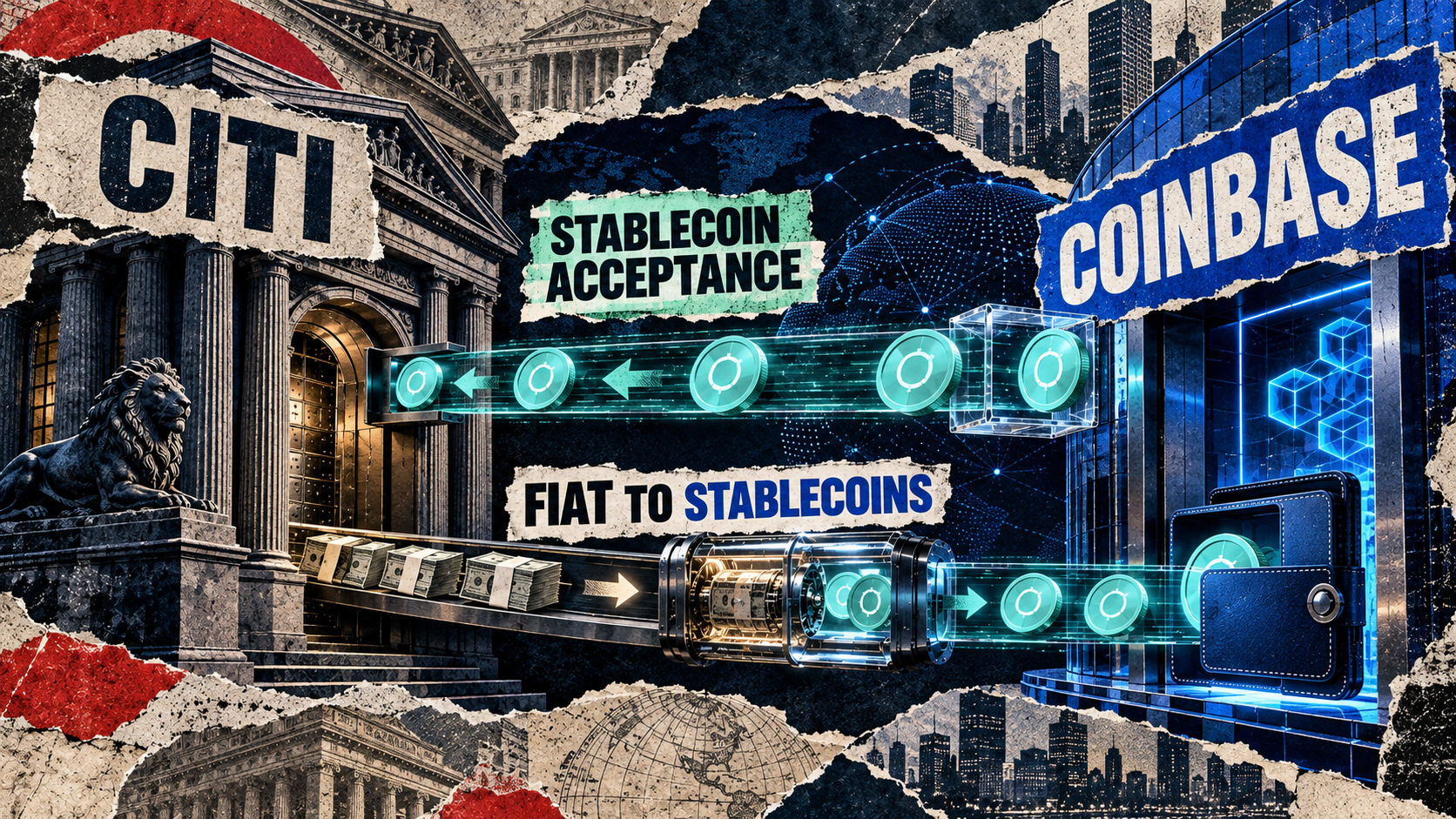
Coinbase powers Citi’s new stablecoin rails, and corporate banking faces a major shift
Citi institutional clients can now accept stablecoin payments through Spring by Citi using Coinbase's payments infrastructure, Coi...