Poland Becomes EU’s Lone Holdout as President Vetoes MiCA Crypto Bill
Key Takeaways: Poland is now the only EU member state without national MiCA legislation after President Karol Nawrocki vetoed the crypto-asset bill. The president claims the law threatens civil liberties, property rights...
Archive context
Older archive item. Useful for background and entity history, but not a fresh market-moving signal.

Key Takeaways:
- Poland is now the only EU member state without national MiCA legislation after President Karol Nawrocki vetoed the crypto-asset bill.
- The president claims the law threatens civil liberties, property rights, and economic competitiveness, especially for small crypto firms.
- The veto leaves Poland’s crypto sector in a regulatory vacuum, with no domestic authority able to issue MiCA-compliant licenses.
Poland has unexpectedly isolated itself within the European Union after President Karol Nawrocki rejected the country’s long-awaited MiCA implementation bill. The decision, announced on December 1, immediately halted the legislative process and positions Poland as the EU’s lone MiCA outlier, an unprecedented situation for a market that has seen rapid crypto adoption in recent years.
A Rare Presidential Veto Leaves Poland Without MiCA AlignmentPresident Nawrocki’s announcement was direct: he refused to sign the crypto-assets market bill, arguing that the law granted excessive power to the government and posed real risks to citizens’ freedoms and financial security. He approved four unrelated legal amendments that same day, underscoring that his veto was targeted at the crypto bill alone.
According to his office, the bill’s most controversial provision allowed the government to block crypto-related websites “with one click.” The president called the domain-blocking mechanism opaque and vulnerable to abuse. Critics have long warned that such powers could be misused against legal businesses, developers, or even information portals, creating a chilling effect in a sector where transparency is crucial.
Another major concern raised by the president involves the size and structure of the bill itself. While other EU states passed slim, straightforward MiCA transposition acts, some just a few pages long, the Polish draft exceeded one hundred pages. Nawrocki argued that such “over-regulation” would push innovation out of Poland and into nearby jurisdictions known for crypto-friendly environments such as Lithuania, Malta, or the Czech Republic.
The final sticking point was the scale of supervisory fees. Under the rejected bill, oversight costs would reach a level that, according to the president, would cripple startups and advantage only foreign corporations and banks. He said the framework “destroyed market competitiveness,” contradicting MiCA’s original goal of opening the European crypto market.
Read More: Chiliz Secures MiCA Pre-Authorization in Malta, Opens Door for EU-Wide Crypto Services
Poland Alone in the EU Without MiCA Implementation Crypto Firms Face Uncertainty as Domestic Licensing Becomes ImpossibleThe veto not only stops the bill, it resets the entire process. Lawmakers must start drafting again from zero, meaning no part of the rejected legislation can be salvaged. As a result, Poland is now the only EU country without a national MiCA implementation mechanism, even though MiCA became directly applicable across the Union in 2024.
MiCA rules require each EU member to appoint a national supervisory authority to issue CASP (Crypto-Asset Service Provider) licenses. Because Poland has not established such an authority, no company in the country can obtain a MiCA-compliant license, including exchanges, custody providers, token issuers, or stablecoin operators.
This leaves the Polish market in an unusual position:
- MiCA is legally in force,
- But no Polish institution can enforce it,
- And no Polish company can apply for a MiCA license.
During the EU transition period, existing VASP licenses remain valid until July 1, 2026, giving local firms temporary breathing room. Ironically, the transition period may be more generous for businesses than what the rejected bill proposed, providing a brief but uncertain window for companies to continue operations while waiting for legislative clarity.
Still, the absence of a national MiCA framework exposes Poland to structural risks. Without licensing authority, Polish firms looking to expand across Europe will be blocked from obtaining the standardized regulatory passport that now governs digital-asset activity in the EU.
Read More: OKX Expands Into Europe: 270 Coins Now Live in Germany & Poland via Regulated Crypto Exchanges
MiCA Becomes a Flashpoint in Poland’s Internal Power StruggleThe controversy around the bill has made the political relations between President Nawrocki and the pro-EU coalition of Prime Minister Donald Tusk more strained. The government has maintained that financial security, consumer protection, and the parity of the other European markets can only be achieved via the implementation of the national MiCA framework.
Tusk’s camp has warned that without MiCA implementation, Poland could become a magnet for unlicensed foreign platforms, money-laundering risks, and political interference. Officials have previously linked unregulated crypto flows to illicit financing schemes associated with Russia and Belarus.
The post Poland Becomes EU’s Lone Holdout as President Vetoes MiCA Crypto Bill appeared first on CryptoNinjas.
Why this matters
This blockchain story adds another data point to the current market tape and is useful when read alongside nearby source coverage.
Original source
Read on CryptoNinjasRelated market context

Crypto Regulation: Firms Face AI Controls Before Dedicated Rules Arrive
In crypto regulation news, the rise of AI has led financial supervisors to shift from broad concern to concrete expectations for h...

Binance Claims Fastest $1 Billion Sprint in bStocks With $6 Billion in Share Conversions
Binance has reported that its bStocks product crossed $1 billion in assets faster than any competing tokenised equity offering. Un...

Trade futures without the wallet-hopping: Unified Wallet is now available in the EEA
TL;DR Unified Wallet is now available to EEA clients on Kraken Pro It combines your spot, margin, and futures balances into one sh...

Ripple Prime Connects Institutions to Hyperliquid’s 24/7 Markets Through Swaps
Ripple Prime has begun offering institutional clients swaps linked to more than 100 traditional-asset perpetual markets. The under...

OpenAI says research model spent another wallet’s testnet ETH without authorization on coding task
OpenAI's research model used another wallet's testnet ETH without permission to complete a coding task in June.
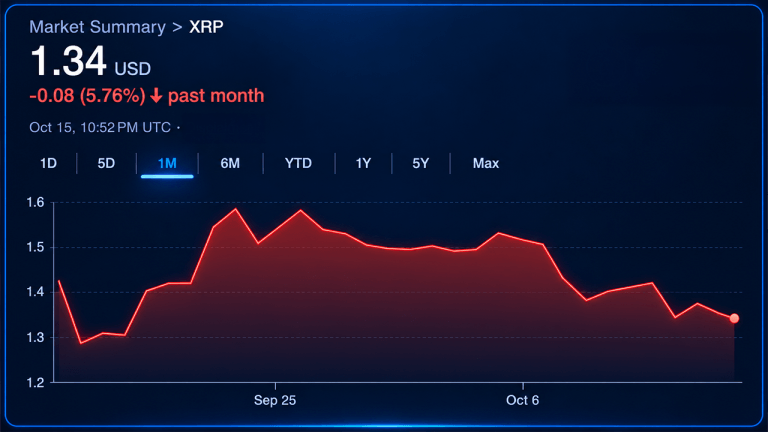
XRP Whales Move 1.67 Billion Tokens to Binance as Price Slips
Large XRP holders have transferred 1.669 billion XRP to Binance over the past 30 days, pushing the exchange’s whale inflow metric...