RChain and ZB: Toward a Queueless, Leaderless, Limitless Blockchain
On November 2rd, 2021, RChain‘s blockchain scientist Atticbee visited ZB exchange as an invited guest for a very technical AMA. ZB is a global exchange being in operation for 8 years with a focus on keeping customers’ as...
Archive context
Older archive item. Useful for background and entity history, but not a fresh market-moving signal.
On November 2rd, 2021, RChain‘s blockchain scientist Atticbee visited ZB exchange as an invited guest for a very technical AMA. ZB is a global exchange being in operation for 8 years with a focus on keeping customers’ assets secure. Atticbee discussed the problems of current blockchain technology and RChain’s answer to these challenges, and why one day RChain will be the most user and developer friendly Web 3.0 infrastructure.
What is Missing In All Current Public Blockchains
In Atticbee’s view, none of existing public chains has addressed these issues that are critical to Web 3.0:
- Currently there is NO REAL solution to the scalability problem: the scalability of Layer 2 and ETH 2.0 is an illusion because the individual Layer 2 and shard subsystems are not interoperable – they do not “look and feel” like one logical chain.
- They are designed for token transfer applications, not data intensive Web 3.0 applications.
- Contracts cannot safely call each other, lacking the “secure composability” to build large, complex software systems from smaller and simpler building blocks as in Web 2.0.
Greg Meredith, the founder of RChain, realized these pain points in 2015 when he and Vitalik, the founder of Ethereum, were working together to scale Ethereum. So he chose the concurrent, composable Rho-Calculus with on-chain formal verification capability as the computational model for the contract layer at the beginning of the design.
This technology route has many features theoretically impossible for other projects:
- Solves the “blockchain trilemma” with concurrent “queueless” transaction processing.
- One platform for all: Direct on-chain storage of large data, integrating all the functions of ETH, IPFS and GRT into one single platform.
- Seamless sharding: shards look and feel like one with atomic cross shard transactions.
- Fast on-chain formal verification based on its OSLF behavior type system.
The Root Cause of the “Blockchain Trilemma” and Its Solution
In Atticbee’s view, the “trilemma of security, performance, and decentralization”, only applies to the current blockchains that require queuing up the transactions, but not applicable to the queueless RChain.
Essentially traditional blockchains require transactions to be processed as a long queue, with all nodes in the network working together to maintain this queue. Then they are doomed to suffer from an impossible triangle of security, performance, and decentralization:
- For security, more nodes need to be involved in maintaining this queue.
- For performance (scalability), the queue needs to move forward as fast as possible.
- For decentralization, all nodes need to have equal opportunity to participate in the management and processing of this queue and monitor each other.
Basic logic tells us one can only choose any two of them and give up the third. Typical examples: Ethereum chooses security and decentralization over performance; Solana, a leader based system, chooses security and performance over decentralization; EOS with 21 equal nodes chooses performance and decentralization over security.
However, when one realizes that “distributedly maintaining a transaction queue is the root cause of the trilemma ”, this problem naturally gets solved if we can eliminate the need for a translation queue like RChain. In RChain’s “block-merge” test network, as more nodes are added, the network achieves higher TPS. It is a solid proof that the trilemma has been solved: more nodes means stronger security; leaderless means decentralized; higher TPS means better performance. Thus RChain reaches all three vertices of the “impossible triangle” simultaneously.
When asked his view on other star projects, Atticbee thinks Solana achieves high TPS at the cost of the blockchain trust model, which is meaningless because any centralized system can have much higher TPS. The idea behind its design is simple: since it is too slow to let many nodes manage the queue together, it simply lets a Proof-of-History node decide the order and write into a tamper resistant PoH ledger. The other nodes just execute and validate the transactions in this ledger.
However, by doing this, the job of managing the queue is centralized, and the PoH node can dictate transaction order, or censor transactions at will. These malicious behaviors are almost impossible to detect and prove. Atticbee mentioned Flow as a project with a similar idea but uses a committee to decide the order, making it a more fair version of Solana, but as a cost its TPS is much lower. It is a textbook example of how a “queued system” inevitably suffers from the trilemma.
As for RChain, it doesn’t need to queue up transactions at all, so it can achieve high TPS while keeping a decentralized leaderless architecture.
Atticbee also views PolkaDot as an incomplete cross-chain solution lacking essential coordination capabilities. It has no way to atomically finalize cross chain transactions. Also it does not provide the “composable security” to ensure that when one contract located calls another contract on another para-chain through the relay chain, the permissions given won’t be leaked to others. RChain has atomic finalization of cross-chain transactions, coupled with a behavioral type system as a “on chain firewall”, making it a superior cross-chain solution.
RChain’s ultimate goal is to build a true global computer to serve as the foundation of Web 3.0. As seen from the Web 2.0 experience, the most valuable asset on the web is the vast amount of data. Therefore all existing blockchains have been built with the wrong design at the beginning: they are exclusively optimized as payment networks. A true Web 3.0 infrastructure must be designed for data-intensive applications.
In addition, we can see that existing Web 2.0 systems are becoming more complex, but thanks to componentization and containerization, developers can quickly build out large systems with smaller reusable components. However, without a fast formal verification system to ensure safe cooperations between contracts, none of the existing blockchains can achieve this. The Venus phase of the RChain roadmap tries to solve this pain point by introducing a behavior type system support. RChain’s Rho-Calculus is one of the very few models that have this capability.
Rholang, a language based on process calculus, has long been neglected by the IT industry because of its reluctance to leave the comfort zone of current programming paradigms. However, entering the blockchain era, Rholang has a range of advantages for blockchain by its design.
First of all, its immutability makes “queueless” transactions possible. All resources in Rholang are immutable data and codes organized by channels. Atticbee made a metaphor: a contract written in a traditional language like Solidity is like a group of kids drawing on a blackboard: the order in which the kids draw will affect the final state of the board, so they must form a queue. On the other hand, Rholang is more like a group of kids playing with Lego blocks: they can pick up and assemble some blocks and then connect the product back to the common project. Since no one can “mutate” any piece, the order doesn’t matter so the kids can play at the same time.
Another important benefit of being “queuess” is that large data can be stored directly on-chain. Any data intensive transactions have to deal with the high latency of network and disk operations. The prerequisite for such transactions to be done on-chain is that they can be processed simultaneously with other types of transactions.
After the sharding milestone, RChain will have another developer friendly feature: there is no difference between writing a cross-shard contract and writing a single-shard contract.
After the Venus milestone, developers can use the behavioral type system to perform static analysis to answer questions such as: Will this code create a race condition, get into a deadlock, or leak any given permissions to a third party? These analyses can be done at compile time in Rholang, before the code runs. With this feature, now you can organize a group of contracts together on-chain and allow them to call each other safely in a concurrent setting. This advantage completes RChain’s ultimate killer feature: on-chain orchestration of contracts, or “Kubernetes on the blockchain”.
The RChain community has already built DApps that other chains can’t do by taking advantage of its on-chain data storage capability:
- Dappy: decentralized DNS server and browser, with NFT and wallets integrated in one package.
- RSong: music streaming DApp with music stored directly on-chain.
- RPI: a photo NFT platform with photo data stored directly on-chain.
- RCovid-19 Passport: vaccination certificates stored directly on-chain.
Atticbee predicts that once all the milestones are complete, the benefit of Rholang is sufficient enough to make every DApp developer adopt this new language paradigm.
This is a sponsored post. Learn how to reach our audience here. Read disclaimer below.
Why this matters
This blockchain story adds another data point to the current market tape and is useful when read alongside nearby source coverage.
Original source
Read on Bitcoin NewsRelated market context
As traditional giants rush into digital dollars, USDD’s Yvonne Chia explains why 24/7 access, self-custody, and transparent yield give decentralized stablecoins an edge banks can’t replicate. 20 November – Road Town, Totorla, British Virgin Islands – Decentralized stablecoin protocol USDD is accelerating its multichain utility across TRON, Ethereum, and BNB Chain—combining automated sUSDD yield via its Smart Allocator with GasFree zero-TRX transfers—as traditional financial giants race to build competing stablecoin rails. In a recent industry interview with instant exchange partner ChangeNOW, USDD Head of Communications Yvonne Chia outlined why self-custody, 24/7 settlement, and transparent onchain reserves give decentralized digital dollars a structural advantage over bank-issued alternatives. 1. Permissionless Access vs. Gatekept Accounts For billions of people globally, opening and maintaining a traditional bank account still involves paperwork, minimum balance requirements, geographic restrictions, and approval delays. Even when banks integrate stablecoin rails behind the scenes, those services remain gated behind legacy compliance walls and intermediary control. Crypto-native stablecoins flip that model on its head. As Yvonne Chia highlighted during the interview: “Compare this to a stablecoin like USDD, where all you need is a phone, a working internet connection, you can immediately start a wallet and you have access to your funds right away.” With USDD, users can access and manage their digital dollars directly through their own wallets, without depending on traditional financial intermediaries. This represents a fundamental shift in financial access: users are no longer limited to the services, operating hours, or account structures of a single institution. Instead, they have the freedom to hold, manage, and transfer their assets on their own terms. Self-custody also gives users greater autonomy over their financial decisions. They can choose which wallets to use, where to transfer their assets, and which supported decentralized applications to interact with, without needing to route every transaction through a centralized financial institution. With USDD, users’ digital dollars can move with them across an open blockchain ecosystem, rather than remaining tied to a particular bank or service provider. 2. 24/7 Global Settlement vs. “Banking Hours” Legacy payment networks still operate on decades-old schedules: weekend cutoffs, bank holidays, and multi-day cross-border settlement delays accompanied by hefty wire fees. Blockchain networks never close. Whether it is a Sunday night or a public holiday, USDD moves globally without depending on traditional banking operating hours or settlement windows. “We are able to have transfers 24/7 and we’re not limited to any traditional banking hours. So I think that in some ways, stablecoins are not just becoming banks, but exceeding what traditional banks can offer to users.” To make everyday transfers even smoother than fintech apps, USDD introduced GasFree integration on TRON, allowing users on supported wallets to pay network fees directly in USDD without needing to hold TRX. This removes another practical barrier to stablecoin adoption: having to acquire and maintain a separate gas token just to transfer digital dollars. With GasFree, eligible users can pay approximately 0.5 USDD per transaction, compared with around 1.5 USDT for a standard USDT transfer under the referenced fee conditions. These improvements matter because the usefulness of a stablecoin is not determined by its peg alone. Low-cost transfers, straightforward wallet experiences, and around-the-clock availability are what make digital dollars practical for everyday payments and global value transfers. 3. Passing Yield Back to Users vs. Bank Spreads Perhaps the sharpest contrast between banks and decentralized stablecoins lies in how yield is distributed. In traditional banking, institutions take customer deposits, deploy them into yield-generating markets, and retain a significant portion of the returns. Everyday depositors may receive relatively low interest rates, while higher-yielding products often come with eligibility requirements, minimum deposits, or fixed maturity periods. Stablecoins introduce another way to participate in digital-dollar opportunities. Rather than keeping capital entirely within a traditional deposit account, users can access onchain yield opportunities through decentralized protocols and transparent investment mechanisms. USDD was built to return that value directly to holders. Through USDD Earn, users can deposit USDD to receive sUSDD, earning automated, competitive yield powered by our Smart Allocator system, with no fixed lock-up periods restricting access to their capital. For users, the distinction is important: USDD Earn provides access to a productive stablecoin while maintaining flexibility, rather than requiring users to commit their capital to a conventional fixed-term product. 4. Onchain Verification vs. Institutional Trust Traditional banks ask customers to trust closed-door balance sheets and periodic regulatory filings—until a crisis proves otherwise. USDD takes a different approach through its “Don’t trust, verify” ethos, emphasizing publicly accessible onchain information and independent verification. Onchain Transparency: Smart contract addresses, collateral reserves, and Smart Allocator deployments are publicly viewable, allowing users to examine relevant information directly on the blockchain. Structured Disclosures: Quarterly Treasury Reports provide additional information about reserve positions, financial performance, and operational developments. Independent Security Reviews: USDD undergoes third-party security audits to assess its smart contracts and identify potential vulnerabilities. Transparency does not eliminate financial or technical risks, but it changes how users can evaluate them. Instead of relying exclusively on an institution’s assurances, users have access to information that can be independently examined and verified. 5. Beyond a Single Network: An Open, Multichain Financial Ecosystem Financial freedom is not just about holding digital dollars. It is also about being able to use them wherever opportunities and applications exist. A stablecoin confined to a single network or limited use case cannot fully realize the potential of open blockchain finance. Following its January 2025 protocol upgrade, USDD expanded natively from TRON onto Ethereum and BNB Chain, extending its reach across multiple blockchain ecosystems. This multichain presence allows USDD to connect with different communities, liquidity environments, and decentralized applications. Its sUSDD product has also expanded into DeFi integrations, including Pendle and Morpho, giving users additional ways to access yield strategies across supported ecosystems. The bigger picture is an interconnected financial ecosystem in which users can move between holding, transferring, exchanging, and deploying their stablecoins according to their own needs. These are not isolated functions. Together, they make stablecoins more useful as everyday financial infrastructure. The Future: Interconnected, Open, and Multichain Banks will undoubtedly continue using stablecoin rails to modernize their back-end settlement. However, true financial freedom comes from open networks where assets flow freely across protocols without intermediaries. For USDD, the opportunity goes beyond offering a dollar-pegged asset. It is about making digital dollars accessible, transferable, and productive across an interconnected financial ecosystem. From self-custody and 24/7 transfers to flexible yield opportunities and multichain DeFi access, these capabilities give users more ways to put their money to work. Banks may be bringing stablecoins into traditional finance. Crypto-native protocols are showing what stablecoins can make possible beyond it.
As traditional giants rush into digital dollars, USDD’s Yvonne Chia explains why 24/7 access, self-custody, and transparent yield...
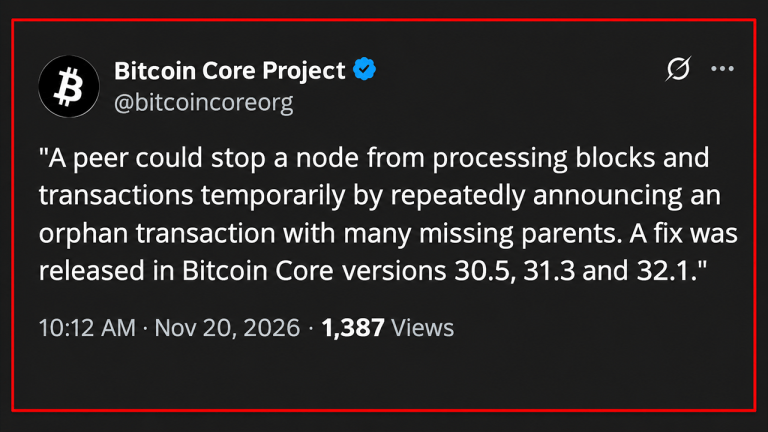
AI Finds Bitcoin Core Security Flaw That Could Temporarily Freeze Nodes
Bitcoin Core disclosed a medium-severity vulnerability on Friday, Nov. 20, 2026, that allowed malicious peers to temporarily paral...

XMR1 Crashes 99.8% After $13.5M Hyperliquid Dump, Wagyu Pledges Full Refunds
Key Takeaways: Hyperliquid saw $13.51 million withdrawn from its XMR1 holdings, resulting in a drop of nearly 99.8%. Bitquery trac...

Researchers Publish Security Analysis of Bitcoin’s Post-Quantum SHRINCS Proposal
Bitcoin Magazine Researchers Publish Security Analysis of Bitcoin’s Post-Quantum SHRINCS Proposal Several researchers have publish...

Ledger CTO Charles Guillemet Exits After Nine Years, Warns AI Is Changing Crypto Security
Key Takeaways: Charles Guillemet, CTO will be exiting the company at the end of 2026. He contributed to the development of Ledger...

Tether builds out QVAC, an open-source AI ecosystem that runs models on your devices
Tether's QVAC ecosystem could decentralize AI processing, enhance privacy, and integrate cryptocurrency transactions into everyday...