Robinhood put stocks on a permissionless blockchain- memecoin traders are stress-testing what happens next
Memecoins paired against Robinhood's tokenized stocks generated $217 million of trading volume on Robinhood Chain on Sept. 2, according to data compiled by on-chain researcher Adam Tehc. The volume outpaced the $127 mill...
Archive context
Older archive item. Useful for background and entity history, but not a fresh market-moving signal.
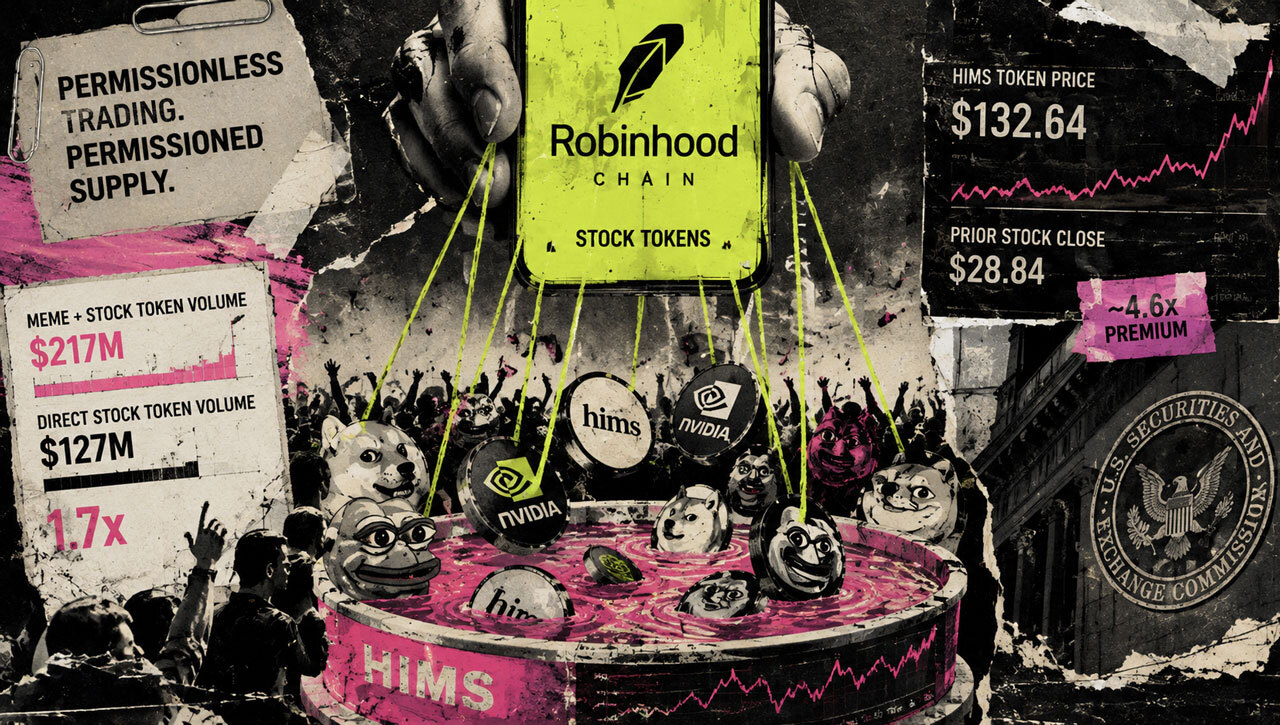
Memecoins paired against Robinhood's tokenized stocks generated $217 million of trading volume on Robinhood Chain on Sept. 2, according to data compiled by on-chain researcher Adam Tehc.
The volume outpaced the $127 million that traded through direct stock token markets that same day. Traders are using tokenized Nvidia or Hims & Hers shares as the plumbing for a memecoin economy Robinhood never designed.
Robinhood describes stock tokens as ERC-20 tokenized debt securities that give holders economic exposure to an underlying stock without legal or beneficial ownership in the issuer.
New supply comes from a single authorized participant, identified at issuance as BBVI, which alone can mint tokens once onboarded. Everyone else trades, pools, and builds with the tokens already in circulation, permissionlessly and without Robinhood's direct involvement.
Activity type Sept. 2 volume What it shows Memecoin pairs using stock tokens $217M Stock tokens are being used as trading infrastructure for speculation Direct stock token markets $127M Traditional “buy the tokenized stock” activity was smaller Difference +$90M Meme-stock-token pairs generated about 71% more volume than direct stock-token trading Ratio 1.7x The casino layer outpaced the investment layer A memecoin cornered more than half the tokenized float on Robinhood ChainA memecoin called BONER accumulated 31,198 of the 58,714 HIMS stock tokens then outstanding, roughly 53% of the entire tokenized supply, with another 1,424 sitting in separate meme pools.
That left only about 20,303 tokens circulating in conventional HIMS pairs against stablecoins and ETH, the thin remainder available for anything resembling ordinary price discovery.
While the New York Stock Exchange sat closed for the weekend, the tokenized HIMS instrument printed as high as $132.64. That compares with a $28.84 close for the underlying stock the previous Friday, a premium of roughly 4.6 times.
A small, closed-loop pool of tokens experienced an AMM scarcity event while the market that could have supplied fresh tokens or corrected the price sat shut.
Hims & Hers has roughly 233.3 million shares outstanding, so the 58,714 HIMS stock tokens involved equal about 0.025% of that count. Reported short interest in the stock runs near 58.7 million shares, meaning the entire tokenized float that briefly cornered represented roughly 0.1% of the shares already sold short.
The episode left Hims & Hers' equity market untouched, while shaking confidence in a much smaller, newer market sitting on top of it.
Once the underlying market reopened, BBVI minted roughly 4,000 new HIMS stock tokens, worth about $115,000 at Friday's closing price and equal to just 6.8% of the prior tokenized supply.
That comparatively small injection was enough to pull the token price back toward the stock's value. The real vulnerability sits in who controls new supply, when they can create it, and which pools need it during a squeeze, well beyond the total dollars involved.
Metric Figure Why it matters HIMS stock tokens outstanding 58,714 The full on-chain wrapper supply was tiny Tokens accumulated by BONER 31,198 Equal to 53.1% of tokenized supply Peak tokenized HIMS print $132.64 About 4.6x the prior stock close HIMS prior Friday stock close $28.84 The reference price the wrapper was meant to track New tokens minted after reopen ~4,000 Only 6.8% of prior tokenized supply Approx. value of new mint at stock close ~$115,000 A small supply injection helped normalize the wrapper Hims & Hers shares outstanding ~233.3M Shows the real equity market was much larger Tokenized float as share of equity count ~0.025% Confirms this was not an equity-float squeeze Robinhood stock tokens become the thing memecoins are priced againstInside the Robinhood Chain pools, HIMS or Nvidia stock tokens become the denominator memecoins are priced against, turning a security-linked instrument into part of the speculative settlement layer itself.
The underlying stock trades during regulated exchange hours, and Robinhood's own oracle feeds for stock token prices update 24 hours a day, five days a week, on that same schedule. The on-chain token itself keeps trading and transferring around the clock regardless, so a weekend print does not necessarily represent a repriced stock.
It more often points to stress inside a thin token wrapper trading without its usual reference market open.
Secondary trading is permissionless and open to anyone, but new stock token supply only comes from an authorized participant. A large on-chain dislocation can form even in an instrument explicitly built to track a real security, because nobody trapped in a cornered pool can mint their way out.
Robinhood's terms say it does not control what third parties build on the chain and cannot reverse transactions once submitted.
Its securities filings separately warn that this same third-party activity may be difficult or impossible to monitor, influence, or prevent, even though Robinhood could still face reputational, legal, or regulatory consequences from whatever happens.
Regulators are already circling the underlying questionThe SEC said in January that representing a security through a crypto network does not change which federal securities laws apply. That statement targeted this kind of third-party product offering synthetic exposure to an underlying stock.
The World Federation of Exchanges has separately warned regulators that tokenized equities raise real issues around market integrity, disclosure and post-trade standards.
Both are describing a genuine gap in who takes responsibility when a security-linked token starts behaving like a permissionless crypto asset.
Nasdaq's approved tokenization framework and DTCC's tokenization service both keep tokenized securities on the same order books, under the same rights and controls as conventional shares.
Related Reading SEC tokenized stock exemption to let equities move onto crypto railsRobinhood Chain sits at the end of a broader move, letting its tokens loose into open DeFi composition. Citi's 2030 tokenization outlook, projecting roughly $5.5 trillion in tokenized assets under its base case, anticipates retail investors doing this with instruments like it.
For crypto markets broadly, the more interesting implication is that on-chain speculation may grow less dependent on BTC, ETH, and stablecoins as its default liquidity legs if tokenized equities keep working this well as collateral and quote assets in their place.
Whether this becomes real infrastructure or a lasting liabilityThe bull case is that stock tokens graduate from meme-pair liquidity into broader usage in lending, collateral, and index products, with direct stock token activity and legitimate collateral use eventually overtaking memecoin-pair volume.
Under that path, Robinhood Chain's RWA activity multiplies several times over from today's roughly $188 million base, and the network becomes credible on-chain brokerage infrastructure.
Path What Robinhood Chain becomes Signal to watch Market implication Bull case: infrastructure Stock tokens become collateral, lending assets, index components, and settlement legs Direct stock-token and collateral activity overtakes memecoin-pair volume Tokenized equities become credible on-chain financial primitives Bear case: liability Meme pools and low-float squeezes remain the dominant source of activity Memecoin-stock pairs repeatedly exceed direct stock-token trading; more weekend dislocations appear High volume starts looking like market-integrity risk rather than product validation Core tension Same assets enable both outcomes Ratio of productive use vs. reflexive speculation Robinhood benefits from activity but inherits reputational and regulatory exposureThe bear case has volumes staying high while remaining dominated by reflexive meme pools and low-float squeezes like the one HIMS just experienced. Regulators and issuers turn their attention toward disclosure and market-integrity risk, well past simple growth metrics.
In that scenario, high transaction counts stop reading as validation, and Robinhood's fee opportunity comes wrapped in the reputational exposure its filings already warn about.
Tokenization promised that a stock stops being just something you buy and becomes something software can use. Memecoin traders are showing Wall Street what “use” means when nobody outside crypto got a vote in the definition.
The post Robinhood put stocks on a permissionless blockchain- memecoin traders are stress-testing what happens next appeared first on CryptoSlate.
Why this matters
Robinhood is showing up inside the Stablecoins theme, so this story is worth tracking for follow-through rather than treating it as a one-off headline.
Original source
Read on CryptoSlateRelated market context

Robinhood Explores Stock Token Tied to T. Rowe Price Actively Managed ETF
Robinhood Crypto said in a post on Thursday that it is exploring a Stock Token tied to an actively managed ETF, with T. Rowe Price...

Jersey, BVI and UAE dominate the tokenized stock market
The concentration of tokenized stock markets in a few jurisdictions highlights potential regulatory vulnerabilities and influences...

IMF Flags $300T Tokenization Gap, Warns 24/7 Markets Could Amplify Market Risks
Key Takeaways: About $300 billion – $350 billion are traded in tokenized repos every day, which remains significantly smaller than...

LiquidAcre selects Uphold to power tokenized real estate infrastructure
The partnership could accelerate the adoption of tokenized real estate, potentially transforming property investment and ownership...
LiquidAcre Selects Uphold to Power Digital Asset Infrastructure and Future Tokenized Real Estate Offerings
LiquidAcre, a financial technology company building a platform designed to expand access to real-world assets and digital financia...

Base creator Jesse Pollak says equities and non-dollar stablecoins will lead upcoming ‘tokenization supercycle’
Coinbase launched tokenized stocks on Base six weeks ago, with about $70 million to $100 million in daily volume, according to Pol...