Standard Chartered’s $100 Uniswap call exposes the open DeFi problem Wall Street may need to solve
Standard Chartered has set a $100 UNI target for the end of 2030, a forecast that would put one of DeFi's largest governance tokens far above its current market range. The bank's thesis states that tokenized assets may e...
Archive context
Older archive item. Useful for background and entity history, but not a fresh market-moving signal.

Standard Chartered has set a $100 UNI target for the end of 2030, a forecast that would put one of DeFi's largest governance tokens far above its current market range.
The bank's thesis states that tokenized assets may eventually require DeFi venues to convert fragmented on-chain instruments into usable liquidity.
The Standard Chartered note said the bank assumes tokenized assets could reach $4 trillion by 2028. The same thesis puts the share active in DeFi rising from about 3.5% today to 30% by 2030.
On that math, DeFi could hold over $2 trillion by 2030.
Tokenization is being built by banks, asset managers, transfer agents, and regulated platforms, yet the liquidity layer could still reward open protocols if those assets require round-the-clock trading, collateral movement, and composability beyond a single issuer's system.
CryptoSlate data on June 16 showed UNI trading near $3.02, with a market cap of roughly $1.88 billion and 24-hour trading volume of about $353.9 million. The broader CryptoSlate coin rankings snapshot showed a crypto market of about $2.27 trillion and a daily trading volume of about $89.8 billion.
Against that market backdrop, the practical question is whether tokenized Treasuries, funds, equities, stablecoins, and other on-chain assets become inventory for open liquidity, or stay in systems where access, settlement, and transfer remain tightly controlled.
Related Reading Wall Street’s on-chain push leaves DeFi facing a $330 billion trust test Regulated players are taking blockchain finance on-chain, forcing DeFi to prove its risk is worth the upside. Apr 5, 2026 · Gino Matos The bank thesis depends on open liquidityThe Standard Chartered call rests on a chain of assumptions. Tokenized assets first need to grow into a large enough market. A meaningful share, then, needs to become active in DeFi, rather than simply sitting on-chain as a record of ownership within a regulated wrapper.
Finally, Uniswap has to capture enough of that activity for UNI economics to benefit. The claim shifts the focus from issuance to liquidity.
Standard Chartered's public work already frames tokenization as a large long-term opportunity. In 2024, the bank said a paper with Synpulse projected tokenized real-world assets could reach $30.1 trillion by 2034, with trade finance among the major categories.
The same release said tokenization could create new applications in DeFi and new business models.
Citi's June 2026 tokenization report points in the same direction on market size, while adding a counterweight. Citi projected a $5.5 trillion base-case tokenized asset market by 2030 and an $8.2 trillion bull case.
It also said hybrid models may dominate, with institutions controlling issuance, distribution, and settlement rails.
The divide defines Uniswap's opportunity. If tokenization grows but the value remains within bank platforms, transfer-agent systems, broker-dealer networks, or approved marketplaces, open DeFi plays a limited role.
If assets need broader venues where different tokenized instruments, stablecoins, and collateral can trade against one another, protocols such as Uniswap become more central.
DefiLlama data supports the view that Uniswap is a plausible candidate for that thesis. As of press time, the protocol had about $2.89 billion in total value locked across multiple chains and more than $50 million in 30-day fees.
The present data only establishes an operating base, but it places Uniswap in the liquidity-infrastructure category rather than the pure governance-token category.
For institutions, the distinction is practical. Issuing a fund token is one process; creating a venue where it can trade against stablecoins, collateral, and other tokenized instruments is another.
That gap is where an open automated market maker could either become useful infrastructure or remain a marginal connection point.
The venue decision, therefore, becomes as important as issuance, because liquidity determines whether tokenized products become usable markets, collateral, and settlement assets, or remain static records within approved systems.
BUIDL shows the bridge and the gateBlackRock's BUIDL fund provides a live example of the thesis. In February, Uniswap Labs and Securitize announced that BlackRock's USD Institutional Digital Liquidity Fund was available for trading on UniswapX.
The integration uses an RFQ framework, whitelisted subscribers, and pre-qualified participants.
CryptoSlate's earlier BUIDL coverage captured the central tension: BUIDL holders can swap into USDC through UniswapX, but the access is gated.
The trade touches DeFi technology while keeping the asset limited to approved participants.
BlackRock's original BUIDL launch terms show how controlled that model can be. The fund was offered to qualified investors through Securitize, had a $5 million initial investment minimum, could be transferred only to pre-approved investors, and was not listed on an exchange.
RWA.xyz showed BUIDL at about $2.37 billion in total asset value and 108 holders on June 16.
Read together with the access terms, that supports a cautious view of tokenization's current state: large tokenized products can exist on-chain while participation remains concentrated and permissioned.
Standard Chartered's own May 2026 investor presentation also cited BUIDL's integration into Uniswap to enable distribution and trading.
The deck places Uniswap within the same institutional digital-asset infrastructure that the reported target depends on, even though the exact UNI initiation note has not been made public.
Routing model What it gives institutions What it gives Uniswap Main constraint Open DeFi liquidity 24/7 markets, composability, stablecoin settlement, and broader collateral use More pools, more fees, deeper relevance for tokenized assets Compliance, identity, and transfer restrictions must be solved without killing open access Controlled bank and broker-dealer rails Permissioned access, familiar compliance, curated counterparties, and easier risk controls Limited integration points such as RFQ access or whitelisted liquidity Liquidity may stay fragmented across private systems and approved venuesThe BUIDL example currently sits between those two models. It uses Uniswap technology, yet preserves institutional controls around who can participate. That design creates a bridge into DeFi infrastructure without moving tokenized assets into fully open liquidity.
Related Reading RWA tokenization nears $30 billion, but DeFi is capturing only a fraction Only $2.47 billion of nearly $30 billion in tokenized RWAs is active in DeFi, showing how compliance rails still limit open-market use. May 18, 2026 · Gino MatosThis is the version of open liquidity institutional assets may accept first: DeFi rails for execution and settlement, paired with restrictions around identity, transferability, and counterparties.
UNI still needs a capture mechanismGreater RWA activity on Uniswap would not by itself guarantee value for UNI holders. The asset still needs a capture mechanism.
The executed UNIfication proposal on Tally describes the protocol-fee and UNI-burn mechanics and states that Uniswap aims to become the default exchange for tokenized value.
That gives the valuation argument a route, but it also makes the path conditional. Governance decisions, fee settings, commercial integrations, and actual volume all need to line up.
The reported Standard Chartered target is well above current market levels and UNI's 2021 all-time high. A $100 target cannot rest only on asset issuance. It requires real trading flows, durable fee generation, and a clearer link between protocol growth and token economics.
The institutional tokenization debate becomes practical at that point. Banks and asset managers may want blockchain settlement, 24/7 transferability, programmable collateral, and stablecoin payment rails.
They may also want KYC, transfer restrictions, approved counterparties, and control over where secondary markets form.
Related Reading SEC targets 20-year-old rule standing between Wall Street and blockchain trading The SEC’s plan to scrap the trade-through rule could remove a major obstacle for equities trading on blockchain networks. Jun 12, 2026 · Oluwapelumi AdejumoThe Financial Stability Board's tokenization work reinforces that caution. It describes tokenization as still small in scale and highlights issues such as limited-access structures, interoperability gaps, settlement-asset constraints, and platform fragmentation.
Those are the frictions that can keep tokenized assets from becoming liquid, composable DeFi inventory.
If those frictions dominate, Uniswap becomes an integration point at the edge of institutional tokenization. If they ease, the protocol could become one of the venues where tokenized funds, stablecoins, and crypto-native assets meet.
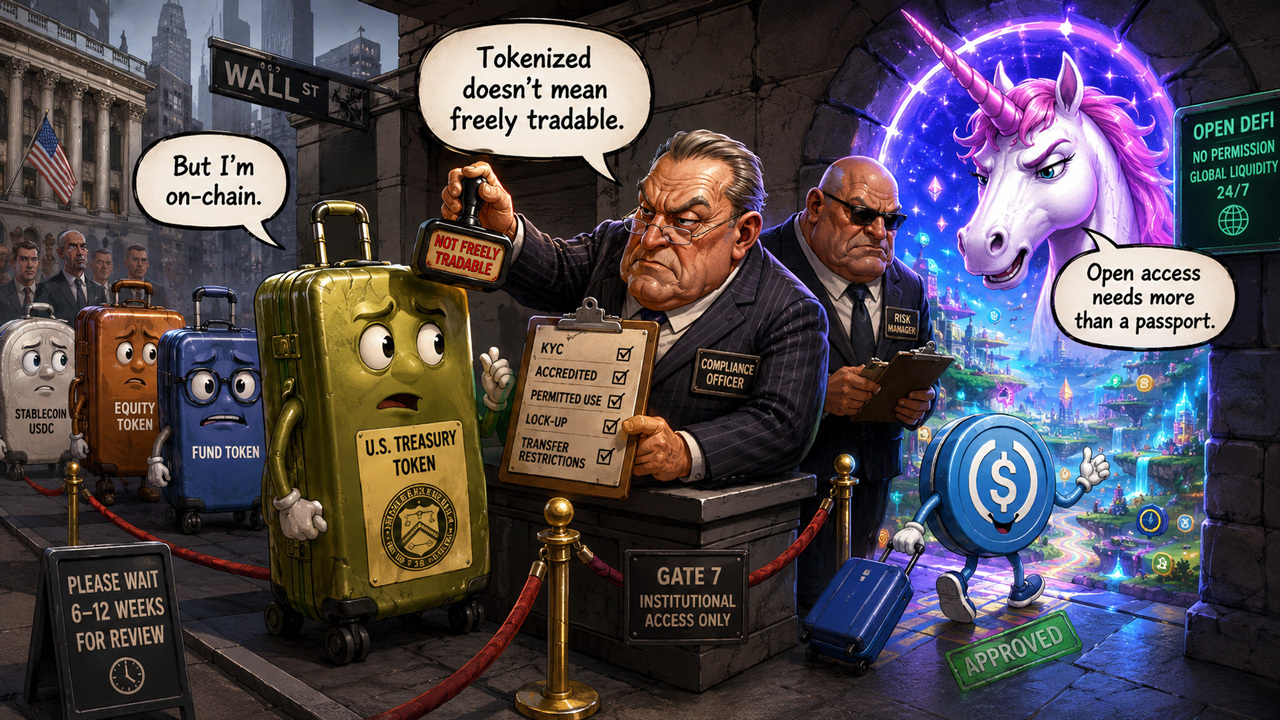
Standard Chartered's reported call ultimately depends on where tokenized liquidity settles. The $100 target introduces market upside, while the stronger claim is that a Wall Street bank sees a path for DeFi protocols to capture part of the institutional tokenization wave.
BUIDL already shows that asset managers can use DeFi technology while preserving tight access controls. Citi's tokenization outlook suggests Wall Street may build hybrid systems that keep issuance, distribution, and settlement close to institutions.
The FSB's caveats show why interoperability and settlement remain central.
The next evidence will come from new tokenized asset integrations. If they remain isolated, whitelisted RFQ channels, open DeFi captures only a slice of the market.
If they create broader pools that allow tokenized assets to move across DeFi liquidity with fewer bespoke controls, Uniswap's role in tokenization could expand beyond crypto-native swaps.
The post Standard Chartered’s $100 Uniswap call exposes the open DeFi problem Wall Street may need to solve appeared first on CryptoSlate.
Why this matters
Uniswap is showing up inside the Stablecoins theme, so this story is worth tracking for follow-through rather than treating it as a one-off headline.
Original source
Read on CryptoSlateRelated market context

Bitcoin defies $800 million crypto wipeout as South Korea’s AI stock market crashes
Bitcoin rebounded above $83,000 on Tuesday despite a sharp Asian stock selloff, as cryptocurrency liquidations exceeded $800 milli...

Coinbase’s Base launches “Earn & Borrow” for Ethereum layer-2 apps
The integration could boost Ethereum's utility and market perception, potentially influencing its adoption and future valuation po...
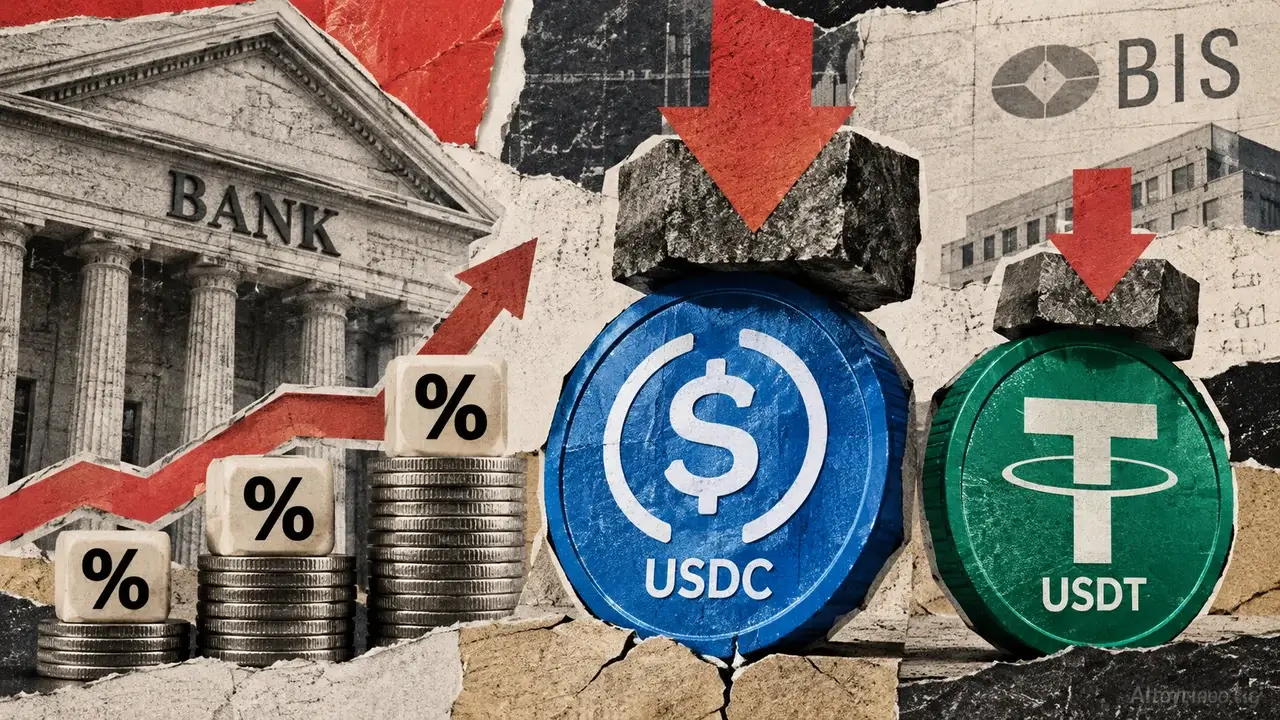
US deposit rates choke USDC adoption, and a BIS model reveals why
Historical estimates point to stronger USDC growth sensitivity to deposit repricing, while exchange rewards complicate adoption fo...
TRON settles $2.2 trillion in stablecoins in Q3 as onchain payments grow
TRON settled $2.2126 trillion in stablecoins in Q3 2026, with supply hitting $93.88 billion and a 23.2% share of stablecoin card s...

$900 billion asset manager Federated Hermes taps crypto infrastructure to bring tokenized funds to brokerages
This partnership could accelerate the integration of blockchain in traditional finance, potentially reshaping investment accessibi...

Stacks’ STX Jumps 50% in Four Weeks as Bitcoin Layer-2 Staking Demand Builds Ahead of November Bonding Period
STX has jumped over 50% in four weeks as investors position for Stacks' November Bonding Period 3 and its non-custodial bitcoin st...