UNIfication Greenlights 100M UNI Burn and Switches On Protocol Fees
Key Takeaways: The proposal of UNIfication has been passed by more than 125 million UNI votes by Uniswap governance, which was well above the expected quorum. This choice opens a one-time burn of 100 million UNI of the t...
Archive context
Older archive item. Useful for background and entity history, but not a fresh market-moving signal.
Key Takeaways:
- The proposal of UNIfication has been passed by more than 125 million UNI votes by Uniswap governance, which was well above the expected quorum.
- This choice opens a one-time burn of 100 million UNI of the treasury and protocol-level trading fees following a brief timelock.
- The shift restructures the tokenomics of Uniswap, which previously relocated the value capture to the frontend fees, and it also alarms the liquidity providers.
Uniswap has passed one of the key governance resolutions in its history. The UNIfication proposal is a game changer in terms of the manner the protocol frames value and aligns incentives throughout its ecosystem.
Uni Governance Provides a Resounding VoteThe support of the UNIfication project is overwhelming among the community of Uniswap, the long-awaited project to revamp the economic model of the protocol. The vote ended on December 25, with 125,342,017 UNI.
The outcome was a smash of the 40 million quorum of UNI, indicating general agreement between token owners. The proposal is currently in a two-day timelock following the normal governance procedure and once the approved changes undergo a timelock, they are executed on-chain.
This is not only a vote that has a margin but has implications. UNIfication will change how Uniswap earns money on its huge trading volumes without charging interfaces and instead capturing value at the protocol layer.
Read More: Uniswap Vote Nears 62M UNI as Fee Switch, 100M Token Burn and Revenue Model Overhaul Loom
Which UNification Changes to the Core of UniswapUNIfication fundamentally reinvents the flows of economic value through the Uniswap ecosystem.
The Treasury will burn a 100 Million UNIThe most seismic and the most newsworthy is a one-time burn of 100 million UNI tokens, which will be sourced directly out of the treasury of Uniswap. This burn permanently lowers the circulating supply of UNI, and is a retroactive fixing of all protocol fees that have never been raised in past years.
Decreasing supply on this level, Uniswap may present a massive deflationary event that depends not on the market, but on governance action.
Protocol Fee Switches are Put into ServiceTogether with the burn, UniSwap will enable protocol fee switches on liquidity pools supported. As opposed to channeling all the swap fees directly to liquidity providers, some of them will now be accrued at the protocol level.
More importantly, these fees are not charged in the interface of Uniswap, but rather in the protocol. This difference supports the purpose of Uniswap as an impartial infrastructure and not an application that charges fees.
Frontend Fees Are Turned OffTo accompany the same change, Uniswap Labs will turn off frontend charges, halting interface-based monetization. The protocol realigns development and revenue generation with the core mechanics of the protocol, and makes Uniswap more consistent with its decentralized ethos.
The Reason This Vote is Important to UNI TokenomicsUNIfication is a structural change in the derivation of value in UNI. Rather than depending on the indirect demand or speculative story, the protocol is much closer to the economic activity of Uniswap by connecting UNI to it. The protocol-level fees become higher as the trading volume is rising. Governance can determine over time how such fees are spent such as additional burns or other value-accretive mechanisms.
The 100 million UNI burn is also a powerful message. It does recognize that the protocol had years of operation without its fee switch going off and tries to amend that hindsight lapse. Very little DeFi protocols have made such an overt retroactive measure.
This forms a more direct relationship between protocol usage and token economics to UNI holders, despite the fact that UNI itself does not automatically get fee distributions.
Liquidity Providers Wave Red FlagsAlthough this was almost unanimous, UNIfication has raised eyebrows among veteran liquidity providers (LPs). Other arguments lobbed by some LPs are that protocol fees will squeeze already small margins, particularly on Uniswap v3 pools where capital efficiency is high but returns are very price-elastic to fees. A minor protocol take can have a material impact on profitability.
Two broad paths of risk have been presented by critics. In the former, there is no aggressive intervention as a form of governance. The decreasing net LP returns are a gradual withdrawal of liquidity which causes a decrease in depth and poor fee generation. In the second, the governing body has a high dependence on UNI incentives to retain liquidity in place. Although this could stabilize pools, it can also cause a systemic effect of a circular economy of token emissions compensating protocol fees at the expense of long-term UNI holders.
Read More: $100B Milestone Reached: Polygon Sets New Record on Uniswap, Signals DeFi Momentum
The post UNIfication Greenlights 100M UNI Burn and Switches On Protocol Fees appeared first on CryptoNinjas.
Why this matters
This blockchain story adds another data point to the current market tape and is useful when read alongside nearby source coverage.
Original source
Read on CryptoNinjasRelated market context

Multiliquid raises $8 million to expand liquidity in $40 billion tokenized asset market
Multiliquid's funding could enhance liquidity in tokenized markets, potentially accelerating institutional adoption and transformi...

Orbs – DeFi’s Next Big Users Are Banks and Bots
Why you should listen Ran came to crypto the way many lawyers of his generation did. In 2015 a university friend and future Orbs c...

Bitcoin ETF Records $260 Million Outflows, Led by Fidelity and BlackRock
US spot Bitcoin ETFs recorded $261.4 million in net outflows on October 14, led by Fidelity’s FBTC with $152.7 million withdrawn a...

Quantum Alliance forms amid warnings 6.4 million bitcoin face future quantum threat
Nine crypto companies launched the Quantum Alliance to jointly prepare for quantum attacks, but they disagree on when the threat w...

U.S. judge rejects Gemini’s appeal to void $5 million settlement despite CFTC backing
The crypto exchange already paid up, but a court order and restrictions from its 2025 settlement will not be lifted even though th...
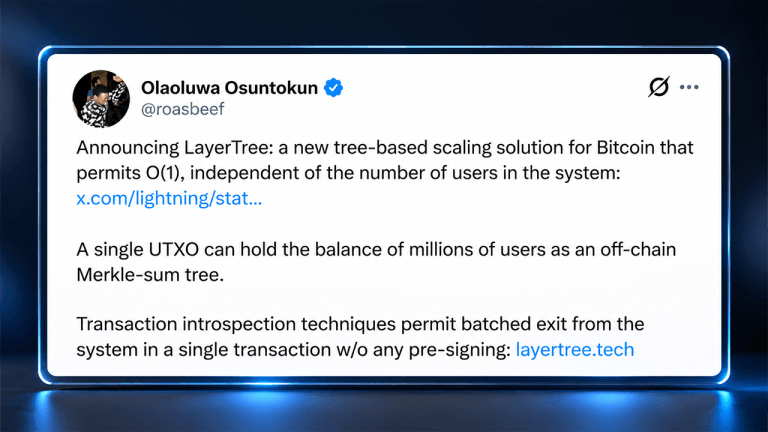
New Tree-Based Bitcoin Scaling Proposal Targets Millions of Users
Bitcoin developer Olaoluwa Osuntokun has unveiled Layertree, a proposal that could squeeze millions of bitcoin owners into a singl...