Web3 Wallets and Centralization: Can They Coexist?
Web3 wallets have become a crucial tool in the new era of the Internet, where decentralization, blockchain, and cryptocurrencies are at the forefront of innovation. A Web3 wallet, also known as a crypto wallet, is a digi...
Archive context
Older archive item. Useful for background and entity history, but not a fresh market-moving signal.

Web3 wallets have become a crucial tool in the new era of the Internet, where decentralization, blockchain, and cryptocurrencies are at the forefront of innovation. A Web3 wallet, also known as a crypto wallet, is a digital wallet that enables users to store, send, and receive cryptocurrencies, interact with smart contracts, transact NFTs, and access dApps on different blockchains.
As the use cases of Web3 wallets continue to expand, the question of whether centralization can play a role in managing these wallets arises. I will explore the concept of Web3 wallets managed by Centralized Exchange (CEX) and discuss whether it aligns with the principles of Web3.
What Is CEX + Web3 Wallet?
CEXs (centralized cryptocurrency exchanges) act as intermediaries for buying, selling, and trading cryptocurrencies in a centralized manner. They offer a user-friendly platform where users can conduct various cryptocurrency transactions. However, users must trust the exchange to manage their funds securely, as the exchange controls the wallets.
Web3 wallets provided by CEXs claim to integrate with decentralized ecosystems and allow interactions with dApps and blockchains. Despite this claim, the underlying nature of these wallets remains centralized, as the exchange retains control over users' private keys and funds.
The centralization aspect of CEXs extends to their Web3 wallets in various ways:
- Users entrust the exchange with storing and managing their private keys, relying on the exchange's security measures.
- The infrastructure supporting Web3 wallets, such as servers and network nodes, is owned and operated by the centralized exchange.
- Transactions from CEX's Web3 wallets undergo internal approval and validation before being broadcasted to the blockchain, introducing a centralized control point.
For users seeking decentralization and full control over their funds, self-hosted software wallets or hardware wallets may be more suitable.
While Web3 wallets and centralization can coexist to some extent, the level of centralization varies depending on specific implementation and design choices by wallet providers. Understanding this relationship can shed light on how these elements interact.
Reputation scores verify wallet reliability based on on-chain activity. 🔒💼 @OrangeProtocol assesses user activity across wallets to build Web3 scores: Reputation, activity, and creditworthiness. Join us in exploring the evolution of identity rating.…
— Orange Protocol (@OrangeProtocol) July 19, 2023Case Studies
Let me share some examples:
Case Study 1: OKX Wallet
OKX, a well-known player in the Web3 technology space and the second-largest cryptocurrency exchange in terms of trading volume, recently unveiled a significant upgrade to its OKX Wallet. This upgrade introduces groundbreaking features that position it as the first Web3 wallet to integrate advanced multi-party computation (MPC) technology.
Integrating MPC technology into the OKX Wallet eliminates the need for traditional key and seed phrase storage methods. Instead, the user's private key is divided into three parts, significantly enhancing security and reducing the risks associated with a single point of failure. Leveraging MPC ensures that users retain complete control over their wallet assets while enjoying the highest level of security.
OKX Wallet operates as a fully decentralized and non-custodial solution, empowering users with full ownership and control over their funds. Unlike centralized exchanges, OKX does not hold users' assets, creating a secure environment that allows individuals to have custody of their cryptocurrencies.
The wallet offers multi-blockchain support and automatically recognizes and connects to supported networks, providing a convenient solution for users engaged in decentralized finance (DeFi), non-fungible tokens (NFTs), and decentralized applications (DApps).
The upgraded OKX Wallet introduces an innovative asset recovery feature called "independent Emergency Escape," revolutionizing the recovery process. In critical situations, users can regain access to their assets through using two out of three access credentials: a device, a cloud backup, or an OKX account login. This unique feature enhances user security and autonomy, allowing individuals to regain control of their assets without relying on OKX's involvement.
In addition to its robust security features, the OKX Wallet provides complete control and ownership of funds, facilitating faster withdrawals without withdrawal approval. The wallet allows seamless management of multiple chains, eliminating the need for manual network switching.
Users can import multiple seed phrases and derive addresses within the wallet. Easy connectivity is ensured through the OKX Wallet web extension and dedicated iOS and Android mobile apps. Integration with the OKX DEX, an integrated decentralized exchange aggregator, enables multi-chain and cross-chain transactions.
Thanks OKX wallet for the integration support, Trait Sniper is not only in NFT domain, now also spreading to SocialFi domain.🥳To be continued... https://t.co/Kwuuwteyt4
— Trait Sniper 🟣💎 | Influence Network (@TraitSnipergame) July 27, 2023Case Study 2: Bitverse
Introducing Bitverse, an innovative MPC + AA Wallet leading the way in building the "Credit Creates Wealth" Web3 ecosystem. Bitverse combines artificial intelligence, Oracle credit protocols, and advanced cryptographic techniques to create a secure, decentralized, and user-friendly environment for controlling and managing assets.
It aims to promote user engagement and loyalty with engaging features like lucky packets, event guessing, non-fungible tokens (NFTs), and airdrop tools. We will explore the key advantages and how it is shaping the landscape of Web3.
One of the primary advantages is its implementation of the Bitverse Credit Protocol (BCP) and Credit Oracle. BCP is a decentralized credit protocol that leverages AI and Oracle technology. It establishes a hybrid credit system (OCC + RWC) that operates on both the blockchain and off-chain.
Extending credit capabilities to both realms ensures that credit is accessible and convenient for all industry members and users. This innovative approach addresses common pain points in the industry, such as low fund utilization and limited benefits for high-credit users.
To achieve robust security, it employs MPC. It also prioritizes convenience for its users and incorporates a secret key partition management system with cryptography principles, zero-knowledge proofs, trusted execution environments (TEE), and robust authentication mechanisms.
In its development, it is actively working on an Account Abstraction (AA) wallet that supports non-main chain currencies. This AA wallet enables users to pay gas fees using alternative tokens. For compatibility, it supports single-signed wallets using traditional mnemonic phrases. This compatibility ensures a seamless transition for users already familiar with existing Web3 wallet practices while expanding the user base.
With its unique features and user-centric approach, it is shaping the future of decentralized finance and revolutionizing how users control and manage their assets in the digital world. It's worth noting that Bitverse is integrated into the Bybit exchange, further expanding its reach and capabilities.
' #Dexalot willl continues deliver the look & feel of centralized exchanges further fulfilling objective, they replicate user experience of centralized exchanges (CEX) without compromising on decentralization & transparency.1/2#Avalanche $AVAX
— DeJetStream 🔺️ (@DeJetStream_) July 19, 2023Can CEXs Manage Web3 Wallets?
The examples provided above serve to illustrate two distinct aspects. The first example showcases how a CEX can develop its own Web3 solution, while the second demonstrates the integration of a third-party solution. Both integrations have their merits and represent a positive step towards enabling users to experience the functionality of Web3.
In contrast, Web3 is founded on the principle of decentralization, ensuring that no single entity maintains control over the network. Decentralization enhances security, transparency, and resilience against attacks by eliminating a central point of failure.
So, can CEXs manage Web3 wallets? Technically, the answer is yes, but it contradicts the principles of Web3. When users entrust their assets to a CEX-managed Web3 wallet, they place their faith in the CEX, which undermines the concept of decentralization.
CEXs have a history of security breaches, and if it is hacked or goes bankrupt, users may permanently lose their funds. Moreover, they may impose restrictions on users' funds, such as freezing or seizing them, which contradicts the financial sovereignty that Web3 aims to achieve.
Another concern with CEX-managed Web3 wallets is the risk of censorship. They may comply with government regulations and limit users' access to specific decentralized applications (dApps) or blockchains, eroding the idea of an open and permissionless internet envisioned by Web3 further.
However, it is essential to note that not all CEXs are identical. Some have taken steps towards decentralization by adopting non-custodial features, enabling users to retain control over their private keys and assets while benefiting from the user-friendly interface of a centralized exchange.
Many also offer cross-chain interoperability, allowing users to access multiple blockchains from a single platform, which can be convenient for those who trade various cryptocurrencies. Nevertheless, despite these efforts, CEX-managed Web3 wallets still diverge from the core principles of Web3.
In Conclusion
Web3 wallets managed by CEXs may offer a user-friendly interface for cryptocurrency trading and accessing different blockchains, but they deviate from the fundamental principles of Web3. Decentralization is a pivotal aspect of Web3, distinguishing it from traditional Internet and financial systems.
While Web3 wallets and centralization can coexist, users should be cognizant of the degree of centralization involved and make informed decisions based on their priorities. For users seeking decentralization, the ideal scenario entails utilizing wallets prioritizing client-side control, locally stored private keys, and open-source code allowing independent verification.
The usual "Anndy Lian" quote to end the article: "Whether championed by a centralized or decentralized entity, this is the journey of Web3. We must respect this entire process."
This article was written by Anndy Lian at www.financemagnates.com.Why this matters
This blockchain story adds another data point to the current market tape and is useful when read alongside nearby source coverage.
Original source
Read on Finance MagnatesRelated market context

A new XRPL upgrade could concentrate XRP ownership inside banks instead of retail wallets
A proposed XRP Ledger (XRPL) upgrade could let banks and fintechs absorb XRP costs so customers never need to hold the token. The...

XRP News: XRPL Records 2K Transactions from 20 Wallets
The XRP Ledger processed a record 3,254 transactions in ledger 106,965,249 yesterday, but 2,000 of the news came from just 20 acco...
Bitcoin exchanges can reduce quantum exposure before a network upgrade
A future quantum-safe Bitcoin will have to pass through the systems that hold and move today's coins. Exchanges, institutional cus...
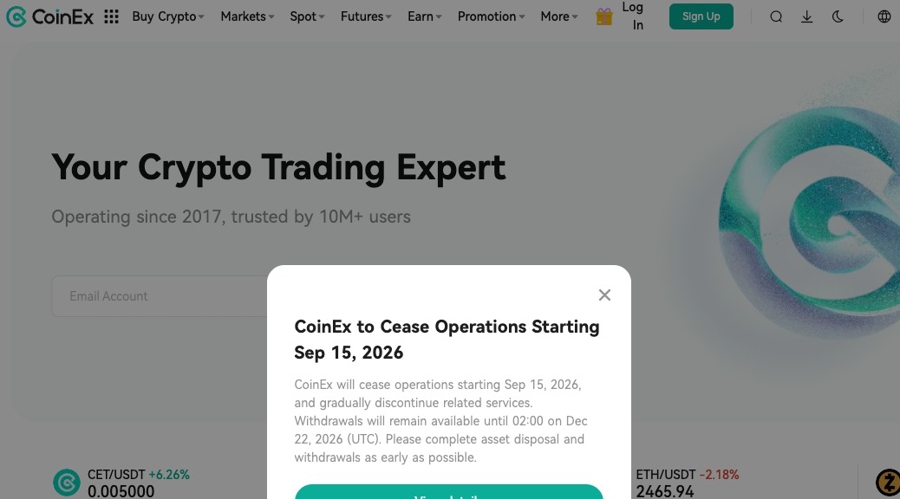
CoinEx Cashes Out: Hong Kong Crypto Exchange to Shut After Nine Years
CoinEx, a Hong Kong-based cryptocurrency exchange founded in December 2017 by mining pool ViaBTC, today (Tuesday) announced that i...
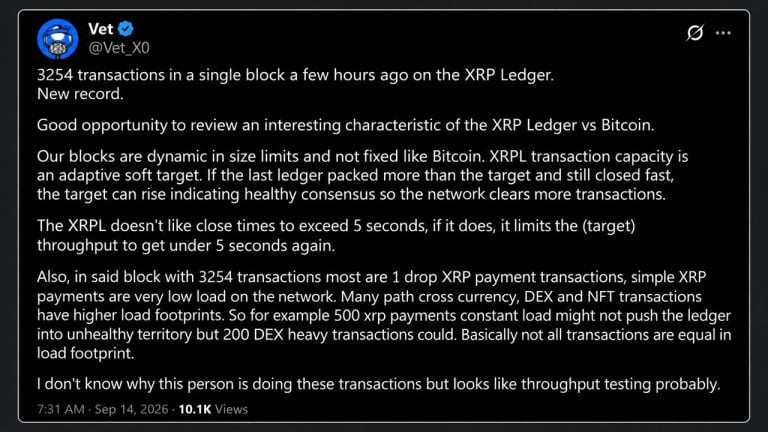
XRP Ledger Broke Its Transaction Record, and 20 Wallets Did Most of It
The XRP Ledger crammed a record 3,254 transactions into one ledger on Sept. 13, yet 2,000 of them were identical 1-drop payments f...

MEXC’s September 2026 Proof of Reserves Reaffirms Full Backing of User Assets, BTC Reserve Ratio Increases to 297%
Mutsamudu, Comoros, September 15, 2026 – MEXC, a pioneer in 0-fee digital asset trading, has released its September 2026 Proof of...