Why crypto traders are ranking prop firms alongside exchanges in 2026 — and how to find the best ones
In 2026 a third category has quietly entered that consideration set — proprietary trading firms. Increasingly, sophisticated traders are evaluating prop firms with the same framework they apply to an exchange or a lendin...
Archive context
Older archive item. Useful for background and entity history, but not a fresh market-moving signal.

In 2026 a third category has quietly entered that consideration set — proprietary trading firms. Increasingly, sophisticated traders are evaluating prop firms with the same framework they apply to an exchange or a lending protocol: what are the mechanics, what is the risk model, and what is the capital efficiency? This piece looks at why that convergence is happening and how to assess it analytically.
The convergence trendThe logic is straightforward once framed in market-structure terms. A crypto trader with a proven edge but limited capital faces the same constraint whether they trade on-chain or on a CEX: returns scale with deployed capital, and deploying more capital means risking more of their own balance sheet. A prop firm inverts that. In exchange for an evaluation fee and adherence to a rule set, the trader operates the firm’s capital and keeps a majority share of the profits. For a strategy that is capital-constrained rather than edge-constrained, that is a materially different risk-return profile — and it is why the category has moved from the retail-forex fringe into the toolkit of traders who also run perp books.
What makes a prop firm worth evaluatingThe same analytical rigor a data-oriented trader applies to an exchange transfers cleanly. Four variables carry most of the signal:
- Payout track record. The single most important variable, and the hardest to fake. A firm’s credibility rests on documented, recurring withdrawals — the equivalent of an exchange’s proof-of-reserves or a protocol’s TVL persistence through a drawdown.
- Rule stability. Written, unambiguous, and not subject to retroactive change. Vague or mutable rules are the mechanism by which weak firms deny payouts, the structural analogue of an exchange changing withdrawal terms under stress.
- Instrument depth. Which markets are tradable, and under what conditions — particularly relevant for crypto traders who need meaningful digital-asset exposure rather than a token gesture.
- Capital scaling. Whether account size and profit split grow with demonstrated performance, which determines the ceiling on the arrangement’s usefulness over time.
Instrument coverage is where a crypto trader’s evaluation gets specific. Most prop firms now list the major digital assets — typically BTC and ETH, sometimes a broader basket — usually as CFDs or synthetic instruments rather than natively settled perpetuals. The practical differences matter. Prop-firm crypto instruments generally lack the funding-rate mechanism that defines CEX perpetuals, which removes both a cost and a signal from the trader’s model. Weekend availability, spread behavior, and maximum position sizing also tend to differ from a deep CEX order book. The takeaway is not that one is superior, but that a trader porting a perp strategy to a funded account cannot assume identical microstructure — funding-basis strategies in particular often do not translate.
Risk model analysis: drawdown versus liquidationThe most instructive comparison is structural, between two different ways of bounding downside.
On a CEX, risk is governed by liquidation. A leveraged position deploys the trader’s own margin, and an adverse move past the maintenance threshold liquidates that margin. The downside is the trader’s deployed capital, and the mechanism is automatic and market-driven.
At a prop firm, risk is governed by a drawdown rule. A typical structure imposes a maximum daily loss (often around 5%) and a maximum overall loss (often around 10%) on the firm’s capital. Breaching either ends the arrangement. Crucially, the trader’s own downside is capped at the evaluation fee plus opportunity cost — not at the notional traded. The firm, not the trader, absorbs losses on its capital up to the breach point.
These are genuinely different risk objects. Liquidation is a capital-loss event on the trader’s balance sheet; a drawdown breach is an access-loss event. For a trader whose primary constraint is protecting personal capital, that distinction is the core of the appeal — but it comes bundled with rule risk and a profit split that a CEX does not impose.
Capital efficiency: funded ROI versus personal deploymentFramed as capital efficiency, the two models measure return against different denominators. On a CEX, ROI is profit over the trader’s own deployed capital, with leverage amplifying both sides. On a funded account, the relevant denominator from the trader’s perspective is the evaluation fee, not the account size: a few hundred dollars of fee unlocks tens of thousands in trading capital, and the return on that fee — net of the profit split — is the efficiency metric that matters.
The honest counterweight is that the fee is a near-certain cost against an uncertain outcome. Most participants do not pass evaluation, so the expected value calculation has to weight the fee against a realistic pass probability, not a best case. A trader who treats the fee as the cost of optionality on scaled capital is reasoning correctly; one who treats it as a guaranteed gateway to a funded account is not.
How to rank prop firmsA data-oriented crypto trader should rank prop firms the way they would rank exchanges — on verifiable, weighted criteria rather than marketing. In rough order of weight: documented payout history first, because nothing else matters if the firm does not pay; then rule stability and transparency; then instrument depth and the specific crypto conditions above; then challenge structure and cost relative to account size; and finally the scaling plan. Regulatory status is deliberately absent from that list — not as an oversight, but because prop firms structurally operate outside securities supervision (they take no client deposits and provide no investment service on client capital), so the diligence burden shifts entirely onto the contract and the payout record.
A current ranking resourceFor traders who want to apply that framework without assembling the underlying data themselves, a current ranking of the best prop firms — scored by instrument coverage, payout track record, and challenge structure — is maintained as a standing resource. It functions the way a market-cap index or exchange comparison does: a starting point for screening, to be validated against a trader’s own criteria rather than taken as a final answer.
Market outlook: where the infrastructure converges nextThe interesting question is not whether prop firms belong in the crypto trader’s consideration set — that convergence has already happened — but where the two infrastructures meet next. Three vectors are worth watching. First, settlement: pressure toward natively crypto-settled funded accounts and crypto-denominated payouts, narrowing the gap with CEX mechanics. Second, instrument parity: firms adding funding-rate-bearing perpetual-style products to attract traders who currently see prop crypto instruments as a downgrade. Third, transparency tooling: on-chain or cryptographically verifiable payout attestation, which would do for prop-firm credibility what proof-of-reserves did for exchanges.
None of this makes prop firms a substitute for an exchange; they solve a different problem — capital access, not custody or execution venue. But the direction of travel is clear. For a sophisticated crypto trader in 2026, the prop firm has earned a place in the same analytical spreadsheet as the exchanges and protocols it sits beside — evaluated on the same evidence, and held to the same standard.
This article is analytical and informational, not investment advice. Leveraged trading — on exchanges or through funded accounts — carries substantial risk of loss.
This is a sponsored article. Opinions expressed are solely those of the sponsor, and readers should conduct their own due diligence before taking any action based on information presented in this article.
Why this matters
Bitcoin is showing up inside the Security Incidents theme, so this story is worth tracking for follow-through rather than treating it as a one-off headline.
Original source
Read on Brave New CoinRelated market context

AI Could Weaken Ethereum Security as Cryptographic Risks Grow, Vitalik Buterin Warns
Buterin urged developers to prepare for potential AI vulnerabilities in both conventional and quantum-resistant cryptography, whil...
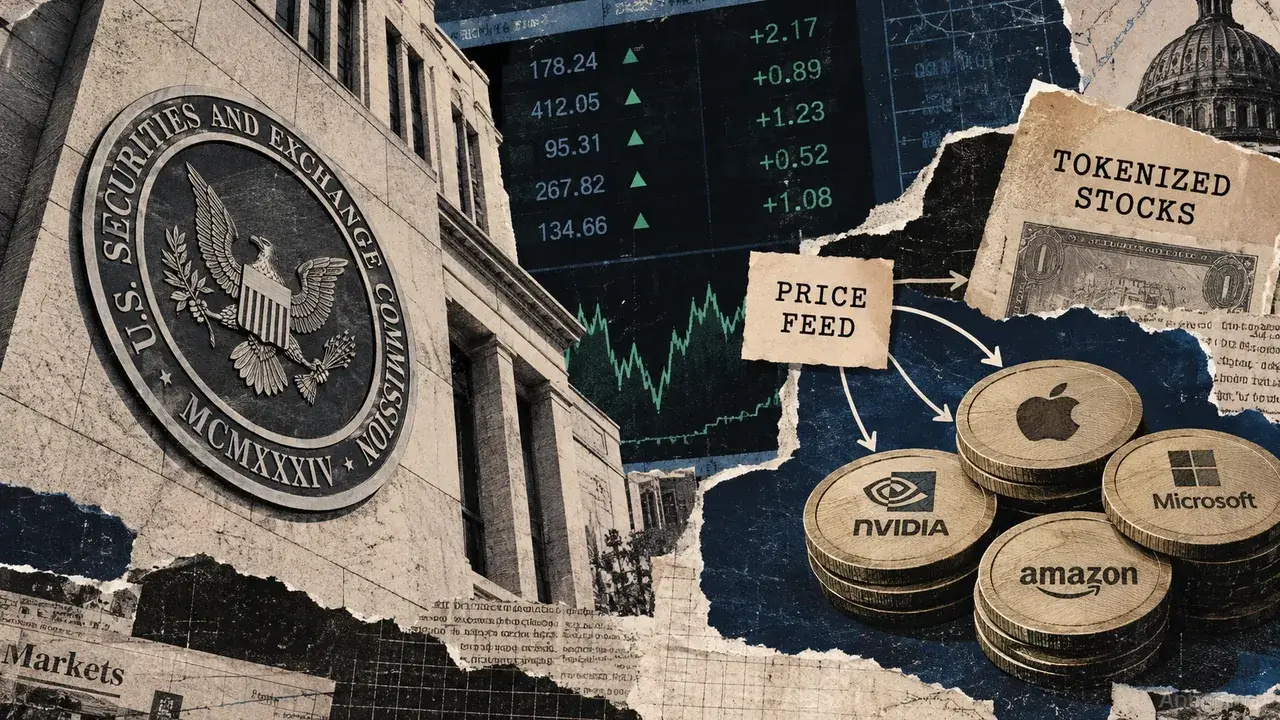
Tokenized stocks can carry the same rights without the same trading protections
Tokenized stocks eligible for the SEC’s September exemption must carry equivalent shareholder rights, yet their trading venues can...

What Is Crypto Spot Trading?
For example, a token can be up 70% and still be a terrible trade if you have no idea when to take profits. Likewise, a 30% dip can...

Bitcoin hedge funds face a liquidation trap when their collateral is split across markets
Here's a hypothetical situation: a hedge fund is making money, but one of its exchanges is about to liquidate its position anyway....
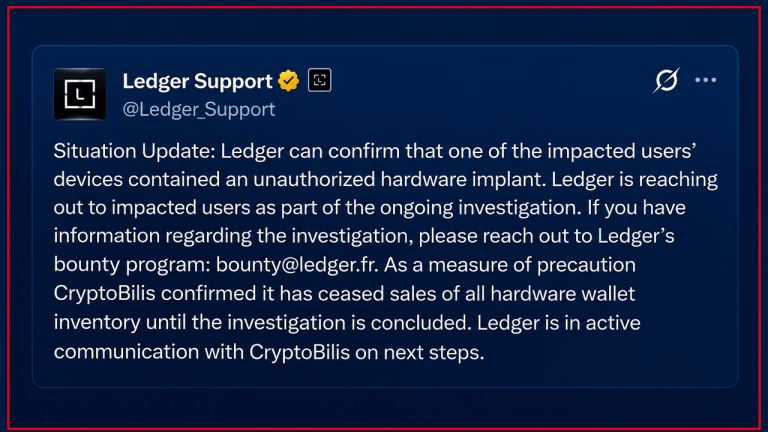
Ledger Confirms Hidden Hardware Implant in Affected User’s Wallet
Ledger confirmed Saturday, Oct. 10, 2026, that a hardware wallet belonging to one affected customer contained an unauthorized impl...

CFTC proposes a divide between prediction contracts and sportsbook wagers
The Commodity Futures Trading Commission announced two actions on Oct. 9 seeking to clarify the federal regulatory boundary betwee...