Why truly decentralized DeFi needs no legal exemption according to SEC Commissioner Hester Peirce
SEC Commissioner Hester Peirce drew a sharp line around decentralized finance on Sept. 17. She said investors need no exemption to use permissionless smart contracts for peer-to-peer trading. The SEC and CFTC actions exa...
Archive context
Older archive item. Useful for background and entity history, but not a fresh market-moving signal.
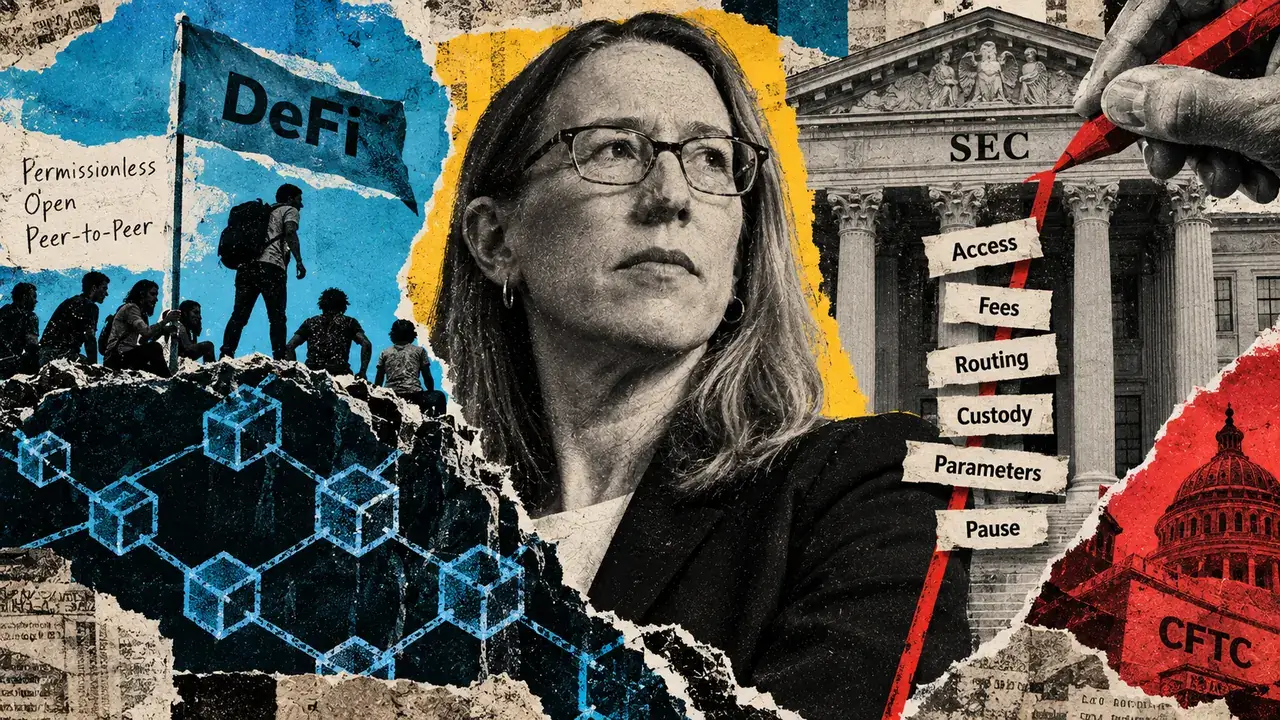
SEC Commissioner Hester Peirce drew a sharp line around decentralized finance on Sept. 17. She said investors need no exemption to use permissionless smart contracts for peer-to-peer trading. The SEC and CFTC actions examined here set separate limits on intermediary control.
The unresolved question is how much control a software provider can retain before it begins to resemble a regulated intermediary.
Peirce’s statement expressed her own position. A binding definition from the US Securities and Exchange Commission would require Commission action. The SEC’s tokenized-securities order and a separate staff statement leave her phrase “truly decentralized” undefined. Their specific provisions focus on custody, access, software parameters, fees, recommendations, routing and execution.
Each action operates under a different statute and carries a different legal effect. Together, they show how federal regulators are examining the authority that identifiable providers retain. A unified federal decentralization test remains absent.
Related Reading SEC and CFTC bypass Congress to open crypto access after CLARITY fails – with a catch The SEC traces control from the market to the frontendThe SEC’s Sept. 17 tokenized-securities order is an order of the Commission. It creates temporary, conditional relief for a defined Tokenized Securities Venue, or TSV, using automated market maker pools for permissioned trading in Tokenized NMS Stocks.
A TSV under the order performs two functions: It provides one or more AMM pools for permissioned participants, and it sets standards governing who may access those pools.
The order gives “provides” a functional meaning for that exemption. Selecting and designating a pool can count. Deploying its trading contract, changing its rules or parameters, setting its fees, or retaining authority to pause trading can also establish provision or control. Solely performing the administrative task of encoding a whitelist falls outside that definition.
Automation leaves several consequential choices in human hands. People may still choose the venue, set fees, pause activity or decide who gets in. Peirce placed the order outside decentralized finance and described genuinely permissionless software as a different model. The permissioned venue illustrates why operational powers matter even when smart contracts execute trades.
The interface creates another layer of control.
An April statement from the SEC’s Division of Trading and Markets describes when staff would refrain from objecting to certain crypto asset securities interface providers operating without broker-dealer registration under Section 15. Its legal effect is limited: The statement represents staff, has no legal force, creates no new obligations and will be considered withdrawn five years after April 13, 2026 absent intervening Commission action.
The covered interfaces help users prepare transactions through self-custodial wallets. The user holds the keys, chooses or customizes transaction parameters, signs the transaction and transmits the instructions. Multiple displayed execution routes must be filterable or sortable using objective factors. When an interface displays one route, users must be able to view alternatives when they exist. Software used to prepare instructions or display route information must operate on pre-disclosed, objective and independently verifiable parameters.
The staff position excludes functions that more closely resemble brokerage. It excludes a provider that solicits a specific crypto asset securities transaction, recommends an investment, holds or accesses user assets, executes or settles a transaction, or takes or routes an order.
How the provider is paid also matters. Staff says it would refrain from objecting when a user pays a flat fee or percentage transaction charge that is objectively determined, consistently applied and neutral among products, routes, venues and counterparties. Payments from another party based on the size, value or occurrence of a transaction fall outside the position.
These conditions make the frontend part of the regulatory analysis. Default settings, route rankings, preferred venues and fee incentives can steer users even when the user signs the final transaction from a self-custodial wallet.
Related Reading Why the SEC just gave self custody crypto apps 5 years to get traditional broker licenses The CFTC permits more promotion under a narrower registration positionThe CFTC’s Sept. 17 announcement and Staff Letter 26-25 state a staff no-action position. The Market Participants Division said it would refrain from recommending enforcement against qualifying passive-software providers for failing to register as introducing brokers, or against relevant personnel for failing to register as associated persons.
The position applies when users transact on a designated contract market directly as members or indirectly through a futures commission merchant or introducing broker that is a DCM member. It is based on the presented facts, leaves Commission authority intact and may be changed, suspended or terminated by the Division.
Its covered activities allow more promotion and compensation than the SEC interface position. A provider may promote particular derivatives, direct users toward specific registered firms, charge users transaction-based fees and receive a share of a registrant’s revenue.
The provider must remain hands-off in several important respects. Users must be able to reach the registrant directly. The provider is barred from custody or control of customer property, explicit buy or sell signals, affirmative involvement in a particular order, and discretion over routing or execution.
The relief also depends on disclosures, marketing controls, written undertakings with registrants, recordkeeping and notices to the Division. These requirements preserve accountability while the software provider remains outside introducing-broker registration.
Related Reading Phantom pulls on-chain perps into the US wallet war ahead of July 9 deadlineThe main differences concern six forms of control.
Area of control SEC order or staff position CFTC staff position Scope of the condition Custody The interface provider is barred from holding or accessing user assets The provider is barred from custody or control of customer property Each staff position requires separation from customer property Access A TSV sets participant standards; an interface discloses venue limits Users trade on a DCM directly or through a member FCM or IB and retain direct access to the registrant Each document specifies its own access structure Recommendations The interface position excludes specific-transaction solicitation and investment recommendations Promotion may be allowed; explicit buy or sell signals are excluded The staff positions draw different lines around steering Routing The interface provider is barred from taking or routing orders; displayed alternatives use objective parameters User-directed transmission may occur; provider discretion over routing or execution is barred The SEC position excludes order routing, while the CFTC position centers on discretion Fees User-paid charges must be objectively determined and neutral Transaction fees and registrant revenue sharing may be allowed Compensation is treated within each statutory setting Parameters and pauses Changing pool rules, parameters or fees, or pausing trading can mean a person provides the pool The letter gives these powers no central role The SEC factor belongs to the order’s specific venue exemptionEvery factor operates inside its source document’s narrow scope. The Commission order governs one securities-venue model. SEC staff states its Section 15 position for covered interfaces. CFTC staff offers conditional enforcement forbearance within the registered derivatives market.
Technical design matters alongside disclosures, access arrangements, marketing limits, recordkeeping and retained authority. The relevant mix changes across securities venues, crypto interfaces and derivatives software.
Who decides what counts as “truly decentralized”Peirce supplies a principle: Removing the trusted intermediary weakens the regulatory rationale built around that intermediary. Her individual statement carries no power to establish a Commission category.
Authority is divided across the actions described here. The Commission defines the scope of its TSV order. The SEC’s Division of Trading and Markets applies its own nonbinding Section 15 position. The CFTC’s Market Participants Division decides whether presented facts fit its conditional enforcement posture. Each judgment answers a question arising under a particular statute and form of relief.
A protocol, its governance process and its frontend may occupy different points on the control spectrum. The core protocol may be difficult to alter while an interface remains curated, fee-taking and capable of steering users. Software may also connect users to regulated firms while leaving orders, assets and execution outside the provider’s discretion.
For builders and users, the practical inquiry begins with specific powers: Who controls access and assets? Who can recommend, route or execute a transaction? Who sets fees or changes software parameters? Who can pause the system? The governing statute and the actor exercising those powers then determine which regulator and legal standard apply.
“Truly decentralized” remains Peirce’s description. Federal law provides no matching legal category. These SEC and CFTC actions produce a fact-specific map of retained authority, with separate boundaries for the Commission order and each staff position.
The post Why truly decentralized DeFi needs no legal exemption according to SEC Commissioner Hester Peirce appeared first on CryptoSlate.
Why this matters
SEC is showing up inside the Regulation theme, so this story is worth tracking for follow-through rather than treating it as a one-off headline.
Original source
Read on CryptoSlateRelated market context
As traditional giants rush into digital dollars, USDD’s Yvonne Chia explains why 24/7 access, self-custody, and transparent yield give decentralized stablecoins an edge banks can’t replicate. 20 November – Road Town, Totorla, British Virgin Islands – Decentralized stablecoin protocol USDD is accelerating its multichain utility across TRON, Ethereum, and BNB Chain—combining automated sUSDD yield via its Smart Allocator with GasFree zero-TRX transfers—as traditional financial giants race to build competing stablecoin rails. In a recent industry interview with instant exchange partner ChangeNOW, USDD Head of Communications Yvonne Chia outlined why self-custody, 24/7 settlement, and transparent onchain reserves give decentralized digital dollars a structural advantage over bank-issued alternatives. 1. Permissionless Access vs. Gatekept Accounts For billions of people globally, opening and maintaining a traditional bank account still involves paperwork, minimum balance requirements, geographic restrictions, and approval delays. Even when banks integrate stablecoin rails behind the scenes, those services remain gated behind legacy compliance walls and intermediary control. Crypto-native stablecoins flip that model on its head. As Yvonne Chia highlighted during the interview: “Compare this to a stablecoin like USDD, where all you need is a phone, a working internet connection, you can immediately start a wallet and you have access to your funds right away.” With USDD, users can access and manage their digital dollars directly through their own wallets, without depending on traditional financial intermediaries. This represents a fundamental shift in financial access: users are no longer limited to the services, operating hours, or account structures of a single institution. Instead, they have the freedom to hold, manage, and transfer their assets on their own terms. Self-custody also gives users greater autonomy over their financial decisions. They can choose which wallets to use, where to transfer their assets, and which supported decentralized applications to interact with, without needing to route every transaction through a centralized financial institution. With USDD, users’ digital dollars can move with them across an open blockchain ecosystem, rather than remaining tied to a particular bank or service provider. 2. 24/7 Global Settlement vs. “Banking Hours” Legacy payment networks still operate on decades-old schedules: weekend cutoffs, bank holidays, and multi-day cross-border settlement delays accompanied by hefty wire fees. Blockchain networks never close. Whether it is a Sunday night or a public holiday, USDD moves globally without depending on traditional banking operating hours or settlement windows. “We are able to have transfers 24/7 and we’re not limited to any traditional banking hours. So I think that in some ways, stablecoins are not just becoming banks, but exceeding what traditional banks can offer to users.” To make everyday transfers even smoother than fintech apps, USDD introduced GasFree integration on TRON, allowing users on supported wallets to pay network fees directly in USDD without needing to hold TRX. This removes another practical barrier to stablecoin adoption: having to acquire and maintain a separate gas token just to transfer digital dollars. With GasFree, eligible users can pay approximately 0.5 USDD per transaction, compared with around 1.5 USDT for a standard USDT transfer under the referenced fee conditions. These improvements matter because the usefulness of a stablecoin is not determined by its peg alone. Low-cost transfers, straightforward wallet experiences, and around-the-clock availability are what make digital dollars practical for everyday payments and global value transfers. 3. Passing Yield Back to Users vs. Bank Spreads Perhaps the sharpest contrast between banks and decentralized stablecoins lies in how yield is distributed. In traditional banking, institutions take customer deposits, deploy them into yield-generating markets, and retain a significant portion of the returns. Everyday depositors may receive relatively low interest rates, while higher-yielding products often come with eligibility requirements, minimum deposits, or fixed maturity periods. Stablecoins introduce another way to participate in digital-dollar opportunities. Rather than keeping capital entirely within a traditional deposit account, users can access onchain yield opportunities through decentralized protocols and transparent investment mechanisms. USDD was built to return that value directly to holders. Through USDD Earn, users can deposit USDD to receive sUSDD, earning automated, competitive yield powered by our Smart Allocator system, with no fixed lock-up periods restricting access to their capital. For users, the distinction is important: USDD Earn provides access to a productive stablecoin while maintaining flexibility, rather than requiring users to commit their capital to a conventional fixed-term product. 4. Onchain Verification vs. Institutional Trust Traditional banks ask customers to trust closed-door balance sheets and periodic regulatory filings—until a crisis proves otherwise. USDD takes a different approach through its “Don’t trust, verify” ethos, emphasizing publicly accessible onchain information and independent verification. Onchain Transparency: Smart contract addresses, collateral reserves, and Smart Allocator deployments are publicly viewable, allowing users to examine relevant information directly on the blockchain. Structured Disclosures: Quarterly Treasury Reports provide additional information about reserve positions, financial performance, and operational developments. Independent Security Reviews: USDD undergoes third-party security audits to assess its smart contracts and identify potential vulnerabilities. Transparency does not eliminate financial or technical risks, but it changes how users can evaluate them. Instead of relying exclusively on an institution’s assurances, users have access to information that can be independently examined and verified. 5. Beyond a Single Network: An Open, Multichain Financial Ecosystem Financial freedom is not just about holding digital dollars. It is also about being able to use them wherever opportunities and applications exist. A stablecoin confined to a single network or limited use case cannot fully realize the potential of open blockchain finance. Following its January 2025 protocol upgrade, USDD expanded natively from TRON onto Ethereum and BNB Chain, extending its reach across multiple blockchain ecosystems. This multichain presence allows USDD to connect with different communities, liquidity environments, and decentralized applications. Its sUSDD product has also expanded into DeFi integrations, including Pendle and Morpho, giving users additional ways to access yield strategies across supported ecosystems. The bigger picture is an interconnected financial ecosystem in which users can move between holding, transferring, exchanging, and deploying their stablecoins according to their own needs. These are not isolated functions. Together, they make stablecoins more useful as everyday financial infrastructure. The Future: Interconnected, Open, and Multichain Banks will undoubtedly continue using stablecoin rails to modernize their back-end settlement. However, true financial freedom comes from open networks where assets flow freely across protocols without intermediaries. For USDD, the opportunity goes beyond offering a dollar-pegged asset. It is about making digital dollars accessible, transferable, and productive across an interconnected financial ecosystem. From self-custody and 24/7 transfers to flexible yield opportunities and multichain DeFi access, these capabilities give users more ways to put their money to work. Banks may be bringing stablecoins into traditional finance. Crypto-native protocols are showing what stablecoins can make possible beyond it.
As traditional giants rush into digital dollars, USDD’s Yvonne Chia explains why 24/7 access, self-custody, and transparent yield...

Mark Zuckerberg’s Meta AI Predicts the Flippening: How Does ADA Flip XRP?
Could 2027 finally be the year Cardano (ADA) overtakes Ripple (XRP) in the cryptocurrency rankings? Mark Zuckerberg’s Meta AI pred...

Visa launches upgraded CLI agent wallet for US users to verify AI agents
Visa's upgraded CLI agent wallet could redefine AI-driven commerce by enhancing trust and creating new earning opportunities throu...
Securitize is down 47% since listing, but its tokenization bet keeps expanding
Despite initial stock decline, Securitize's strategic positioning in the burgeoning tokenization market could yield significant lo...

Kalshi faces New York court hearing on order that could shut down its exchange
Kalshi's legal battle highlights the precarious balance between state regulations and federal oversight, potentially reshaping pre...
Coinbase Backs CFTC Prediction Market Push Amid Senate Backlash
Coinbase is urging the Commodity Futures Trading Commission to classify prediction market event contracts as swaps under federal l...